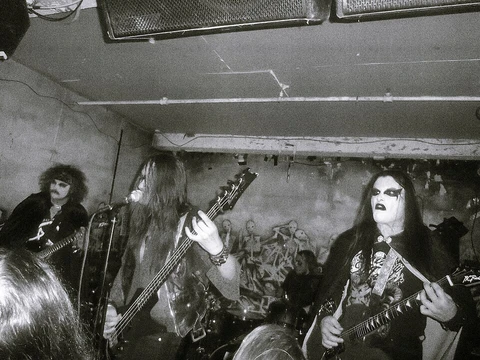
Bahimiron
American black metal band active 2001–2014.

Bahimiron was an American black metal band with roots in Houston, Texas, and Phoenix, Arizona. Vocalist and guitarist David "Grimlord" Herrera founded the group in 2001. The core lineup—bassist Jenoside and an unnamed drummer—remained with the band from its start until its end, while guitarist Luna joined in 2013. The band is most recognized for its 2008 album *Southern Nihilizm*. After thirteen years, Bahimiron disbanded in 2014. Their music has been described as black metal and war metal. Pitchfork’s Brandon Stosuy likened their sound to “Beherit, Absu, and Gorgoroth in a dusty southern bar brawl,” while Blabbermouth.net’s Scott Alisoglu characterized it as a “Texas style of dangerously hot black metal” evoking images of ritual sacrifice victims in extreme heat.
- Formed
- 2001
- Disbanded
- 2014
- Origin
- Houston, Texas, and Phoenix, Arizona, United States
- Genre
- Black metal, war metal
- Known for
- Second album Southern Nihilizm (2008)
Lore & Background
Bahimiron was formed in 2001 by vocalist and guitarist David 'Grimlord' Herrera. The band's core lineup included bassist Jenoside and an unnamed drummer, both of whom played from the band's formation until its dissolution. Second guitarist Krag was a member from 2001 until 2013, when he was replaced by Luna (Milton Luna), who remained with the band until the split in 2014.
Reader's Guide
Bahimiron's significance lies in its contribution to the American black metal and war metal scenes, particularly through its second album Southern Nihilizm (2008), which became the band's most recognized release. The band's sound was described by Pitchfork's Brandon Stosuy as 'Beherit, Absu, and Gorgoroth in a dusty southern bar brawl,' and by Blabbermouth.net's Scott Alisoglu as 'Texas style of dangerously hot black metal that offer one images of decomposing bodies baking in 105-degree temperatures, no doubt the victims of ritual sacrifice.' These descriptions highlight the band's fusion of raw black metal with a distinctly Southern, oppressive atmosphere. Despite a relatively short active period of thirteen years, Bahimiron released three studio albums, several EPs and splits, and three demos, establishing a consistent presence in the underground metal scene. The band's dissolution in 2014 ended its run, but its recorded output, especially Southern Nihilizm, continues to be referenced in discussions of regional black metal styles.
Did You Know?
- Bahimiron was based in both Houston, Texas, and Phoenix, Arizona.
- Founder David 'Grimlord' Herrera had previously been in the death metal band Imprecation.
- The band's second album, Southern Nihilizm, was released in 2008.
Origins & Lineup
David Herrera, known by the stage name Grimlord, had been a member of the death metal band Imprecation until 1993, but it was not until 2001 that he launched Bahimiron as a black metal project. The group operated out of Houston, Texas, and Phoenix, Arizona, giving it a distinctly regional identity within the broader extreme metal landscape. From the very beginning, the rhythm section was fixed: Jenoside on bass and Blaash on drums and percussion, both of whom stayed with the band from its formation all the way through its dissolution. Herrera handled vocals and guitar throughout the entire thirteen-year run. On the second guitar chair, Krag served from 2001 until 2013, when Milton Luna, credited as Luna, stepped in to fill that role for the band's final year. For most of its existence, then, Bahimiron functioned as a tight three-piece with Herrera at the helm, Jenoside anchoring the low end, and Blaash driving the rhythmic engine behind everything else.
Sound & Style
Bahimiron occupied a specific niche at the intersection of black metal and what is often termed war metal, and critics quickly found vivid language to capture what made the sound feel so geographically rooted. Brandon Stosuy of Pitchfork likened the band's output to "Beherit, Absu, and Gorgoroth in a dusty southern bar brawl," a comparison that immediately evokes the raw, aggressive textures of those European acts filtered through a distinctly American, sun-scorched sensibility. Scott Alisoglu of Blabbermouth.net went even further into imagery, describing the music as a "Texas style of dangerously hot black metal" that conjured "images of decomposing bodies baking in 105-degree temperatures, no doubt the victims of ritual sacrifice." These descriptions point to a band that leaned heavily into atmosphere and thematic weight, blending the foundational aggression of traditional black metal with a sense of regional identity and visceral, almost cinematic storytelling. The result was a sound that felt simultaneously familiar to European black metal devotees and unmistakably planted in the American South.
Discography & Career Arc
Bahimiron built its catalog gradually over thirteen years, moving from raw demo recordings to fully realized studio albums. The early period, spanning 2002 to 2004, saw three demos—Funeral Black, Terror Division Bloodstrike, and Xrist Gutzlice—alongside two EPs, Hunting Down the Weak and As the Sun Burns, both issued in 2004. By 2006 the band had matured enough to drop its first full-length, Pure Negativism: In Allegiance with Self Wreckage, the same year it also put out the split EP Pact in Dizease & Profanation and a collaborative release with Sargeist. The 2008 album Southern Nihilizm became the project's most recognized work and the record most tightly associated with the band's name. A 2009 EP titled Last of the Confederates kept the output moving before the final studio album, Rebel Hymns of Left Handed Terror, arrived in 2011. The titles across the discography, ranging from "Funeral Black" to "Xrist Gutzlice" to "Rebel Hymns of Left Handed Terror," paint a picture of a band unafraid of provocative, thematically dense naming conventions that matched the intensity of the music itself.
Dissolution & Aftermath
The final chapter of Bahimiron arrived in 2014, after thirteen years of continuous activity. The band's last year saw a notable personnel shift: longtime guitarist Krag departed in 2013 and Milton Luna, credited as Luna, came in to replace him on guitar. That brief window of a four-member lineup lasted only a year before the group called it quits. The dissolution marked the end of a project that had been a consistent, if niche, presence in the American extreme metal scene, operating across two cities—Houston and Phoenix—throughout its entire run. The post-split period brought a particularly somber note when drummer Blaash, who had been the band's rhythmic backbone from 2001 to 2014, passed away in 2017. His death three years after the final performance added a layer of finality to a band that had already been gone for a few years. For fans who discovered Bahimiron through Southern Nihilizm or the earlier demos, the 2014 split and Blaash's subsequent passing closed the book on a project that never achieved mainstream visibility but maintained a devoted following within the black and war metal communities.
Frequently Asked Questions
Who is Bahimiron?
Bahimiron was an American black metal band put together in 2001 by vocalist-guitarist David 'Grimlord' Herrera. The group was based between Houston, Texas, and Phoenix, Arizona, and existed until 2014.
What genre does Bahimiron play?
Their output is generally classified as black metal with strong war metal tendencies. Pitchfork's Brandon Stosuy once compared the overall vibe to Beherit, Absu, and Gorgoroth playing in a dusty southern bar.
What is Bahimiron's best-known album?
Their 2008 second record, Southern Nihilizm, is the release most listeners associate with the band. It stands as their defining statement and the title they are most recognized for.
Who were the members of Bahimiron?
The constant core was David 'Grimlord' Herrera on vocals and guitar, bassist Jenoside, and an unnamed drummer, all of whom stayed from the 2001 inception through the 2014 breakup. Guitarist Luna joined the lineup later, in 2013.
When did Bahimiron disband?
The band split up in 2014 after thirteen years of activity. Their final year saw the addition of guitarist Luna before the group ultimately called it quits.
More in American black metal musical groups 1-24
Spotted an error? Know more?
Reader corrections go straight into our review queue. Suggest an edit · How this site is sourced