The Taj Mahal
Ivory-white marble mausoleum on the Yamuna river.

Jakub Hałun · CC BY-SA 4.0
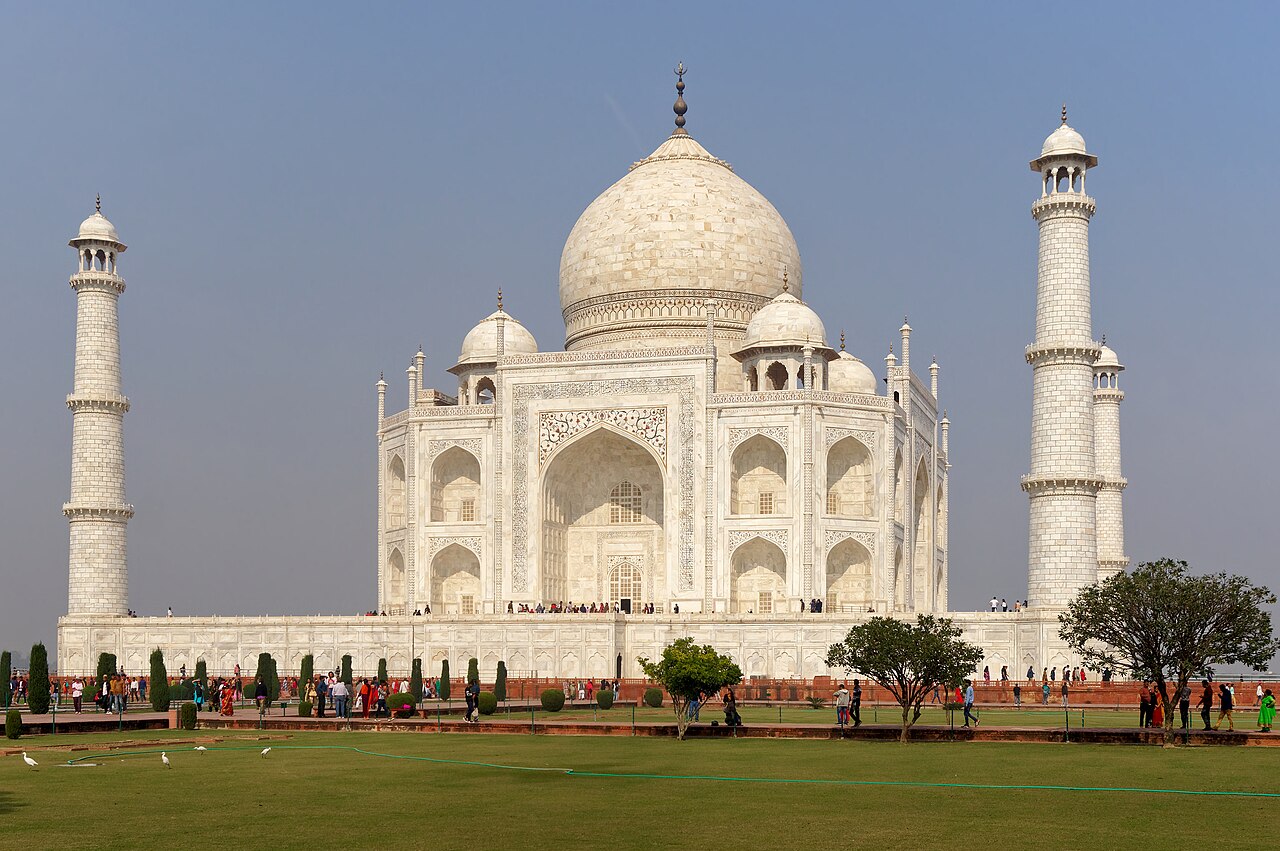
The Taj Mahal, whose name comes from Urdu and means "Crown of the Palace," is a mausoleum built from white marble with a slight ivory tint. It stands on the Yamuna River's right bank in Agra, Uttar Pradesh, India. The fifth Mughal emperor, Shah Jahan, ordered its construction in 1631 to hold the tomb of his wife, Mumtaz Mahal, who died that year. The emperor's own tomb is also housed there. The mausoleum sits at the center of a 17-hectare complex that includes a mosque, a guest house, and formal gardens, all enclosed on three sides by a crenellated wall. The main tomb building was finished in 1648, though work on the rest of the complex continued for five more years. The first ceremony at the site took place on 6 February 1643, when Shah Jahan observed the 12th anniversary of Mumtaz Mahal's death. The entire complex is thought to have been completed by 1653, with a construction cost estimated at the time as roughly ₹32 million—about ₹52.8 billion (US$827 million) in 2015.
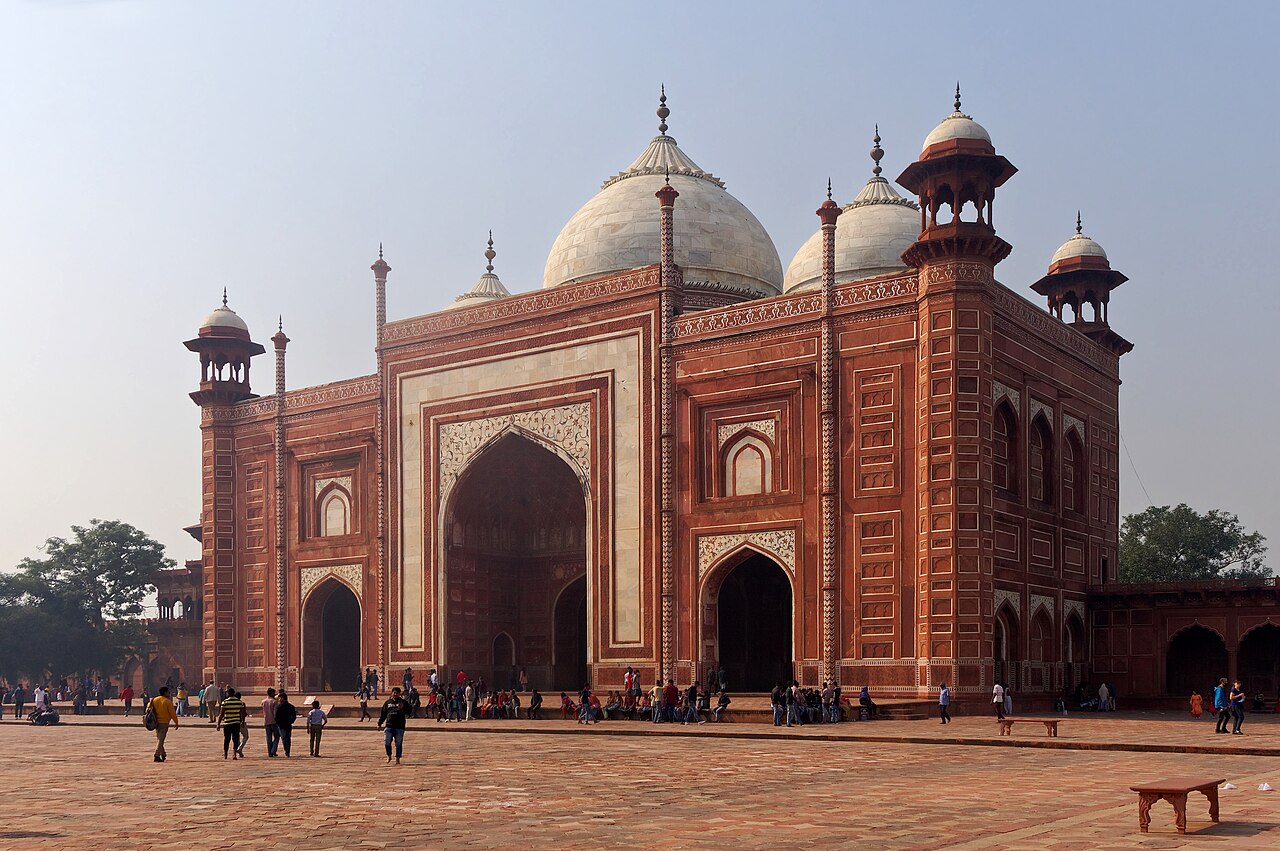
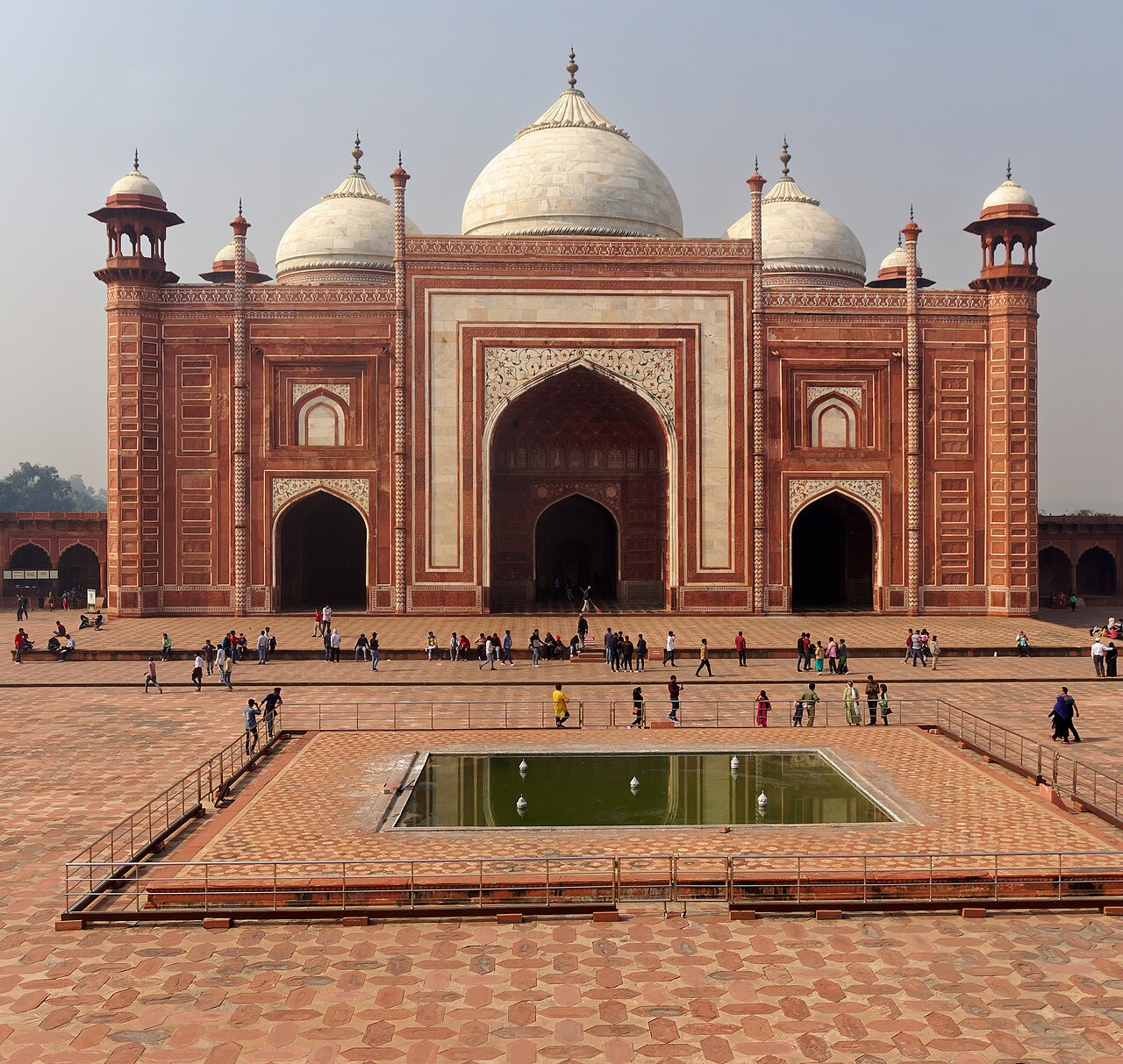
The design blends Indo-Islamic and Mughal architectural traditions, using symmetrical layouts and various shapes and symbols. The mausoleum itself is built of white marble inlaid with semi-precious stones, while red sandstone was used for the other buildings, matching the style of contemporary Mughal structures. Over 20,000 workers and artisans worked on the project, guided by a board of architects led by Ustad Ahmad Lahori, the emperor's court architect. The team included a multinational group of specialists: Ottoman dome designer Ismail Afandi; Persian architects Ustad Isa, Isa Muhammad Effendi, and Puru; chief calligrapher Amanat Khan Shirazi; finial caster Qazim Khan; and masonry supervisors Muhammad Hanif, Mir Abdul Karim, and Mukkarimat.
In 1983, UNESCO designated the Taj Mahal a World Heritage Site, calling it "the jewel of Islamic art in India and one of the universally admired masterpieces of the world's heritage." It is seen as a top example of Mughal architecture and a symbol of Indian history. The site draws more than five million visitors each year. In 2007, it was named a winner of the New 7 Wonders of the World initiative. The Taj Mahal and its grounds, including all surrounding structures, are a Monument of National Importance, managed by the Archaeological Survey of India.
The name "Taj Mahal" comes from Urdu, likely from Arabic and Persian words meaning "crown" (tāj) and "palace" (mahall). Another idea is that "taj" is a corruption of the second syllable of "Mumtaz." In his 1636 book *Padshahnama*, Abdul Hamid Lahori refers to the building as *rauza-i munawwara* (Perso-Arabic for "the illumined or illustrious tomb").
Shah Jahan commissioned the Taj Mahal in 1631 to honor his wife Mumtaz Mahal, who died on 17 June that year while giving birth to their 14th child, Gauhara Begum. Construction began in 1632, the mausoleum was finished in 1648, and the surrounding buildings and garden were completed five years later. Court records describe Shah Jahan's deep grief after her death. Historians Muhammad Amin Qazvini, Abdul Hamid Lahori, and Muhammad Saleh Kamboh note that the emperor showed no other person the same affection he had for Mumtaz. He avoided royal duties for a week, gave up music and fine clothing for two years, and chose the site for her tomb—land south of Agra owned by Raja Jai Singh I—after being captivated by its beauty. Jai Singh gave up the land in exchange for a large palace in central Agra.
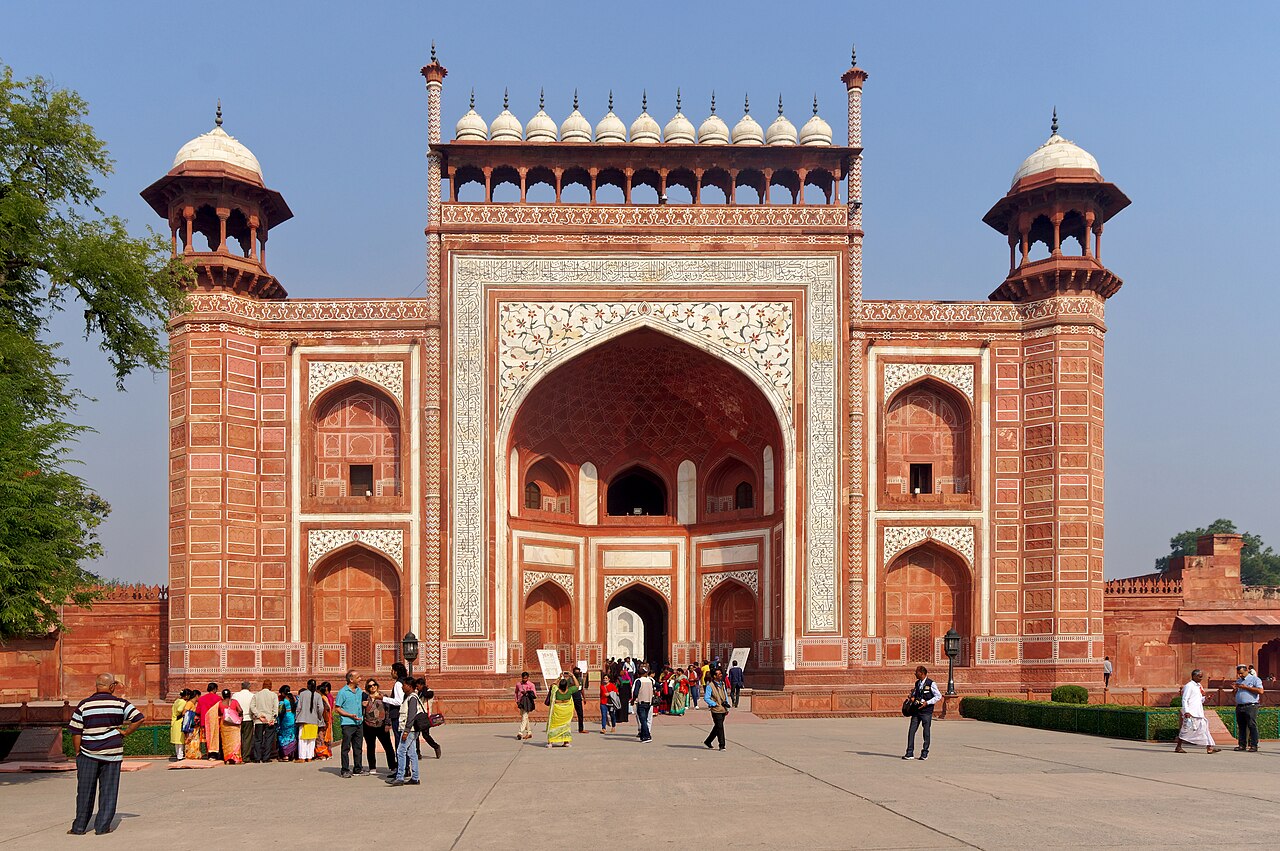
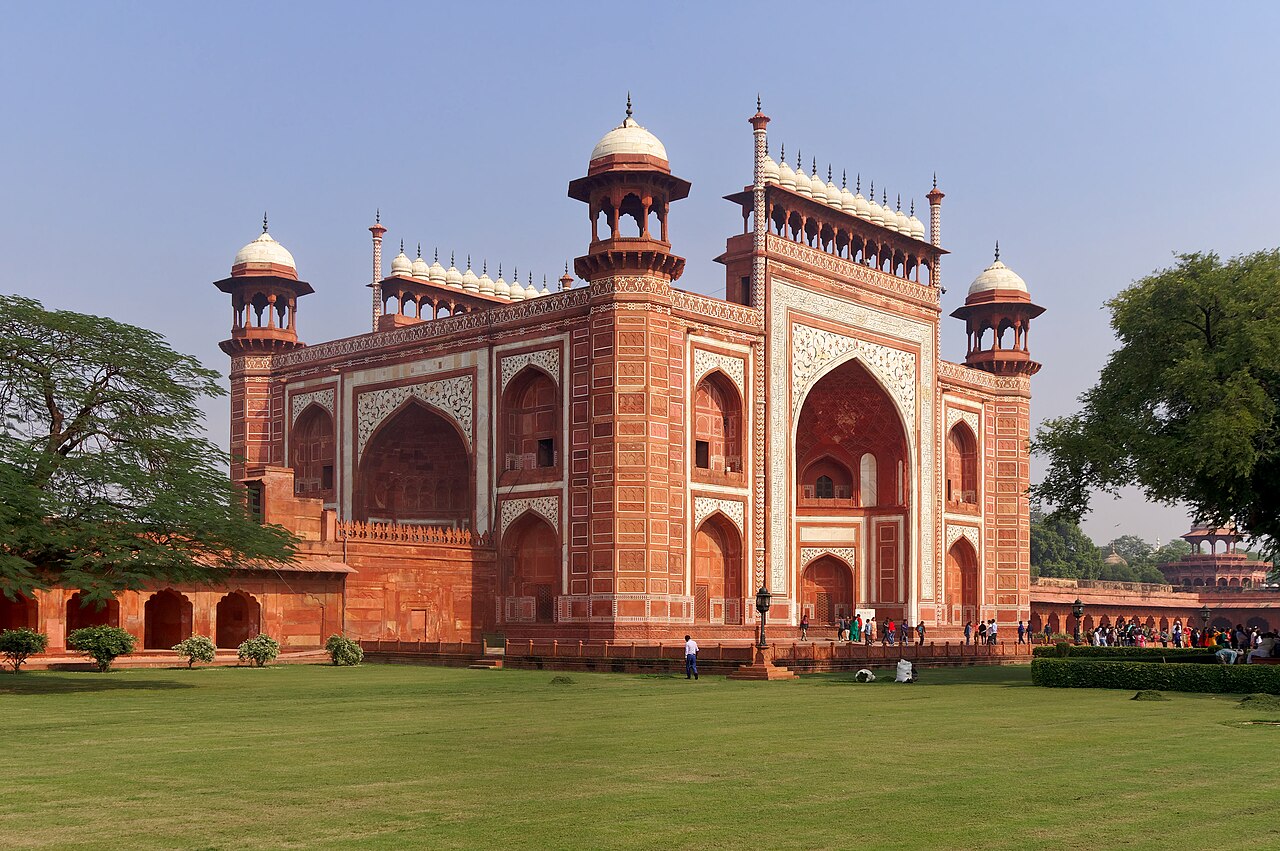
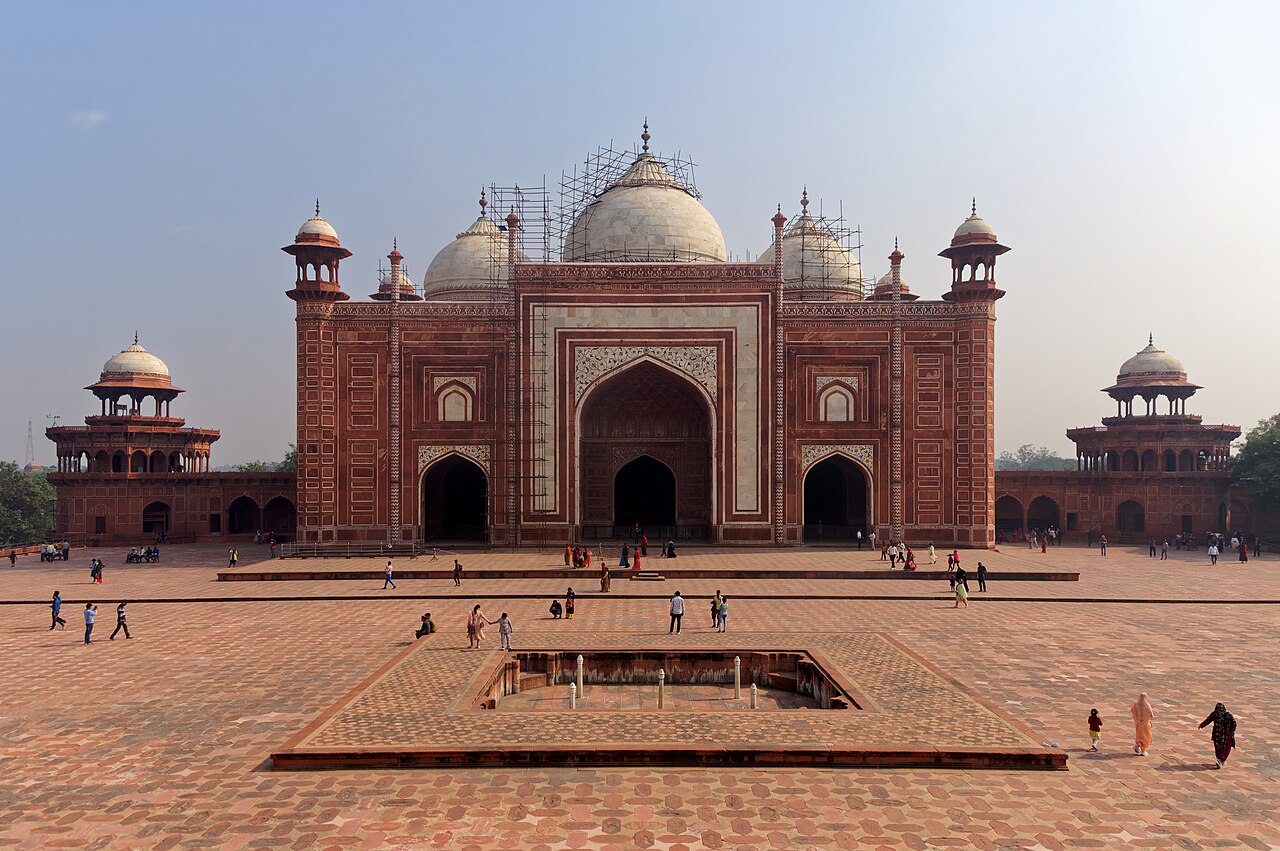
The architecture draws on Timurid and Mughal precedents, such as the Gur-e Amir in Samarkand (tomb of Timur) and Humayun's Tomb in Delhi, which inspired the Charbagh gardens and the hasht-behesht (eight-paradise) layout. The complex uses symmetrical designs with varied shapes and symbols. The mausoleum is white marble with semi-precious stone inlay, while red sandstone appears in other buildings, as was common in Mughal times. The entire complex rests on a platform 300 meters long and 8.7 meters high, built on the Yamuna's banks with dark and light sandstone patterns.
The mausoleum itself is the central structure. It is a white marble building on a 6-meter-high square plinth, each side measuring 95.5 meters. The base is a large, multi-chambered cube with chamfered corners, forming an eight-sided shape roughly 57.3 meters on each of the four long sides. All four sides are identical, each with an iwan (arch-shaped doorway) topped by a large dome and finial. Every iwan is framed by a 33-meter-high pishtaq (vaulted archway) with two similarly shaped arched balconies stacked on either side. This arch motif repeats on a smaller scale at the chamfered corners, making the design fully symmetrical. On the southern side of the platform, facing the garden, two flights of stairs are partly set into the structure.
- Location
- Agra, Uttar Pradesh, India
- Architectural style
- Indo-Islamic and Mughal architecture
- Material
- White marble and red sandstone
- Cost (at time)
- ₹32 million
Lore & Background
The Taj Mahal is an ivory-white marble mausoleum situated on the right bank of the Yamuna River in Agra, India. Its appearance is defined by a central, eight-sided white marble structure standing on a high square plinth. Each of its four identical sides features a large arch-shaped doorway, topped by a massive dome and a finial. The archways are framed by vaulted arches, with stacked arched balconies on either side, a design motif repeated on the chamfered corners to achieve perfect symmetry. The entire complex is set within formal gardens bounded on three sides by a crenellated wall, and includes a mosque and a guest house built from red sandstone, contrasting with the mausoleum’s white marble inlaid with semi-precious stones. The complex sits on a platform built with varying patterns of dark and light sandstone. Its defining characteristics stem from Indo-Islamic and Mughal architectural traditions, employing symmetrical constructions and symbolic shapes. The tomb itself houses the remains of Mumtaz Mahal and Shah Jahan. Construction of the mausoleum was completed in 1648, with the rest of the complex finished by 1653, employing over 20,000 workers and artisans under a board of architects led by Ustad Ahmad Lahori. The site was designated a UNESCO World Heritage Site in 1983 and attracts over five million visitors annually.
Reader's Guide
The Taj Mahal was commissioned in 1631 by the Mughal emperor Shah Jahan to house the tomb of his wife, Mumtaz Mahal, who died that year; it later also became the emperor’s own tomb. The mausoleum was completed in 1648, with the surrounding complex finished by 1653. The first ceremony at the site was held in 1643, marking the twelfth anniversary of Mumtaz Mahal’s death. The building complex draws on Indo-Islamic and Mughal architectural traditions, with symmetrical designs and varied shapes and symbols. The central mausoleum is built of white marble inlaid with semi-precious stones, while other structures in the complex use red sandstone, consistent with contemporary Mughal buildings. The entire complex sits on a platform on the right bank of the Yamuna River in Agra, India. More than 20,000 workers and artisans were employed, overseen by a board of architects led by Ustad Ahmad Lahori. The design and execution involved a multinational team, including an Ottoman dome designer, Persian architects, a chief calligrapher, and several masonry supervisors. The Taj Mahal was designated a UNESCO World Heritage Site in 1983, described as a jewel of Islamic art and a universally admired masterpiece. It is considered a prime example of Mughal architecture and a symbol of Indian history, attracting over five million visitors annually. In 2007, it was named a New 7 Wonder of the World. The site is a Monument of National Importance, administered by the Archaeological Survey of India.
Did You Know?
- The name 'Taj Mahal' is of Urdu origin, believed to be derived from Arabic and Persian, meaning 'crown palace'.
- The main dome is 23 metres high and topped by a 9.6-metre gilded finial, originally made of gold but replaced with gilded bronze in the early 19th century.
- The minarets were constructed slightly oriented outward so that in the event of collapse, material would fall away from the tomb.
The Global Voting Spectacle
The New 7 Wonders of the World initiative launched in 2001 as a worldwide popularity contest, inviting the public to select seven standout monuments from a pool of two hundred existing structures. Canadian-Swiss organizer Bernard Weber spearheaded the effort through the New 7 Wonders Foundation, headquartered in Zurich, Switzerland. Voters could cast their ballots through free online platforms or by telephone, and the final seven were revealed on 7 July 2007 at the Estádio da Luz stadium in Lisbon, Portugal. The selection process began with seventy-seven nominations that a panel narrowed to twenty-one finalists in 2006, from which the ultimate seven emerged. Critics noted the methodology lacked scientific rigor, particularly because individuals were permitted to register multiple votes. Despite this, John Zogby, founder and chief executive of Zogby International, described the exercise as the largest poll ever conducted. The Taj Mahal, India's iconic mausoleum, stood among the monuments vying for a place on this coveted list.
India's Nationwide Mobilization
When the voting window opened, India mounted an energetic push to ensure the Taj Mahal received maximum public support. The campaign to publicize the monument gathered momentum steadily throughout the contest, building toward a dramatic crescendo in July 2007. During that climactic month, television news channels, radio stations, and a wide array of celebrities joined forces to urge citizens to cast their votes for the Taj Mahal. The effort transformed the monument into a rallying point for national pride, with media outlets dedicating airtime to reminders and calls to action. This grassroots-style mobilization mirrored similar campaigns in other nations—Brazil's 'Vote for the Christ' drive, Peru's state-backed push for Machu Picchu, and Jordan's royal endorsement of Petra all followed comparable patterns of mass media engagement. In India's case, the convergence of broadcast media and celebrity advocacy created a sustained wave of public attention that kept the Taj Mahal at the forefront of the global conversation during the final weeks of voting.
Institutional Skepticism and UNESCO's Distance
The campaign attracted a spectrum of official responses from governments and international bodies. While some nations championed their respective finalists and actively lobbied for additional votes, others chose to minimize or openly criticize the contest. UNESCO's relationship with the initiative was particularly fraught. The organization had initially offered guidance on the selection of nominees, but its bylaws required it to treat all World Heritage Sites with equal standing, making a ranked 'top seven' list philosophically incompatible with its mission. UNESCO formally distanced itself in 2001 and reiterated that separation in a June 20, 2007 press release. The statement emphasized that Weber's media-driven campaign bore no resemblance to the scientific and educational work behind UNESCO's heritage inscriptions. The organization further argued that the resulting list would merely reflect the preferences of internet users rather than global consensus, and that the exercise could not meaningfully advance the preservation of the sites it highlighted. Meanwhile, the United Nations itself contracted a separate partnership with the foundation in 2007 to promote its Millennium Development Goals.
The Foundation's Economics and Ongoing Legacy
Behind the spectacle of global voting lay a complex financial structure. The New 7 Wonders Foundation, established in 2001, operated without any public funding, sustaining itself through private donations and the sale of broadcast rights. After the 2007 announcement, the organization disclosed that it had generated no profit from the entire exercise and had barely recouped its initial investment. Although the foundation presents itself as a not-for-profit entity, the commercial company behind it—the New Open World Corporation—collects all licensing and sponsorship revenue. The initiative's influence extended well beyond the original monument vote. The pyramids at Giza in Egypt, home to the Great Pyramid—the sole surviving member of the original Seven Wonders of the Ancient World—were granted honorary recognition, acknowledging their unique historical status outside the competitive framework.
Common Misconceptions (Editorial)
- Some believe the Taj Mahal was built as a palace, but it is a mausoleum, as confirmed in the record. - The name "Taj Mahal" is sometimes thought to be Persian for "crown of palaces," but it is of Urdu origin, derived from Arabic and Persian, meaning "crown palace." - A common misconception is that the minarets are purely decorative, but they were actually constructed slightly oriented outward so that in the event of collapse, material would fall away from the tomb.
Why It Matters (Editorial)
The Taj Mahal endures not only as a masterpiece of Mughal architecture but as a monument to personal grief rendered in marble and sandstone. Shah Jahan’s documented withdrawal from public life after his wife’s death reminds us that even emperors are moved by love and loss, giving the structure a human resonance that transcends its physical grandeur.
Gallery
Frequently Asked Questions
How does The Taj Mahal's story end?
Shah Jahan was ultimately laid to rest alongside Mumtaz Mahal in the very tomb he had raised for her. The complex survives today as a UNESCO World Heritage Site and one of the most visited monuments on the planet.
Why is The Taj Mahal important?
It is widely cited as a peak achievement of Mughal architecture and holds UNESCO World Heritage status. The monument endures as both an imperial landmark and a universal symbol of devotion, attracting millions of visitors each year.
Where exactly is The Taj Mahal located?
It stands on the right bank of the Yamuna River in the city of Agra, in the Indian state of Uttar Pradesh. The site functions as a major tourist hub and a defining landmark of the region.
More in World Wonders 1-22
Spotted an error? Know more?
This is a living reference — every entry is fact-audited, and reader corrections feed straight into our audit queue. Suggest an edit · See this site's audit record