The Alhambra
Palace and fortress complex in Granada, Spain.
The Alhambra is a fortified palace complex in Granada, Spain, renowned as a landmark of Islamic architecture and the sole surviving medieval Islamic palace in good condition. It also features significant Spanish Renaissance architecture. Construction began in 1238 under Muhammad I Ibn al-Ahmar, the first Nasrid emir and founder of the Emirate of Granada, the last Muslim state in al-Andalus. The complex was built on Sabika hill, a spur of the Sierra Nevada that previously held older fortresses and the 11th-century palace of Samuel ibn Naghrillah. Later Nasrid rulers made continuous modifications, with the most defining additions to the royal palaces occurring in the 14th century under Yusuf I and Muhammad V. After the Christian Reconquista ended in 1492, the site became the royal court of Ferdinand and Isabella—where Christopher Columbus received royal backing for his voyage—and the palaces were partly altered. In 1526, Charles V ordered a new Renaissance-style palace built directly next to the Nasrid palaces. Over subsequent centuries, the Alhambra fell into decay, with squatters occupying its buildings. Napoleon’s troops destroyed parts of it in 1812. Afterward, it attracted British, American, and other European Romantic travelers, most influentially Washington Irving, whose *Tales of the Alhambra* (1832) drew global attention. It was among the first Islamic monuments to undergo modern scientific study and has seen numerous restorations since the 19th century. Today, it is a major Spanish tourist attraction and a UNESCO World Heritage Site.
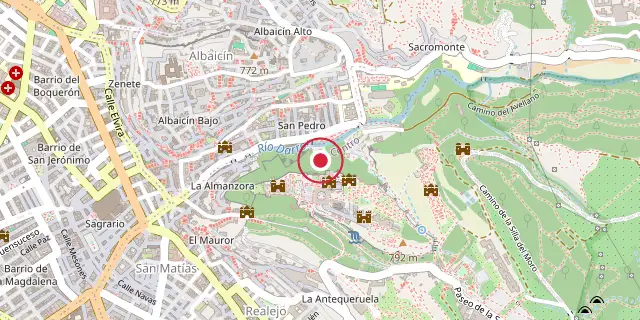
During the Nasrid period, the Alhambra functioned as a self-contained city, separate from Granada below. It included amenities typical of a Muslim city: a Friday mosque, hammams (public baths), roads, houses, artisan workshops, a tannery, and a sophisticated water supply system. As a royal city and citadel, it housed at least six major palaces, mostly along the northern edge with views over the Albaicín quarter. The best-preserved and most famous are the Mexuar, the Comares Palace, the Palace of the Lions, and the Partal Palace, which are the main attractions today. Other palaces are known from historical records and modern excavations. At the western tip lies the Alcazaba fortress. Numerous smaller towers and fortified gates line the walls. East of the Alhambra, outside its walls, is the Generalife, a former Nasrid country estate and summer palace with historic orchards and modern landscaped gardens.
The Nasrid palaces’ architecture follows the Moorish tradition developed over earlier centuries. It centers on the courtyard as a core space and organizing unit for surrounding halls and rooms. Courtyards typically feature water elements at their center, like a reflective pool or fountain. Decoration is concentrated on interiors, using tile mosaics on lower walls and carved stucco on upper walls. Geometric patterns, vegetal motifs, and Arabic inscriptions are the main decorative themes. Muqarnas, a stalactite-like sculpting technique, is used for three-dimensional features such as vaulted ceilings.
The name Alhambra comes from the Arabic *al-Ḥamrā’*, meaning “the red,” with the full form being *Qal‘at al-Ḥamrā’* (“the red fortress”). The Arabic definite article “Al-” is typically ignored in English and Spanish usage, where the name is given a definite article. The “red” refers to the reddish color of its walls, built from rammed earth; the color comes from iron oxide in the local clay. Most current names for specific structures within the Alhambra were imaginative labels coined after the medieval period, often in the 19th century. The original Arabic names of Nasrid-era buildings are unknown, though some scholars have linked certain buildings to names in historical sources.
Evidence of a Roman presence is unclear, but archaeologists have found ancient foundations on Sabika hill. A fortress or citadel, likely from the Visigothic period, existed there in the 9th century. The first mention of *Qal‘at al-Ḥamra* occurred during battles between Arabs and Muladies under ‘Abdallah ibn Muhammad (r. 888–912). Contemporary documents describe the red castle as quite small, with walls unable to repel a determined army. The first reference to *al-Ḥamrā’* appears in poetry attached to an arrow shot over the ramparts, recorded by Ibn Hayyan (d. 1076). In the early 11th century, the Granada region was dominated by the Zirids, a Sanhaja Berber dynasty.
- Location
- Granada, Spain
- Founder
- Muhammad I Ibn al-Ahmar
- Period
- Nasrid era / Spanish Renaissance
- UNESCO status
- World Heritage Site
- Known for
- Islamic architecture, Nasrid palaces, Washington Irving's Tales of the Alhambra
Lore & Background
The Alhambra is a palace and fortress complex situated on Sabika hill, an outcrop of the Sierra Nevada in Granada, Spain. Its construction began in 1238 under Muhammad I Ibn al-Ahmar, the first Nasrid emir, on a site that previously held earlier fortresses and an 11th-century palace. The complex was a self-contained royal city, separate from Granada below, containing a Friday mosque, public baths, roads, houses, artisan workshops, a tannery, and a sophisticated water system. It housed at least six major palaces along its northern edge, with the best-preserved being the Mexuar, Comares Palace, Palace of the Lions, and Partal Palace. At the western tip stands the Alcazaba fortress, while multiple towers and fortified gates line the walls. Nearby to the east lies the Generalife, a former Nasrid country estate with orchards and gardens. The architecture follows Moorish tradition, centered on courtyards with reflective pools or fountains. Interior decoration features tile mosaics on lower walls, carved stucco with geometric patterns, vegetal motifs, and Arabic inscriptions on upper walls, along with muqarnas—stalactite-like sculpting—on vaulted ceilings. The name derives from Arabic for "red fortress," referencing the reddish rammed-earth walls colored by iron oxide in local clay. After the Christian Reconquista in 1492, it became the Royal Court of Ferdinand and Isabella, and in 1526 Charles V commissioned a Renaissance-style palace adjacent to the Nasrid structures. The site fell into disrepair, was damaged by Napoleon’s troops in 1812, and later attracted Romantic travelers, notably Washington Irving, whose 1832 *Tales of the Alhambra* brought international fame. It is now a major tourist attraction and UNESCO World Heritage Site.
Reader's Guide
The Alhambra is significant as the only well-preserved medieval Islamic palace complex, reflecting the tradition of Moorish architecture developed over previous centuries. Its architecture is characterized by the use of the courtyard as a central space, with water features such as reflective pools or fountains at the centre. Decoration focused on the interior, using tile mosaics on lower walls, carved stucco on upper walls, and muqarnas (stalactite-like sculpting) for vaulted ceilings. Geometric patterns, vegetal motifs, and Arabic inscriptions were the main decorative motifs. During the Nasrid era, the Alhambra was a self-contained city with a Friday mosque, hammams, roads, houses, artisan workshops, a tannery, and a sophisticated water supply system. It contained at least six major palaces, the most famous being the Mexuar, Comares Palace, Palace of the Lions, and Partal Palace. The Alcazaba fortress stands at its western tip. Outside the walls to the east is the Generalife, a former Nasrid country estate and summer palace. The Alhambra's legacy includes its role as a major tourist attraction and UNESCO World Heritage Site, and its influence on Romantic-era travel and literature.
Did You Know?
- The name Alhambra derives from the Arabic al-Ḥamrāʼ, meaning 'the red one', referring to the reddish colour of its rammed-earth walls.
- The Alhambra was one of the first Islamic monuments to become the object of modern scientific study.
- Most of the names used today for structures within the Alhambra were coined after the medieval period, often in the 19th century.
Common Misconceptions (Editorial)
Some people believe the Alhambra's name refers to its reddish walls, but this is actually correct—the name derives from the Arabic *al-Ḥamrāʼ*, meaning "the red one," due to the color of its rammed-earth walls. Another common misconception is that most of the Alhambra's famous structure names are original; in fact, most of the names used today for structures within the Alhambra were coined after the medieval period, often in the 19th century.
Why It Matters (Editorial)
The Alhambra endures as a rare, intact window into the medieval Islamic world, preserving both the artistry of Nasrid architecture and the layered history of Spanish Renaissance influences. Its global significance is recognized by UNESCO, but its cultural resonance is deepened by works like Washington Irving’s *Tales of the Alhambra*, which helped spark modern scholarly and public fascination with the site.
Frequently Asked Questions
What is The Alhambra?
The Alhambra is a sprawling palace-and-fortress complex perched on a hill above Granada, Spain. It stands as the best-surviving royal residence from the medieval Islamic world and also features later Spanish Renaissance additions.
Why is The Alhambra considered so important?
It is the only major medieval Islamic palace that remains largely intact, making it an irreplaceable window into Nasrid court life. Its intricate stucco work, geometric tile patterns, and courtyard gardens set a benchmark for Islamic architectural artistry that still influences design today.
What is The Alhambra's UNESCO designation?
The Alhambra holds UNESCO World Heritage Site status, recognizing its outstanding universal value as a masterpiece of both Islamic and later Renaissance architecture. That designation protects the complex and underscores its global cultural significance.
How did Washington Irving connect to The Alhambra?
In the 1820s, American writer Washington Irving lived within the complex and later published his collection *Tales of the Alhambra*, blending history, legend, and personal observation. That book introduced the site to a wide English-speaking audience and helped cement its romantic reputation.
More in World Wonders 1-22
Spotted an error? Know more?
This is a living reference — every entry is fact-audited, and reader corrections feed straight into our audit queue. Suggest an edit · See this site's audit record