
Great Smoky Mountains National Park
Last updated
Where it is
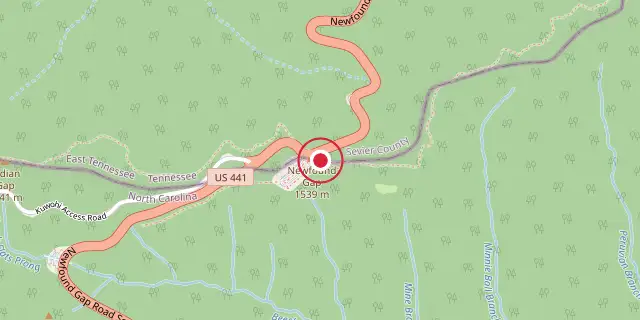
Coordinates: 35°36′40″N 83°25′30″W (35.6110, -83.4250) · Open in OpenStreetMap
Coordinates and connected clubs: the infobox of Wikipedia: Great Smoky Mountains National Park (CC BY-SA 4.0). Map: drawn by Codexery from OpenStreetMap tiles.
In the southeastern United States, a national park called Great Smoky Mountains National Park spans portions of both North Carolina and Tennessee.[1] The United States Congress authorized the park's creation in 1934, and President Franklin D. Roosevelt formally dedicated it six years later in 1940.[2]
Life and work
The park covers 522,419 acres and is roughly evenly divided between Tennessee and North Carolina.[3][4] The park contains an estimated 2,900 miles of streams, all within the Tennessee Valley watershed.[5] The Great Smoky Mountains, which are a subdivision of the Blue Ridge Mountains, have their ridgeline straddled by the park.[1] From its starting point in Georgia to its endpoint in Maine, the Appalachian Trail runs right through the middle of the park.[1]
Within Tennessee, Kuwohi is the tallest mountain, and east of the Mississippi River it ranks as the third highest.[6] Mountains, waterfalls, a wide variety of plant and animal life, and forested areas are what the park is known for around the world.[7]
What the cited sources add
The park is sometimes referred to as the “Wildflower National Park” due to its over 1,500 kinds of flowering plants.[8] The park hosts the Spring Wildflower Pilgrimage, a week-long festival of programs and guided walks each spring.[8] Over 19,000 species have been documented in the park, including more than 100 species of native trees and over 1,500 flowering plant species.[9] The park’s abundant rainfall and high summertime humidity provide excellent growing conditions.[9]
Between 1999 and 2003, the park experienced roughly 150 days with unhealthy air, which works out to about one month's worth of such days annually.[10] An estimated $2.5 billion is brought into the surrounding local economy each year from tourism related to the park.[11][12]
References
- Wikipedia, "Great Smoky Mountains National Park" (CC BY-SA 4.0), which cites: "Public Interest in National Parks Remains Strong as Visits Top 323 Million in 2025", National Park Service; Crane, "National Parks by Popularity 2024", Park Quest, 2025-04-19 (we also read that source) en.wikipedia.org
- Wikipedia, "Great Smoky Mountains National Park" (CC BY-SA 4.0), which cites: "The National Parks: America's Best Idea"; "Global Context", Great Smoky Mountains National Park (original not read by us) en.wikipedia.org
- Wikipedia, "Great Smoky Mountains National Park" (CC BY-SA 4.0) en.wikipedia.org
- Wikipedia, "Great Smoky Mountains National Park" (CC BY-SA 4.0), which cites: DeLorme, "Tennessee Atlas & Gazetteer", DeLorme, 2017 (we also read that source) en.wikipedia.org
- Wikipedia, "Great Smoky Mountains National Park" (CC BY-SA 4.0), which cites: Chávez, "Smokies scientists find 900 more miles of streams", Asheville Citizen-Times, January 26, 2015 (original not read by us) en.wikipedia.org
- Wikipedia, "Great Smoky Mountains National Park" (CC BY-SA 4.0), which cites: "Clingmans Dome", Great Smoky Mountains National Park, August 26, 2026; "Natural Features & Ecosystems", Great Smoky Mountains National Park (original not read by us) en.wikipedia.org
- Wikipedia, "Great Smoky Mountains National Park" (CC BY-SA 4.0), which cites: "Great Smoky Mountains National Park", Great Smoky Mountains National Park; Cuthbert, "Everything to know about Great Smoky Mountains National Park", National Geographic, March 28, 2019 (original not read by us) en.wikipedia.org
- "Wildflowers", Great Smoky Mountains National Park, January 27, 2020. nps.gov
- "Nature", Great Smoky Mountains National Park, December 22, 2022. nps.gov
- Feanny, "Smokies top list of most polluted parks", CNN, June 24, 2004. cnn.com
- Wikipedia, "Great Smoky Mountains National Park" (CC BY-SA 4.0), which cites: "Sevier County's billion-dollar tourist industry grinds to a halt amid COVID-19 pandemic", WVLT-TV, March 23, 2020 (we also read that source) en.wikipedia.org
- "Sevier County's billion-dollar tourist industry grinds to a halt amid COVID-19 pandemic", WVLT-TV, March 23, 2020. wvlt.tv
Each numbered sentence above was checked against the source it cites before publication. Sentences citing Wikipedia adapt text from the English Wikipedia article Great Smoky Mountains National Park (contributors), used under CC BY-SA 4.0; this entry is available under the same licence. Other sources were used for facts only.
More in World Heritage Sites in the United States
Sources
Compiled from Wikipedia and the sources listed below. Text from Wikipedia is available under CC BY-SA 4.0; this entry is adapted from it.
- Wikipedia: Great Smoky Mountains National Park (CC BY-SA 4.0).
Spotted an error? Know more?
Reader corrections go straight into our review queue. Suggest an edit · How this site is sourced