
Poverty Point
Last updated
Where it is
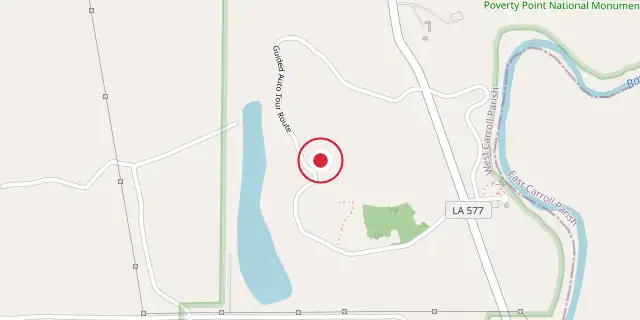
Coordinates: 32°38′13″N 91°24′40″W (32.6370, -91.4110) · Open in OpenStreetMap
Coordinates and connected clubs: the infobox of Wikipedia: Poverty Point (CC BY-SA 4.0). Map: drawn by Codexery from OpenStreetMap tiles.
The 402-acre property is operated as the Poverty Point State Historic Site and has been designated a UNESCO World Heritage Site.[1][2] Indigenous people constructed earthen ridges and mounds at the Poverty Point site during the Late Archaic period, with construction occurring between 1700 and 1100 BCE.[3]
Life and work
The inhabitants produced small amounts of pottery and imported stone vessels made of steatite from the Appalachian Mountains.[4] For example, the north sector was favored for manufacturing tools, while the south sectors were where projectile points were used.[5] Mound A was constructed quickly, probably over less than three months, after the vegetation was burned between 1450 and 1250 BCE.[6] The inhabitants of Poverty Point were Native Americans whose ancestors are thought to have crossed the Bering Strait land bridge into North America roughly 20,000 to 23,000 years ago.[7]
Evidence indicates that most tools were manufactured at the site, and analysis of artifacts shows that different ridges and sectors were used for distinct, specialized activities.[8] Lapidary items such as beads and pendants were found mainly in the West sector.[5] The earliest earthwork constructed at Poverty Point was Mound B, which dates to sometime after 1700 BCE.[9] The earthworks were built over many generations rather than all at once, with the final layout resulting from successive construction efforts across a long period.[10]
What the cited sources add
The World History Encyclopedia account states that the concentric ridges at Poverty Point all once had homes on top built facing the ceremonial plaza and Mound C.[11] The same source notes that the city flourished through 1100 BCE and was abandoned sometime before c. 500 BCE, possibly due to climate change and flooding.[11] It also reports that the land was purchased by Phillip Guier of Kentucky in 1843 as a farm, and the plantation was known as Poverty Point by 1851.[11] The World History Encyclopedia adds that Mound A may have served as the central energy point for rituals before Mound C was constructed.[11]
It further states that the Poverty Point citizens engaged in long-distance trade, importing materials like stone and copper from areas such as the Tennessee River Valley and the Great Lakes region.[11]
References
- Wikipedia, "Poverty Point" (CC BY-SA 4.0), which cites: Greg Hilburn, "A first for Louisiana: Poverty Point selected as World Heritage site", Monroe News-Star; Milner, George R. (2004). The Moundbuilders: Ancient Peoples of Eastern North America. London: Thames & Hudson Ltd. (original not read by us) en.wikipedia.org
- Wikipedia, "Poverty Point" (CC BY-SA 4.0), which cites: U.S. Department of the Interior, "Monumental Earthworks of Poverty Point.", Nomination to the World Heritage List by the United States of America., 2013, p. 106; "Poverty Point" , National Historic Landmarks Program, National Park Service (original not read by us) en.wikipedia.org
- Wikipedia, "Poverty Point" (CC BY-SA 4.0), which cites: U.S. Department of the Interior, "The Monumental Earthworks of Poverty Point", Nomination to the World Heritage List by the United States of America, 2013, p. 106 (original not read by us) en.wikipedia.org
- Wikipedia, "Poverty Point" (CC BY-SA 4.0), which cites: Christopher Hays and Richard Weinstein, "Early Pottery at Poverty Point: Origins and Function", In Early Pottery: Technology, Function, style, and Interaction in the Lower Southeast edited by Rebecca Saunders and Christo; Gibson, Jon L. (2000). The Ancient Mounds of Poverty Point: Place of Rings. Gainesville, Florida: University Press of Florida, p. 121. (original not read by us) en.wikipedia.org
- Wikipedia, "Poverty Point" (CC BY-SA 4.0), which cites: Connolly, "Scratching the Surface: The Role of Surface Collections in Solving the "Mystery" of Poverty Point", Louisiana Archaeology, 2008, p. 79–115 (original not read by us) en.wikipedia.org
- Wikipedia, "Poverty Point" (CC BY-SA 4.0), which cites: Kidder, "Poverty Point and the Archaeology of Singularity", Society for American Archaeology Archaeological Record, November 2008, p. 9–12 (original not read by us) en.wikipedia.org
- Wikipedia, "Poverty Point" (CC BY-SA 4.0), which cites: Gibson, Jon L. 2000. Ancient Mounds Of Poverty Point: Place Of Rings (Native Peoples, Cultures, And Places Of The Southeastern United States). E-Book. Gainesvil (original not read by us) en.wikipedia.org
- Wikipedia, "Poverty Point" (CC BY-SA 4.0), which cites: Gibson, Jon L. (2000). The Ancient Mounds of Poverty Point: Place of Rings. Gainesville, Florida: University Press of Florida, p.112 (original not read by us) en.wikipedia.org
- Wikipedia, "Poverty Point" (CC BY-SA 4.0), which cites: U.S. Department of the Interior, "Monumental Earthworks of Poverty Point.", Nomination to the World Heritage List by the United States of America., 2013, p. 30–32 (original not read by us) en.wikipedia.org
- Wikipedia, "Poverty Point" (CC BY-SA 4.0), which cites: Connolly, Robert P. "An Assessment of Radiocarbon Age Results from the Poverty Point Site". 2006. Louisiana Archaeology, Volume 28, pp. 1-14.; "Poverty Point : Plaza", Louisiana Division of Archaeology; Greenlee, Diana, "Poverty Point", Louisiana Endowment for the Humanities (original not read by us) en.wikipedia.org
- "Poverty Point - World History Encyclopedia", www.worldhistory.org. worldhistory.org
Each numbered sentence above was checked against the source it cites before publication. Sentences citing Wikipedia adapt text from the English Wikipedia article Poverty Point (contributors), used under CC BY-SA 4.0; this entry is available under the same licence. Other sources were used for facts only.
More in World Heritage Sites in the United States
Sources
Compiled from Wikipedia and the sources listed below. Text from Wikipedia is available under CC BY-SA 4.0; this entry is adapted from it.
- Wikipedia: Poverty Point (CC BY-SA 4.0).
Spotted an error? Know more?
Reader corrections go straight into our review queue. Suggest an edit · How this site is sourced