Monticello
Last updated
Where it is
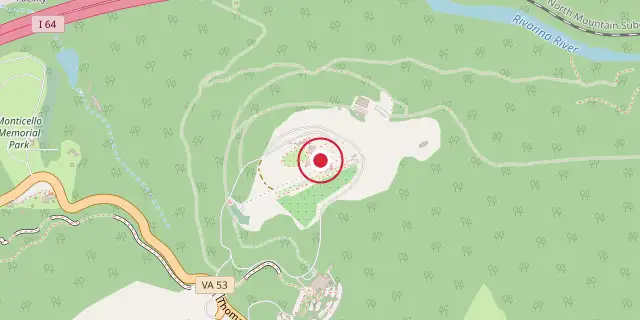
Coordinates: 38°00′36″N 78°27′07″W (38.0100, -78.4520) · Open in OpenStreetMap
Coordinates and connected clubs: the infobox of Wikipedia: Monticello (CC BY-SA 4.0). Map: drawn by Codexery from OpenStreetMap tiles.
The name Monticello comes from Italian meaning "little mountain".[1]
Life and work
Jefferson designed the main house using neoclassical principles from Italian architect Andrea Palladio, reworking the design through much of his presidency.[1] In Europe he saw classical buildings and discovered modern French architecture.[2] He began rebuilding his house in 1794 based on ideas acquired in Europe.[2] Jefferson added a center hallway and parallel rooms, more than doubling the house's area.[3]
Construction of what historians call "the first Monticello" started in 1768, on a 5,000-acre plantation that served as Jefferson's villa and plantation house.[3] The rebuilding effort went on through nearly all of Jefferson's presidency (1801–1809) and was largely finished by 1809, though he kept working on Monticello until his 1826 death.[2] The original house's second full-height story was taken out and a mezzanine floor for bedrooms was put in its place.[3] An octagonal dome, set above the west front where a second-story portico had been, became the most striking feature of the revised design.[3]
What the cited sources add
A Smithsonian Magazine account describes Monticello as requiring ascent of "this steep, savage hill" through thick forest.[4] The same source notes that Jefferson walked alone on Monticello's long terrace every day at first light.[4] According to the Smithsonian article, some 16 slaves waited upon a daily horde of guests in what was essentially a mid-sized hotel.[4] It reports that young black boys age 10 to 12 were whipped to work in Jefferson's nail factory.[4]
The Smithsonian piece notes that Jefferson launched the nailery in 1794 and supervised it personally for three years.[4] It states that Jefferson said he spent half the day counting and measuring nails.[4] Most enslaved people at Monticello dwelled in groups of cabins spread down the mountainside and on distant farms.[4]
References
- Wikipedia, "Monticello" (CC BY-SA 4.0), which cites: "The Long Shadow of the Plantation", BackStory (original not read by us) en.wikipedia.org
- Wikipedia, "Monticello" (CC BY-SA 4.0), which cites: "Monticello", National Park Service, US Dept of the Interior (original not read by us) en.wikipedia.org
- Wikipedia, "Monticello" (CC BY-SA 4.0), which cites: "Monticello", Archipedia, March 13, 2019 (original not read by us) en.wikipedia.org
- "The Dark Side of Thomas Jefferson", Smithsonian Magazine. smithsonianmag.com
Each numbered sentence above was checked against the source it cites before publication. Sentences citing Wikipedia adapt text from the English Wikipedia article Monticello (contributors), used under CC BY-SA 4.0; this entry is available under the same licence. Other sources were used for facts only.
More in World Heritage Sites in the United States
Sources
Compiled from Wikipedia and the sources listed below. Text from Wikipedia is available under CC BY-SA 4.0; this entry is adapted from it.
- Wikipedia: Monticello (CC BY-SA 4.0).
Spotted an error? Know more?
Reader corrections go straight into our review queue. Suggest an edit · How this site is sourced