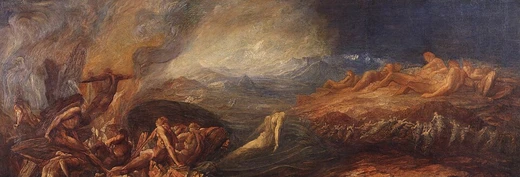
Sisyphean
Describes a futile, never-ending labor.
Sisyphean describes a task that is laborious, futile, and never-ending. The term derives from the Greek mythological figure Sisyphus, who was condemned in the underworld to push an immense boulder up a hill only for it to roll back down each time it neared the top, repeating this action for eternity. Through classical influence on contemporary culture, the word has come to characterize any similarly endless and pointless effort.
Quick Facts
- Mythological figure
- Sisyphus (Sisyphos)
- Kingdom
- Ephyra (later Corinth)
- Parents
- King Aeolus of Aeolia and Enarete
- Spouse
- Merope (a Pleiad)
- Associated god
- Zeus
Facts from the source article.
Did You Know?
- R. S. P. Beekes suggested a pre-Greek origin for the name Sisyphus and a connection with the root of the word sophos ('wise').
- German mythographer Otto Gruppe thought the name derived from sisys ('a goat's skin'), in reference to a rain-charm using goats' skins.
- Ovid's Latin wording for Sisyphus stopping his task is 'inque tuo sedisti, Sisyphe, saxo' ('and you sat, Sisyphus, on your rock').
Family
Sisyphus was a Thessalian prince, the son of King Aeolus and Enarete. His many siblings included Athamas, Salmoneus, and Alcyone. He married the Pleiad Merope and had four sons: Ornytion, Glaucus, Thersander, and Almus. Through Glaucus, he was the grandfather of Bellerophon, and through Almus, the grandfather of Minyas, who founded Orchomenus—though some say Minyas was his son instead. In certain traditions, Sisyphus, not Laërtes, was the true father of Odysseus by Anticleia.
Mythology
Sisyphus was the founder and first ruler of Ephyra, which was the earlier name for Corinth. He is credited with creating the Isthmian Games, though accounts differ: the writer Pausanias says he did so to honor Melicertes, whose body a dolphin carried to the Corinthian isthmus, while a fragment from the poet Pindar claims he followed instructions from nymphs. He turned Corinth into a center for travel and sea trade, but angered Zeus by murdering every guest who stayed at his palace, breaking the sacred rule of xenia to show he was a merciless king. Sisyphus and his brother Salmoneus were bitter enemies, and Sisyphus asked the Oracle of Delphi how to kill Salmoneus without facing harsh punishment. Known from Homer onward as the most cunning of men, he seduced Salmoneus’s daughter Tyro as part of a scheme to eliminate her father, but she killed their children after learning he meant to use them to overthrow him. Sisyphus also betrayed Zeus by telling the river god Asopus where his daughter Aegina was hidden, in exchange for a spring that never dried on the Corinthian hilltop. Zeus sent Thanatos, the personification of death, to chain Sisyphus in Tartarus, but Sisyphus tricked and bound Thanatos instead. With death halted, no one could die, and the god Ares freed Thanatos, handing Sisyphus over. In other versions, Hades was sent and got chained; while he was trapped, no one could die and sacrifices to the gods stopped. The gods then threatened Sisyphus with such misery that he would beg for death, forcing him to release Hades.
Interpretations
The solar theory interprets King Sisyphus as the disk of the sun that rises daily in the east and sinks in the west. Other scholars regard him as a personification of waves rising and falling, or of the treacherous sea. The 1st-century BC Epicurean philosopher Lucretius interprets the myth as personifying politicians aspiring for office who are constantly defeated, with the quest for power being likened to rolling the boulder up the hill. Friedrich Welcker suggested Sisyphus symbolizes the vain struggle of man in the pursuit of knowledge, and Salomon Reinach that his punishment is based on a picture of Sisyphus rolling a huge stone at Acrocorinthus, symbolic of the labor and skill involved in building the Sisypheum. Albert Camus, in his 1942 essay The Myth of Sisyphus, saw Sisyphus as personifying the absurdity of human life, concluding 'one must imagine Sisyphus happy' as 'The struggle itself towards the heights is enough to fill a man's heart.' J. Nigro Sansonese, building on Georges Dumézil, speculates the name 'Sisyphus' is onomatopoetic of the continual back-and-forth sound of breath in the nasal passages, situating the mythology in the context of archaic trance-inducing techniques related to breath control, with the repetitive inhalation–exhalation cycle described esoterically as the up–down motion of Sisyphus and his boulder. In experiments testing how workers respond when the meaning of their task is diminished, the test condition is referred to as the Sisyphusian condition, with conclusions that people work harder when their work seems more meaningful and that people underestimate the relationship between meaning and motivation. Homer describes Sisyphus in both Book VI of the Iliad and Book XI of the Odyssey. Ovid, in the story of Orpheus and Eurydice, shows the moving power of Orpheus's song by noting that Sisyphus stopped his eternal task and sat on his rock.
More in Words and Phrases Derived from Greek Mythology
Spotted an error? Know more?
Reader corrections go straight into our review queue. Suggest an edit · How this site is sourced