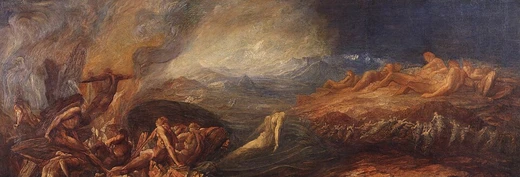
Cassandra phenomenon
A person whose valid warnings are disbelieved by others.
The Cassandra phenomenon describes a situation where accurate warnings or predictions are disbelieved or ignored.[1] The metaphor has been applied in psychology, environmentalism, politics, and corporate contexts since at least 1914.[1] French philosopher Gaston Bachelard coined the term "Cassandra Complex" in 1949.[1]
Quick Facts
- Book and author
- A History of the Peninsular War, Volume 5 by Charles Oman
- Coiner of 'cassandra complex'
- Gaston Bachelard
- Year 'cassandra complex' coined
- 1949
Facts from the source article.
Key facts and history
Klein described Cassandra as one who "predicts ill to come and warns that punishment will follow and grief arise"[2] In a 1988 study, Jungian analyst Laurie Layton Schapira explored the "Cassandra complex" in two of her analysands.[3] Schapira delineated three factors constituting the complex: dysfunctional relationships with the "Apollo archetype," emotional or physical suffering including hysteria, and being disbelieved.[3] Schapira views the complex as resulting from a dysfunctional relationship with an archetype dedicated to order, reason, and clarity.[4]
In 1989, Jean Shinoda Bolen published an essay detailing a psychological profile of the "Cassandra woman"[5] Bolen suggested the Cassandra woman may exhibit "hysterical" overtones and be disbelieved when sharing what she knows.[5] Within corporate settings, individuals who advocate for a new organizational vision are labeled "Cassandras"—they can foresee future events but are not believed.[6]
What the cited sources add
Grove's 1998 transcript explains that Cassandras must bring bad news against senior management and the fear of repercussions.[7] Grove stated that unless management deals with this fear, they will never hear from those helpful Cassandras and will be late responding to Strategic Inflection Points.[7]
References
- Wikipedia, "Cassandra (metaphor)" (CC BY-SA 4.0), which cites: ; Bachelard, Gaston, Le Rationalisme appliqué PUF, Paris, (1949). (original not read by us) en.wikipedia.org
- Wikipedia, "Cassandra (metaphor)" (CC BY-SA 4.0), which cites: Klein, M., Envy and Gratitude- And Other Works 1946–1963, p. 293 (1975); Klein, M., Envy and Gratitude – And Other Works 1946–1963, p. 295 (1975); Klein, M., Envy and Gratitude- And Other Works 1946–1963, p. 293 (1975) (original not read by us) en.wikipedia.org
- Wikipedia, "Cassandra (metaphor)" (CC BY-SA 4.0), which cites: Schapira, "The Cassandra Complex: Living with Disbelief: A Modern Perspective on Hysteria", Inner City Books, 1988 (we also read that source) en.wikipedia.org
- Wikipedia, "Cassandra (metaphor)" (CC BY-SA 4.0), which cites: Laurie Layton Schapira, The Cassandra Complex: Living With Disbelief: A Modern Perspective on Hysteria p.10 (1988); Schapira, "The Cassandra Complex: Living with Disbelief: A Modern Perspective on Hysteria", Inner City Books, 1988; Laurie Layton Schapira, The Cassandra Complex: Living With Disbelief: A Modern Perspective on Hysteria p.65 (1988) (we also read that source) en.wikipedia.org
- Wikipedia, "Cassandra (metaphor)" (CC BY-SA 4.0), which cites: Jean Shinoda Bolen, Gods in Everyman: A New Psychology of Men's Lives and Loves (1989); Jean Shinoda Bolen, Gods in Everyman: A New Psychology of Men’s Lives and Loves pp. 130–160 (1989) (original not read by us) en.wikipedia.org
- Wikipedia, "Cassandra (metaphor)" (CC BY-SA 4.0), which cites: Davies, P., "The Cassandra Complex: how to avoid generating a corporate vision that no one buys into" pp. 103–123 in Success in Sight: Visioning (1998); The Bear Book: Survive and Profit in Ferocious Markets, p. 81 (2000); Only The Paranoid Survive (1999); Grove, "Academy of Management, Annual Meeting", Intel Keynote Transcript, August 9, 1998 (we also read that source) en.wikipedia.org
- Grove, "Academy of Management, Annual Meeting", Intel Keynote Transcript, August 9, 1998. facts only, no text reused. intel.com
Each numbered sentence above was checked against the source it cites before publication. Sentences citing Wikipedia adapt text from the English Wikipedia article Cassandra (metaphor) (contributors), used under CC BY-SA 4.0; this entry is available under the same licence. Other sources were used for facts only; no text or images are copied from them.
More in Words and Phrases Derived from Greek Mythology
Spotted an error? Know more?
Reader corrections go straight into our review queue. Suggest an edit · How this site is sourced