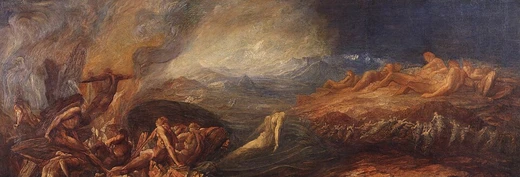
Cassandra complex
A person whose true warnings are disbelieved by others.
The Cassandra complex is a metaphor applied in psychology, environmentalism, politics, and corporate contexts since at least 1914.[1] French philosopher Gaston Bachelard coined the term "Cassandra Complex" in 1949 to refer to a belief that things could be known in advance.[1]
Quick Facts
- Origin
- Greek mythology
- Coiner of 'cassandra complex'
- Gaston Bachelard, 1949
- Key psychological study
- Laurie Layton Schapira, 1988
Facts from the source article.
Key facts and history
Klein described Cassandra as moral conscience that "predicts ill to come and warns that punishment will follow and grief arise"[2] Klein's use of the metaphor centers on the moral nature of certain predictions that evoke denial.[2] In a 1988 study, Jungian analyst Laurie Layton Schapira explored the "Cassandra complex" in the lives of two of her analysands.[3] In 1989, Jean Shinoda Bolen published an essay detailing a psychological profile of the "Cassandra woman"[4]
Bolen suggests that a Cassandra woman may become increasingly hysterical and irrational when in a dysfunctional relationship with a negative Apollo.[5] Melanie Klein, a psychoanalyst, saw Cassandra as a symbol for the moral conscience that warns of consequences.[2] According to Schapira, the Cassandra complex has three components: a troubled connection with the "Apollo archetype", either emotional or physical pain, and a lack of belief from others.[3] In business settings, individuals who back a novel direction are called "Cassandras"—they foresee future events yet are not trusted.[6]
What the cited sources add
Atkisson describes the "Cassandra dilemma" as a situation where individuals foresee adverse outcomes from present patterns and try to alert others, yet most people are either unable or unwilling to react.[7] Taylor Swift released a track titled "Cassandra" on her 2024 album The Tortured Poets Department, using the figure to convey that her truth-telling was not believed, and questioning whether those same people now believe her after they "set her life in flames".[8]
References
- Wikipedia, "Cassandra (metaphor)" (CC BY-SA 4.0), which cites: ; Bachelard, Gaston, Le Rationalisme appliqué PUF, Paris, (1949). (original not read by us) en.wikipedia.org
- Wikipedia, "Cassandra (metaphor)" (CC BY-SA 4.0), which cites: Klein, M., Envy and Gratitude- And Other Works 1946–1963, p. 293 (1975); Klein, M., Envy and Gratitude – And Other Works 1946–1963, p. 295 (1975); Klein, M., Envy and Gratitude- And Other Works 1946–1963, p. 293 (1975) (original not read by us) en.wikipedia.org
- Wikipedia, "Cassandra (metaphor)" (CC BY-SA 4.0), which cites: Schapira, "The Cassandra Complex: Living with Disbelief: A Modern Perspective on Hysteria", Inner City Books, 1988 (we also read that source) en.wikipedia.org
- Wikipedia, "Cassandra (metaphor)" (CC BY-SA 4.0), which cites: Jean Shinoda Bolen, Gods in Everyman: A New Psychology of Men's Lives and Loves (1989); Jean Shinoda Bolen, Gods in Everyman: A New Psychology of Men’s Lives and Loves pp. 130–160 (1989) (original not read by us) en.wikipedia.org
- Wikipedia, "Cassandra (metaphor)" (CC BY-SA 4.0), which cites: Jean Shinoda Bolen, Gods in Everyman: A New Psychology of Men’s Lives and Loves pp. 130–160 (1989) (original not read by us) en.wikipedia.org
- Wikipedia, "Cassandra (metaphor)" (CC BY-SA 4.0), which cites: Davies, P., "The Cassandra Complex: how to avoid generating a corporate vision that no one buys into" pp. 103–123 in Success in Sight: Visioning (1998); The Bear Book: Survive and Profit in Ferocious Markets, p. 81 (2000); Only The Paranoid Survive (1999); Grove, "Academy of Management, Annual Meeting", Intel Keynote Transcript, August 9, 1998 (we also read that source) en.wikipedia.org
- Wikipedia, "Cassandra (metaphor)" (CC BY-SA 4.0), which cites: AtKisson, A., Believing Cassandra: An Optimist Looks at a Pessimist's World, Earthscan (1999); AtKisson, A., Believing Cassandra: An Optimist Looks at a Pessimist's World, Earthscan (1999) (original not read by us) en.wikipedia.org
- Wikipedia, "Cassandra (metaphor)" (CC BY-SA 4.0), which cites: "Aégis", Official Theatre of Tragedy website (we also read that source) en.wikipedia.org
Each numbered sentence above was checked against the source it cites before publication. Sentences citing Wikipedia adapt text from the English Wikipedia article Cassandra (metaphor) (contributors), used under CC BY-SA 4.0; this entry is available under the same licence. Other sources were used for facts only; no text or images are copied from them.
More in Words and Phrases Derived from Greek Mythology
Spotted an error? Know more?
Reader corrections go straight into our review queue. Suggest an edit · How this site is sourced