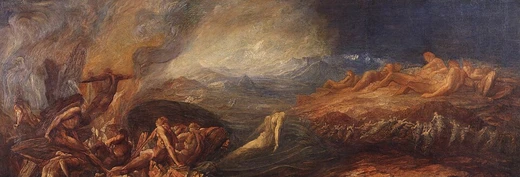
Between Scylla and Charybdis
A dilemma of two equal dangers, from Greek sea monsters.
The idiom 'between Scylla and Charybdis' originates from Greek mythology and describes a situation where avoiding one danger leads directly into another. It has become proverbial for choosing the lesser of two evils or facing equally hazardous extremes, often resulting in disaster.
Quick Facts
- Mythological figures
- Scylla and Charybdis
- Location
- Strait of Messina between Sicily and Calabria
- First recorded proverb
- Erasmus, Adagia (1515)
- Latin proverb
- evitata Charybdi in Scyllam incidi
- Latin hexameter
- incidit in Scyllam cupiēns vītāre Charybdem
Facts from the source article.
The myth and its proverbial use
In Greek mythology, Scylla and Charybdis were two sea monsters mentioned by Homer, positioned across from each other in the Strait of Messina, which separates Sicily from the Italian mainland at Calabria. Scylla, often described as a six-headed monster, was later understood to be a rocky shoal on the Calabrian side, while Charybdis was a whirlpool off Sicily’s coast. These hazards were so close that sailors could not avoid one without risking the other. In Homer’s tale, Odysseus was told to steer toward Scylla and sacrifice a few crew members rather than lose his entire ship to the whirlpool. This impossible choice entered common speech. In 1515, Erasmus included it in his Adagia under the Latin phrase “evitata Charybdi in Scyllam incidi,” meaning “having escaped Charybdis I fell into Scylla,” and also gave a Greek version. He outlined three uses: choosing the lesser evil when any escape comes at a cost; indicating that all options carry equal danger; or describing someone who, in fleeing one extreme, lands in its opposite. For the last meaning, he quoted a line from the 12th-century Latin epic Alexandreis by Walter of Châtillon: “incidit in Scyllam cupiēns vītāre Charybdem” (into Scylla he fell, wishing to avoid Charybdis).
Cultural references
The story was often applied to political situations. In James Gillray's 1793 cartoon 'Britannia between Scylla and Charybdis', William Pitt helms the ship Constitution between the rock of democracy and the whirlpool of arbitrary power, referencing the French Revolution's effect on British politics. Percy Bysshe Shelley returned to the idiom in his 1820 essay A Defence of Poetry, writing that 'the vessel of the state is driven between the Scylla and Charybdis of anarchy and despotism.' A Punch caricature by John Tenniel (10 October 1863) showed Lord Palmerston steering the British ship between Scylla as Abraham Lincoln and Charybdis as Jefferson Davis, with a shield marked 'Neutrality' referencing his impartiality in the American Civil War. American magazine Puck used the myth in a caricature by F. Graetz (26 November 1884) depicting unmarried president-elect Grover Cleveland rowing between monsters labeled 'Mother-in-law' and 'Office Seekers'. In literature, Victor Hugo used the French equivalent 'tomber de Charybde en Scylla' in Les Misérables (1862) as a metaphor for rebel barricades, titling a chapter 'The Charybdis of the Faubourg Saint-Antoine and the Scylla of the Faubourg du Temple'. James Joyce framed events in Episode 9 of Ulysses (1922) using the idiom.
More in Words and Phrases Derived from Greek Mythology
Spotted an error? Know more?
Reader corrections go straight into our review queue. Suggest an edit · How this site is sourced