Iron in folklore
Iron appears in global folklore as a protector and symbol of power.

Iron appears throughout global mythology and folklore, carrying a deep and varied history. Today, "iron" refers to a chemical element, but traditionally it meant what we now call wrought iron. In East Asia, cast iron—known as "cooked iron"—was common after 500 BC, while wrought iron was called "raw iron." (In Europe, cast iron stayed rare until the 14th century, when it was first used for cannonballs.) The shift from the Bronze Age to the Iron Age saw iron tools and weapons replace bronze ones, and iron-using societies overtook those that relied on bronze. This transition sparked many early legends, including the Homeric epics, the Vedas, and major cultural changes in Africa.
**In Europe**
**Cold iron** "Cold iron" was long believed to repel, contain, or harm ghosts, fairies, witches, and other malevolent supernatural beings. This belief persisted in later superstitions in several forms: nailing an iron horseshoe to a door was thought to drive away evil spirits or, later, bring good luck; surrounding a cemetery with an iron fence was said to keep the souls of the dead inside; burying an iron knife under a home's entrance was believed to prevent witches from entering. Irish fishermen used "cold iron" as a substitute name for animals and events they considered unlucky, and Scottish fishermen had a similar practice.
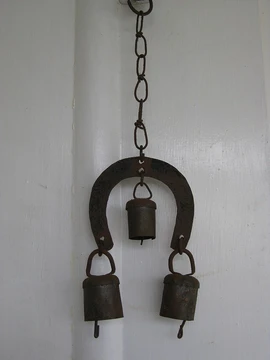
**Horseshoes** In many cultures—including those of England, Denmark, Lithuania, and Estonia—horseshoes are seen as good luck charms, with their shape, fabrication, placement, and how they are obtained all mattering. A common belief holds that if a horseshoe is hung on a door with its ends pointing up, good luck follows; if the ends point down, bad luck comes. Traditions vary, though. Some cultures hang the shoe points down so luck pours onto anyone standing beneath it; others hang it points up so the luck cannot spill out; still others say it does not matter as long as the shoe is used (not new), found (not purchased), and can be touched. In all traditions, luck resides in the shoe and can flow out through the ends. In some traditions, only the owner of the horseshoe—not the person who hangs it—receives any good or bad luck. So if the shoe is stolen, borrowed, or found, the owner, not the finder or thief, gets the luck. Other traditions require the shoe to be found to work.
- Material
- Iron (wrought, cast, meteoric, steel)
- Cultural roles
- Repelling supernatural beings, good luck charm, ritual implements
- Notable beliefs
- Cold iron repels ghosts, fairies, witches; horseshoes bring luck
- Regions
- Europe, East Asia, Tibet, Himalayas, Scotland, Ireland, Denmark, Lithuania, Estonia
- Historical periods
- Bronze Age transition, Iron Age, Industrial Revolution
- Associated figures
- Saint Dunstan, Sir Walter Scott, Rudyard Kipling
Lore & Background
In European folklore, 'cold iron' is historically believed to repel, contain, or harm ghosts, fairies, witches, and other malevolent supernatural creatures. This belief continued into later superstitions in a number of forms: nailing an iron horseshoe to a door was said to repel evil spirits or, later, to bring good luck; surrounding a cemetery with an iron fence was thought to contain the souls of the dead; burying an iron knife under the entrance to one's home was alleged to keep witches from entering. 'Cold iron' is a substitute name used for various animals and incidents considered unlucky by Irish fishermen, and a similar phenomenon has been found with Scottish fishermen.
Horseshoes are considered a good luck charm in many cultures, including those of England, Denmark, Lithuania, and Estonia, and its shape, fabrication, placement and manner of sourcing are all important. A common belief is that if a horseshoe is hung on a door with the two ends pointing up then good luck will occur, but if the two ends point downwards then bad luck will occur. Traditions do differ on this point. One reputed origin of the tradition of lucky horseshoes is the story of Saint Dunstan and the Devil. Dunstan, who would become the Archbishop of Canterbury in AD 959, was a blacksmith by trade. The story relates that he once nailed a horseshoe to the Devil's hoof when he was asked to reshoe the Devil's horse, causing the Devil great pain, and Dunstan only agreed to remove the shoe and release the Devil after the Devil promised never to enter a place where a horseshoe is hung over the door.
In Tibet, meteoric iron was highly prized throughout the Himalayas, where it was included in sophisticated polymetallic alloys for ritual implements such as the singing bowl and phurba. Beer (1999) states that meteoric iron or 'sky-iron' (Tib. gnam lcags) is the supreme substance for forging the physical representation of the vajra or other iron weapons, since it has already been tempered by the celestial gods in its passage across the heavens. Many vajras held by deities as weapons are described as being forged from meteorite iron, and Tibet, with its high altitude, thin atmosphere and desolate landscape, received an abundance of meteorite fragments.
Reader's Guide
Iron's significance in folklore spans multiple continents and millennia, reflecting its practical and symbolic importance. The transition from bronze to iron at the end of the Bronze Age and beginning of the Iron Age is echoed in early legends such as Homeric epic and the Vedas, as well as major cultural shifts in Africa. The belief that 'cold iron' repels supernatural creatures—ghosts, fairies, witches—persisted in European superstitions, manifesting in practices like nailing horseshoes to doors, surrounding cemeteries with iron fences, and burying iron knives under thresholds. These customs illustrate how a common material became a protective talisman.
The horseshoe tradition, with its varied rules about orientation and sourcing, shows how folklore adapts locally while retaining core ideas. The story of Saint Dunstan and the Devil provides a narrative origin for the practice, linking blacksmithing skill with spiritual power. In Tibet, meteoric iron was considered sacred, used for ritual implements like the vajra, and believed to have been tempered by celestial gods. This cross-cultural reverence for iron—whether as a weapon against evil, a bringer of luck, or a divine substance—demonstrates its enduring role in human belief systems. The legacy continues in modern fiction, where 'cold iron' appears in works by Rudyard Kipling, Sir Walter Scott, and in contemporary fantasy, often retaining its traditional properties against fairies and spirits.
Did You Know?
- In East Asia, cast iron was called 'cooked iron' and wrought iron 'raw iron' after 500 BC.
- In Europe, cast iron remained very rare until it was used for cannonballs in the 14th century.
- One reputed origin of the lucky horseshoe tradition is the story of Saint Dunstan and the Devil.
- In Tibet, meteoric iron was called 'sky-iron' and used for forging ritual implements like the vajra.
More in Witchcraft in folklore and mythology 1-24
Spotted an error? Know more?
Reader corrections go straight into our review queue. Suggest an edit · How this site is sourced