Moll Dyer
Legendary 17th-century Maryland woman accused of witchcraft.

Bohemian Baltimore · CC0
Moll Dyer is a legendary figure from 17th-century Leonardtown, Maryland. According to local lore, she was accused of witchcraft and driven from her home by townspeople on a winter night. Her body was reportedly discovered days later, partially frozen to a large stone. This story is an oral folktale from St. Mary's County, passed down for decades or centuries, but no primary sources or firm historical evidence confirm it happened.
The tale's origins are hazy, but the events are generally placed in a February during the late 1690s, a period that included Maryland witch trials—which saw multiple acquittals and one recorded execution. Leonardtown's colonial records are incomplete, as many were lost in a courthouse fire on March 8, 1831. Despite the lack of proof, supporters of the story often point to several details: a "great epidemic" struck Southern Maryland in 1697/98 (Archives of MD, V23, p. 396); an 1892 article in *The St. Mary's Beacon* by Joseph F. Morgan claimed Moll lived in the area for years and her cottage was burned while "Cotton Mather held sway"; and several witchcraft trials occurred in Maryland from 1654 to 1712, including the 1685 hanging of Rebecca Fowler in neighboring Calvert County. In recent years, community efforts have revived the legend, with some—including St. Mary's County Government—linking it to a possibly real Mary Dyer, born in Devon, England, in 1634, who appears in records as an indentured servant in the Virgin Islands in 1669 and traveled to Dorchester, Maryland, in 1677. Whether this woman ever lived or died in Leonardtown is unclear, and these claims, though printed in publications like *The Washington Post*, remain debated. In 2021, Leonardtown Mayor Dan Burris declared February 26 "Moll Dyer Day" to honor the town's history.
The folktale itself describes a deadly plague (likely influenza) and poor crops that, combined with a harsh winter, left the small, puritanical Leonardtown community fearful. Superstition led them to blame famine, disease, and ice storms on witchcraft. A meeting at a local shop identified Moll Dyer, an older woman living on the town'
- Born
- Unknown (legendary figure; often placed in the late 1600s)
- Died
- Late 1690s (legendary)
- Field
- Folklore, Witchcraft legend
- Nationality
- Colonial American (Maryland)
- Known for
- Accused witch; legend of Moll Dyer Rock; curse on Leonardtown
Lore & Background
According to the folktale, a deadly plague and poor crops had taken their toll on the small Leonardtown community, and a particularly harsh winter made people fearful. The deeply religious and puritanical townsfolk turned to superstition, claiming the famine, disease, and ice storms were the product of witchcraft. A meeting in a local shop determined that Moll Dyer, an older woman living on the southern edge of town, was the witch and had called upon the Devil. A mob formed, surrounded her hut, and set it on fire; Moll barely escaped into the woods, some accounts say with only a light shawl for warmth. She ran for miles until her legs gave in.
Reader's Guide
The legend of Moll Dyer is a persistent oral-history folktale in St. Mary's County, Maryland, told for decades if not centuries. Despite dubious sourcing, the story has been linked to immigration records of a Mary Dyer transported to Dorchester County in 1677, and to the Maryland Witch Trials that resulted in multiple acquittals and one recorded death. The tale has inspired local commemorations, including the declaration of February 26 as 'Moll Dyer Day' in Leonardtown in 2021, and the relocation of the alleged 'Moll Dyer Rock' to the grounds of Tudor Hall. The rock, a 875-pound limestone boulder, was moved by the National Guard in 1972 and now sits under plexiglass with a plaque. Touching the stone is said to cause nausea, dizziness, or misfortune, and small offerings are often left to nullify the curse. The legend has appeared in popular culture, including an episode of The Weather Channel's American Supernatural, and inspired the titular character in The Blair Witch Project. The Washington Times has called her 'perhaps Maryland's best-known bit of witch lore.'
Did You Know?
- Moll Dyer's body was allegedly found partially frozen to a large stone, with her hand still raised toward the sky.
- The 875-pound limestone boulder known as Moll Dyer Rock was moved by the National Guard in 1972 to the Leonardtown courthouse lawn.
- The legend of Moll Dyer was one of the historical figures that inspired the titular character in The Blair Witch Project.
The Legend of the Frozen Curse
The core narrative of Moll Dyer is one of persecution and supernatural retribution. In a harsh winter in the late 1690s, the small community of Leonardtown, Maryland, was ravaged by what was likely influenza and failing crops. The deeply religious, puritanical townsfolk, terrified of not surviving the season, blamed their suffering on witchcraft. A gathering at a local shop singled out Moll Dyer, an older woman living on the town's southern edge, as the one who had summoned the Devil. A mob descended on her dwelling, surrounding it and setting it ablaze. Moll barely escaped, clutching nothing but a thin shawl, and fled into the woods. She ran for miles until her legs finally failed. Knowing the cold would kill her before dawn, she pressed her right hand against a boulder, raised her left toward the moon, and invoked a curse upon Leonardtown. Days later, her body was discovered frozen to the stone, her hand still outstretched. The curse—varying by teller—typically involves blighted harvests, child death, or generational misfortune.
Historical Context and the Absence of Proof
The Moll Dyer story exists entirely in the realm of oral tradition, with no surviving primary documents, census entries, or other firm historical evidence to confirm that the events actually transpired. The consensus places the tale in a February of the late 1690s, during a broader wave of Maryland witchcraft proceedings that spanned from 1654 to 1712 and produced multiple acquittals alongside at least one recorded execution—Rebecca Fowler of Calvert County, hanged in 1685. Colonial-era records for Leonardtown are notoriously incomplete, largely because the town courthouse burned on March 8, 1831, destroying much of the documentation. Advocates who attempt to anchor the legend in fact point to immigration records showing a Mary Dyer, a Marg. Dyer, and a Malligo Dyer arriving in Dorchester County in October 1677 aboard Captain Thomas Taylor's vessel, and to a documented epidemic in Southern Maryland in 1697–98. An 1892 article in The St. Mary's Beacon, written by Joseph F. Morgan, also references Moll's cottage being burned during the era of Cotton Mather's influence. Yet none of these fragments constitute definitive proof.
A Shape-Shifting Story: Variations in the Telling
Because the Moll Dyer legend has been transmitted orally across generations, its details shift dramatically depending on who is speaking. In 1994, Thomas Jarboe interviewed ten local residents—including a member of the Dyer family, a local historian, and individuals from families rooted in the county since the 1600s—and found enormous disagreement on basic biographical facts. Respondents placed her origins in England, Ireland, Virginia, Kentucky, New England, or Connecticut. Her social identity ranged from spinster to widow to a woman jilted in love to a mother of two sons. Two interviewees recalled the name as "Moldy Dyer" and described her as a Native American, likely Chaptico, maid who had been abandoned by a white lover after bearing his child. The date of her death swung from the mid-1600s to the late 1700s, and several informants speculated she was an English Catholic who chose Maryland for its greater religious tolerance—a plausible detail given that English Catholics had been fleeing persecution for the Americas since roughly the late 1500s. These contradictions underscore that Moll Dyer is less a fixed historical figure than a living narrative that absorbs the concerns of each generation that retells it.
Moll Dyer Rock and the Living Legacy
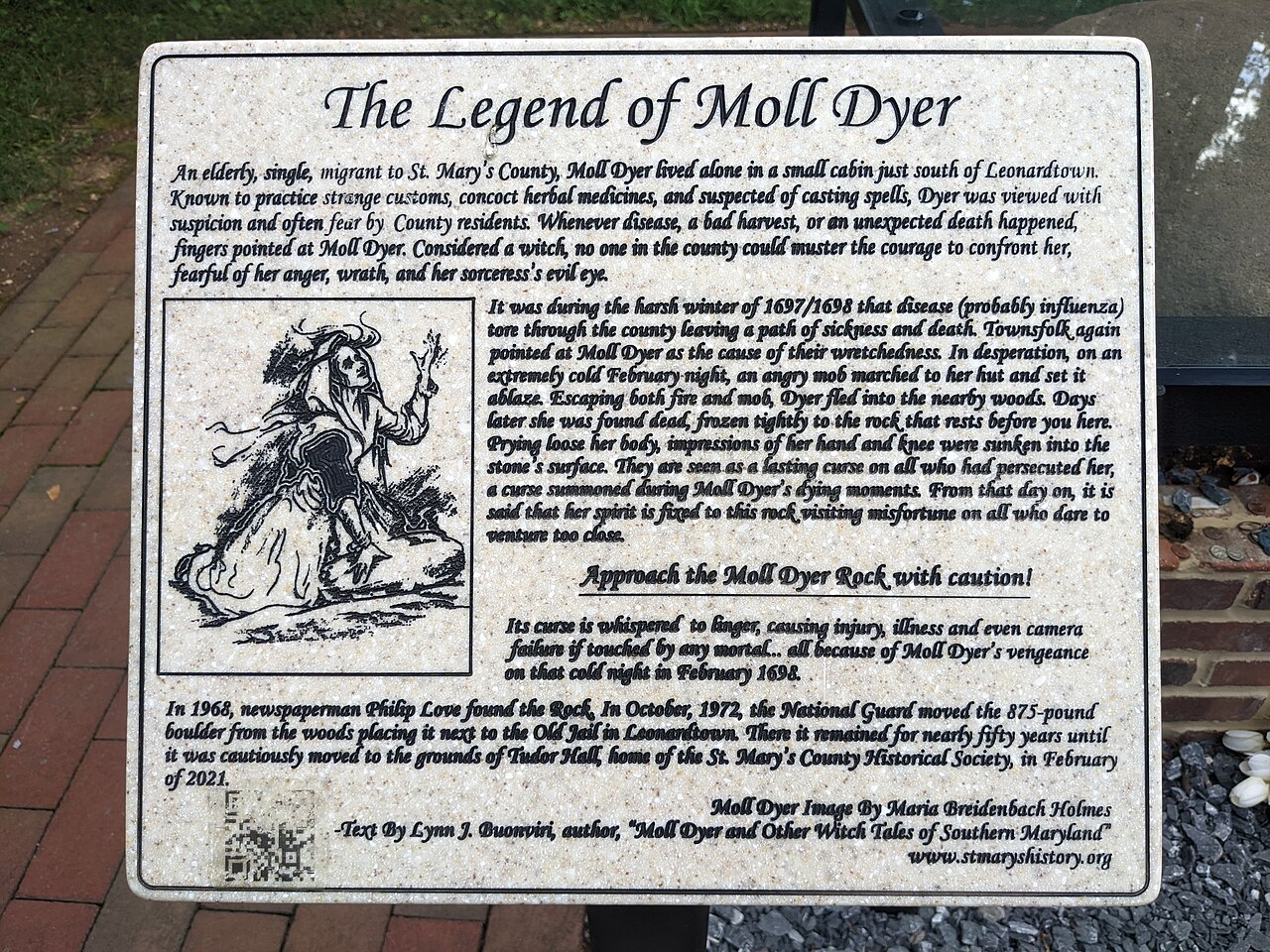
The physical and cultural footprint of the Moll Dyer legend has grown considerably in the modern era. The "Moll Dyer Rock," said to bear the indentations of her hand and knees, was lost for centuries until 1968, when Philip H. Love, a writer for the Washington Evening Star, read about the tale in a local historical journal and set out to find it. Today a discolored handprint is occasionally reported on the stone, which sits in front of the Tudor Hall Mansion. In 2021, Leonardtown Mayor Dan Burris officially declared February 26 "Moll Dyer Day" as a tribute to the town's heritage. The St. Mary's County Government has also linked the legend to a possibly real Mary Dyer—allegedly born in Devon, England, in 1634, appearing in records as an indentured servant in the Virgin Islands by 1669, and arriving in Dorchester in 1677—claims that have been picked up by outlets such as The Washington Post, though their accuracy remains contested. Residents near Moll Dyer Road, a branch of Maryland Route 5, continue to report shadow figures, will-o'-the-wisps, a white dog linked to car accidents, unexplained fog, and frequent lightning, keeping the story alive in the collective imagination of the community.
Gallery

Frequently Asked Questions
Who is Moll Dyer?
Moll Dyer is a legendary 17th-century woman from Leonardtown, Maryland, whose story in local oral tradition describes her being branded a witch and cast out of her home by hostile townspeople. She is one of the most recognized figures in Colonial American witchcraft folklore.
What is Moll Dyer Rock?
Moll Dyer Rock is a large stone in St. Mary's County, Maryland, to which the legend says her half-frozen body was discovered after she was expelled from the community. It serves as the physical anchor point for the story and a local landmark tied to the witchcraft narrative.
Is Moll Dyer's story historically verified?
No; the tale survives purely as an oral tradition passed down through generations in the Leonardtown area, and no primary documents or firm historical records confirm the events actually took place. Scholars treat it as folklore rather than established history.
What curse is associated with Moll Dyer?
Local legend holds that Moll Dyer placed a curse on Leonardtown before her death, and the town is said to have suffered ongoing misfortune as a result. This element of the story reinforces her role as a vengeful, otherworldly figure in Maryland witchcraft lore.
More in Witchcraft in folklore and mythology 1-24
Spotted an error? Know more?
Reader corrections go straight into our review queue. Suggest an edit · How this site is sourced