
Black cat
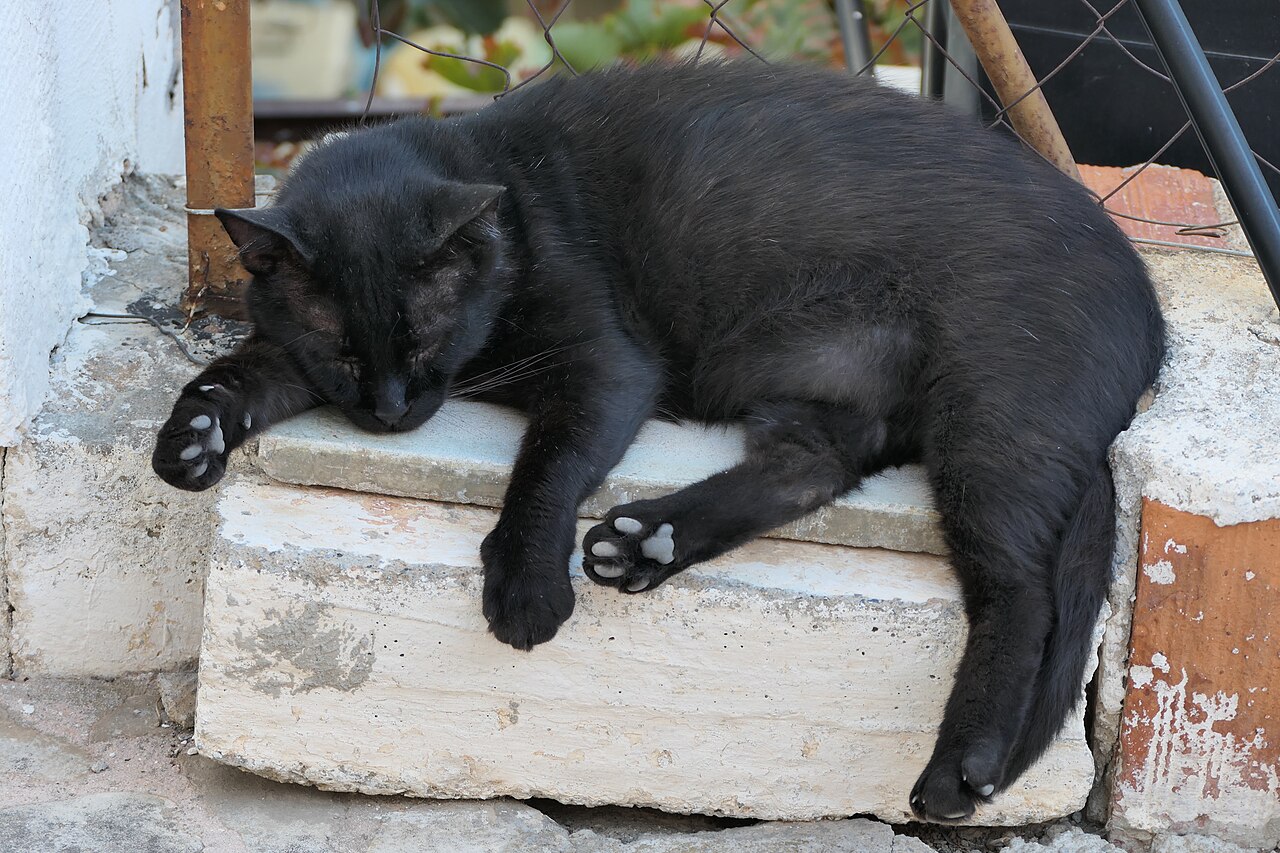
A domestic cat with black fur, steeped in myth and superstition.

Petro Stelte · CC BY-SA 4.0
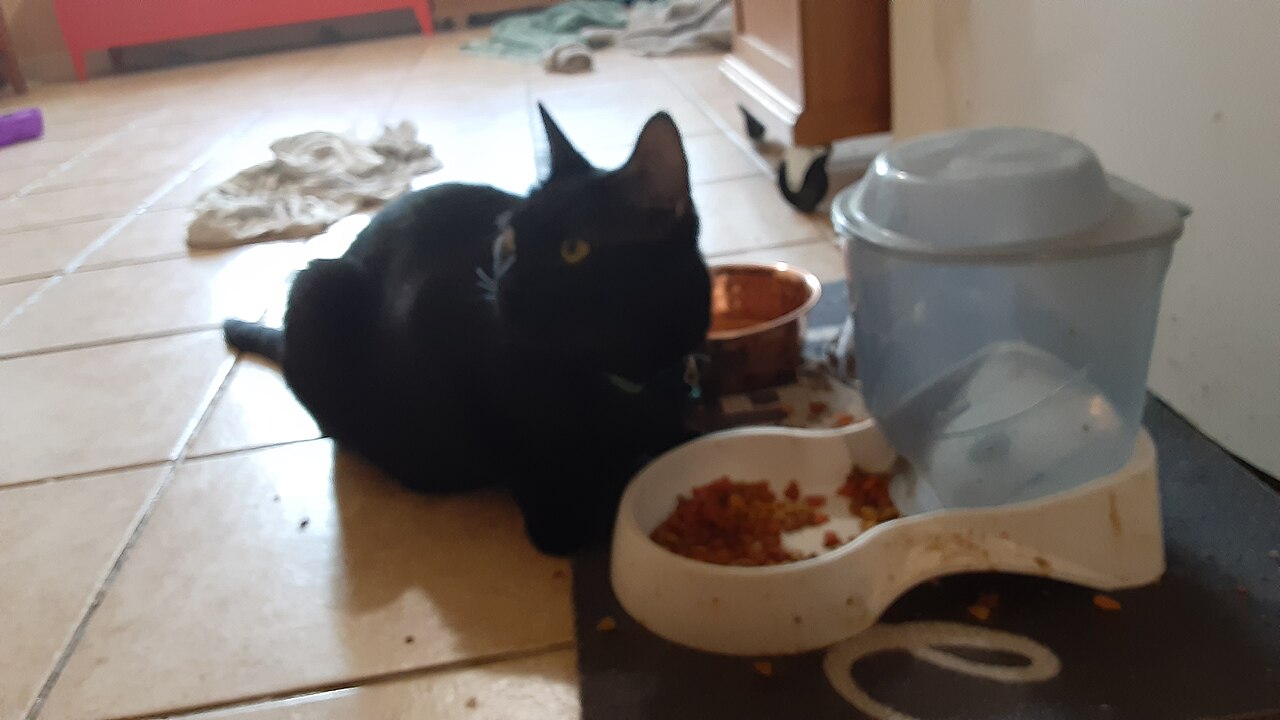
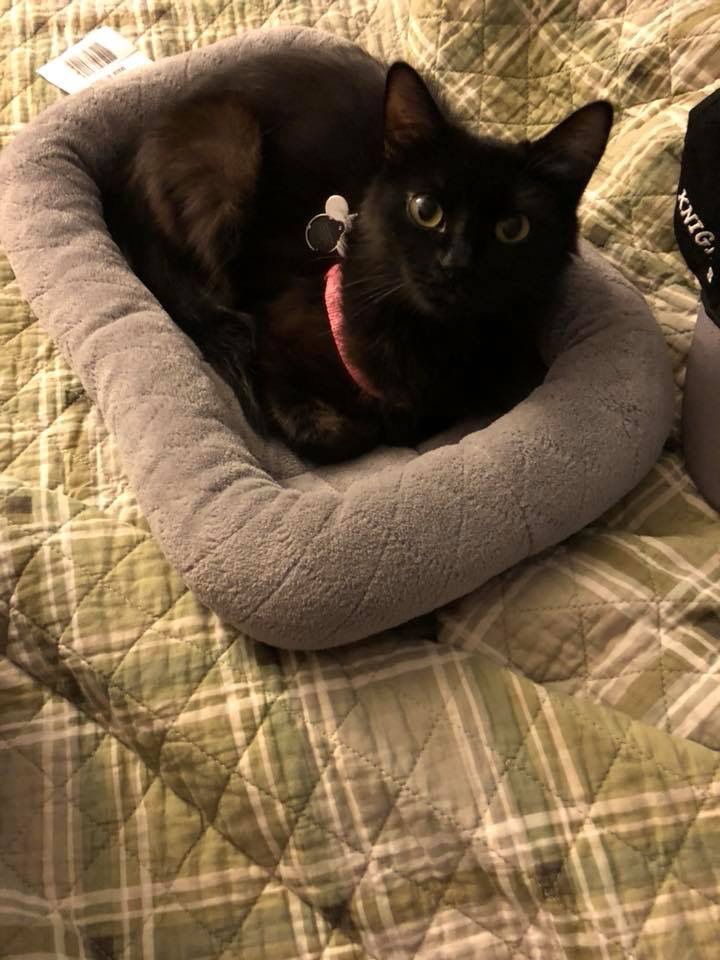
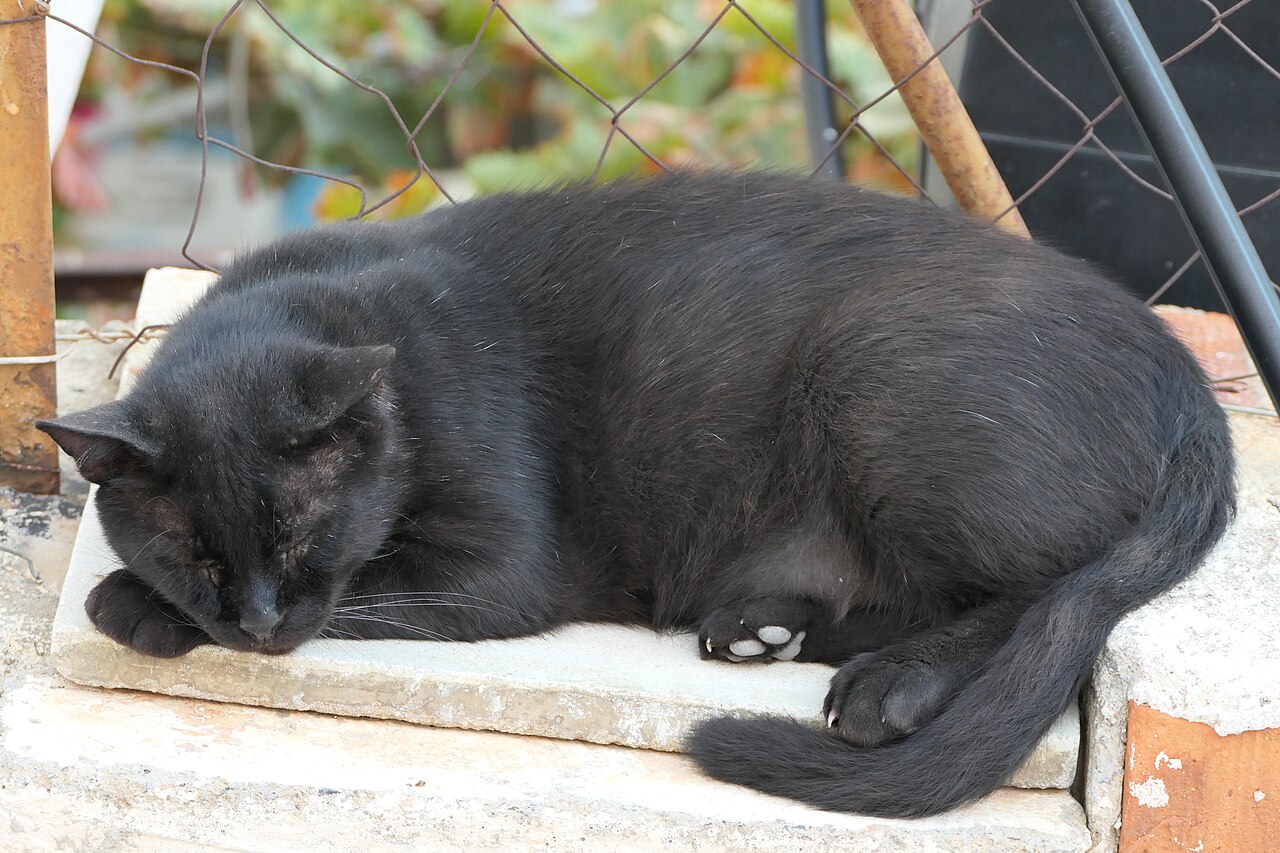
A black cat is simply a domestic cat whose fur is entirely black. It can belong to a recognized breed or be a mixed-breed cat without any specific lineage. Because of their high melanin levels, most black cats have golden eyes. These animals appear frequently in folklore, myth, and superstition, particularly in European traditions where they are linked to witches and believed to bring either good or bad luck.
The Cat Fanciers' Association (CFA) lists 22 breeds that can have solid black coats, with the Bombay being the only breed that is always black.
Regarding their coat, a cat with fur of a single color—including black—is called a "solid" or "self" cat. Solid black coats can range from coal black to grayish or brownish black. Most solid-colored cats inherit a recessive gene that hides the tabby pattern, though faint markings may sometimes appear in certain lighting. A cat with black fur and white roots is known as a "black smoke." Black cats may also "rust" in sunlight, their fur turning a lighter brownish-red. This happens because eumelanin, the pigment responsible for black fur, is fragile, and sun exposure can break it down. A rarer cause of rusting is a deficiency in the amino acid tyrosine, which is needed to produce eumelanin.
Beyond the Bombay, the CFA permits solid black as a color option in 21 other breeds. The official color description for most of these breeds is: dense coal black, sound from root to tip, with no rust on the ends; nose leather black; paw pads black or brown. Exceptions include the Oriental (called "Ebony," with no rust or smoke undercoat), the Sphynx (described simply as "black," with an even tone from nose to tail tip), and the Ragamuffin (whose standard allows any color, with or without white, so an all-black Ragamuffin is technically permitted).
Historically, black cats have been seen as positive omens in Britain and Ireland. In Celtic nations and England, a black cat crossing your path is considered good luck. The RSPCA noted in 2014 that in UK folklore, black cats symbolize good luck. Scottish lore says a black cat arriving at a new home brings prosperity, while Welsh tradition holds it brings good health. The Gaels also had tales of feral black cats, including the Scottish fairy Cat sìth, which appears as a black cat with a white chest spot.
- Symbolism
- Good luck in Britain and Ireland; bad luck in some European folklore
Lore & Background
Black cats have been historically considered bad luck in Europe, with their association with witchcraft likely stemming from the Vox in Rama, where Pope Gregory IX described a demonic ritual involving a black cat. In contrast, in Britain and Ireland, a black cat crossing one's path is considered good luck. Scottish lore holds that a black cat's arrival at a new home signifies prosperity, while Welsh lore states it brings good health. In Japan, black cats are good luck and associated with Maneki-neko. In Latvia, black cats on farms mean prosperity and a good harvest. In Italy, black cats mean upcoming good luck. In Germany, a black cat walking left to right is good luck. In Thailand, black cats are considered auspicious and bring prosperity to their owners.
Reader's Guide
Black cats hold a complex place in human culture, serving as both omens of good and bad luck across different societies. Their association with witchcraft and Halloween is well-known, but they are also seen as bringers of prosperity in many cultures. In the early days of television in the United States, stations on VHF channel 13 used a black cat as a mascot to make sport of being on an 'unlucky' channel. Since the 1880s, the black cat has been adopted as an anarchist symbol, particularly in anarcho-syndicalism, representing sabotage and direct action. The Space Shuttle program's STS-41C crew included a black cat on their mission patch after superstition avoided STS-13. Despite myths about lower adoption rates, studies have conflicting outcomes. Organizations like Cats Protection in the UK have designated October 27 as Black Cat Day, and in the US, August 17 is Black Cat Appreciation Day, to encourage adoption. The 2018 film Black Panther sparked a fad of adopting black cats and naming them after characters from the film.
Did You Know?
- The Bombay breed is exclusively black.
- Black cats can 'rust' in sunlight, turning a lighter brownish-red shade due to fragile eumelanin.
- In Scottish mythology, the Cat sìth is a fairy that takes the form of a black cat with a white spot on its chest.
- The crew of STS-41C made a humorous mission patch that included a black cat and a number 13.
Coat Genetics & the Science of Black
A black cat's coat is the product of a recessive gene that suppresses the tabby markings most cats inherit, producing what breeders call a "solid" or "self" coloration. The resulting fur can range from deep coal black to grayish or brownish black, and in certain lighting, faint tabby patterns may still ghost through the coat. A related variant, the "black smoke," features black fur over white roots. Most black cats display striking golden irises, a byproduct of the high melanin concentration in their eyes. One of the most visually notable quirks of black coats is their tendency to "rust" when exposed to sunlight. The pigment responsible—eumelanin—is somewhat fragile, so cats that spend long hours in the sun can develop a lighter brownish-red sheen. A rarer cause of this fading is a deficiency in the amino acid tyrosine, which the body needs to synthesize eumelanin in the first place.
Breed Recognition & Show Standards
The Cat Fanciers' Association acknowledges solid black as a permissible coat in twenty-two distinct breeds, making the color far more widespread than the Bombay alone might suggest. The Bombay is the only breed whose entire standard is defined by black; every other recognized variety simply permits it as one option among many. For most of those twenty-one additional breeds, the CFA standard demands a "dense coal black" coat that is sound from root to tip, with no rust on the ends, a black nose leather, and paw pads that are either black or brown. A few breeds carry slightly modified wording: the Oriental lists its black as "Ebony" and adds a prohibition on smoke undercoat; the Sphynx simply requires a single even tone from nose to tail tip; and the Ragamuffin, while never naming black explicitly, allows "any color, with or without white," which technically opens the door to an all-black specimen. This breadth of recognition means a solid black cat might be a pedigreed show animal or a common domestic shorthair with no breed designation at all.
Global Folklore, Luck & Superstition
Few animals carry as much cultural baggage as the black cat. In Britain and Ireland, the association is largely positive: Scottish tradition holds that a black cat arriving at a new home signals prosperity, while Welsh lore credits it with bringing good health. Scottish mythology even features the Cat sìth, a fairy that takes the shape of a black cat bearing a white chest spot. Across the Channel, however, the image darkens. European superstition tied black cats to witchcraft, a link scholars trace to the Vox in Rama, in which Pope Gregory IX described a demonic rite involving a black cat. Sailors, paradoxically, sought out black ship's cats for protection at sea, and fishermen's wives kept them at home for the same reason. In Japan, black cats are linked to the lucky Maneki-neko; in Thailand, the Ayutthaya-era guidebook Tamra Maew catalogued as many as nine black cat breeds; in Latvia they promise a bountiful harvest; and in Germany, direction matters—a black cat crossing left to right is fortunate. Even early American television stations on VHF channel 13 adopted black cat mascots to joke about their "unlucky" number.
Political Symbolism & Famous Individual Cats
Beyond folklore, the black cat has become a potent political and cultural symbol. Since the 1880s, black has been the color of anarchism, and a black cat in an alert, fighting stance was adopted as an emblem of anarcho-syndicalism, the labor-organizing branch of the movement. Ralph Chaplin, credited with designing the International Workers of the World's "sab cat" or "sabo-tabby," explained that it represented the "slow down" as a form of striking on the job. In 1918, testifying before a court trying IWW leaders, Chaplin described how workers used the cat to "frighten the employer" by the mere mention of sabotage. The cat also appeared in aerospace humor: when the Space Shuttle program renumbered missions to skip STS-13, the crew of what became STS-41C designed a patch featuring a black cat and the number 13; the mission succeeded and even landed on a Friday the 13th. Among famous individual cats, Gladstone serves as Chief Mouser of HM Treasury in the UK; India, also called Willie, was the cat of George W. Bush at the White House; Trim sailed with Matthew Flinders mapping Australia's coastline and now appears on statues in Australia and England; and Hodge was the cat of Samuel Johnson.
Gallery
Frequently Asked Questions
What is a black cat in witchcraft folklore?
In European folk tradition, the black cat is a domestic cat whose solid black coat and high melanin levels (which typically give it golden eyes) made it a natural emblem of the mysterious and supernatural. It became the archetypal symbol tied to witches, omens, and the occult.
What role do black cats play in witchcraft mythology?
They are most commonly portrayed as familiars—supernatural companions of a witch—or as the witch herself in shapeshifted form. They also function as omens, carrying either good or bad luck depending on the cultural tradition.
Is a black cat a good or bad omen in folklore?
In Britain and Ireland, a black cat crossing your path is traditionally a sign of good fortune. In several other European folk traditions, the same encounter is read as an ill omen or evidence that a witch is near.
Why are black cats specifically linked to witches in these stories?
Their uniformly dark fur contrasted with striking golden eyes made them seem otherworldly to medieval Europeans, who associated darkness with the occult. That visual contrast cemented their role as the quintessential witch's companion across centuries of storytelling.
Do black cats have any canonical powers in witchcraft folklore?
In most folk accounts their power is symbolic rather than literal: they embody the witch's bond with the unseen and serve as a harbinger of fortune. A few tales describe them as shapeshifters, but that ability is the witch's own power projected onto the cat rather than an independent trait.
More in Witchcraft in folklore and mythology 1-24
Spotted an error? Know more?
Reader corrections go straight into our review queue. Suggest an edit · How this site is sourced