
Hostility
Hostility as emotionally charged aggression and psychological extortion.

Richard Webb · CC BY-SA 2.0
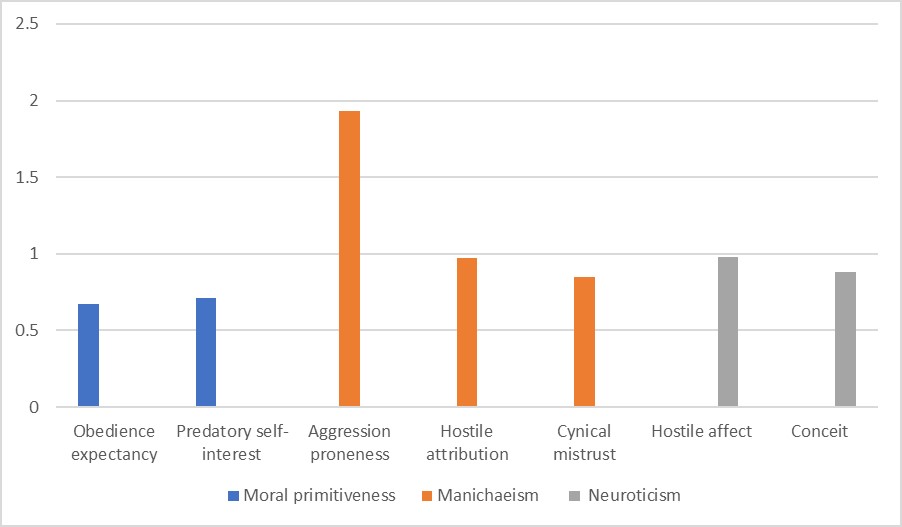
Hostility is a form of emotionally charged aggressive behavior, often used as a synonym for anger and aggression in everyday speech. It appears in several psychological theories, including as a facet of neuroticism in the NEO PI and as a key concept in George Kelly's personal construct psychology.
Quick Facts
- Field
- Psychiatry
Facts from the source article.
Lore & Background
In psychological terms, George Kelly considered hostility as the attempt to extort validating evidence from the environment to confirm types of social prediction, constructs, that have failed. Instead of reconstructing their constructs to meet disconfirmations with better predictions, the hostile person attempts to force or coerce the world to fit their view, even if this is a forlorn hope, and even if it entails emotional expenditure and/or harm to self or others. In this sense hostility is a form of psychological extortion – an attempt to force reality to produce the desired feedback, even by acting out in bullying by individuals and groups in various social contexts, in order that preconceptions become ever more widely validated.
Kelly's theory of cognitive hostility forms a parallel to Leon Festinger's view that there is an inherent impulse to reduce cognitive dissonance. While challenging reality can be a useful part of life, and persistence in the face of failure can be a valuable trait, in the case of hostility it is argued that evidence is not being accurately assessed but rather forced into a Procrustean mould in order to maintain one's belief systems and avoid having one's identity challenged. Instead it is claimed that hostility shows evidence of suppression or denial, and is 'deleted' from awareness – unfavorable evidence which might suggest that a prior belief is flawed is to various degrees ignored and willfully avoided.
Reader's Guide
Hostility is significant as a concept bridging everyday aggression and formal psychological theory. In the NEO PI, it is a facet of neuroticism, linking it to personality assessment. George Kelly's model reframes hostility not merely as anger but as a cognitive strategy: an attempt to force reality to confirm failed predictions, akin to psychological extortion. This parallels Leon Festinger's cognitive dissonance theory, highlighting how individuals may ignore disconfirming evidence to protect their beliefs. The concept also appears in broader social contexts: Robert Sapolsky argues that humans inherently form in-groups and out-groups, directing hostility at the latter, and that intra-group hostility may be reduced when external hostility is increased—a dynamic exploited by insecure leaders. Non-verbal indicators of hostility, such as teeth grinding, fist clenching, and grimacing, are considered universal, with the All Blacks haka as a ritualized example. The tension between hostility and hospitality, noted in hunter-gatherer societies and archaic Greece, remains potent in the 21st century. The legacy of hostility as a concept lies in its integration across personality psychology, cognitive theory, and social behavior, offering a lens to understand both individual and collective conflict.
Gallery



More in Violence & Conflict
Spotted an error? Know more?
Reader corrections go straight into our review queue. Suggest an edit · How this site is sourced