
Military
A heavily armed, highly organized force for warfare.

Solomon203 · CC BY-SA 3.0
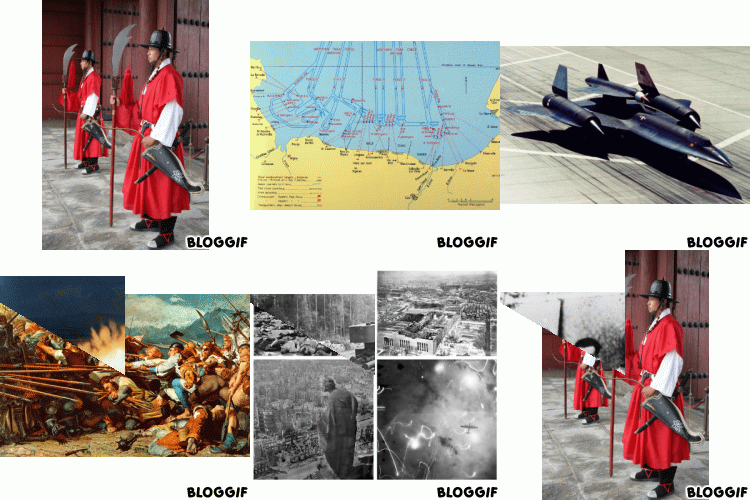
A military, often called the armed forces, is a well-armed and strictly organized group created mainly for fighting wars. Sovereign states typically authorize and support their militaries, whose members wear a recognizable uniform. These forces can include several branches, like an army, navy, air force, space force, marines, or coast guard. Their primary job is usually to protect the state and its interests from outside armed threats.
In common speech, "armed forces" and "military" mean the same thing, though technically a country's armed forces might also include paramilitary groups, such as armed police. Beyond warfare, a military can take on other roles, both approved and unapproved, within a state. These include handling internal security, controlling crowds, pushing political agendas, providing emergency services and reconstruction, protecting corporate profits, and performing social ceremonies or serving as national honor guards.
A nation's military often forms its own social subculture, with dedicated infrastructure like housing, schools, utilities, logistics, hospitals, legal services, food production, and even finance and banking. The profession of soldiering predates written history. Ancient art, such as bas-reliefs from the Battle of Kadesh in 1274 BC under Ramses II, shows the power of military leaders. The first emperor of a unified China, Qin Shi Huang, built the Terracotta Army to display his military strength. The Ancient Romans produced many writings on warfare and built numerous triumphal arches and victory columns.
The English word "military" was first recorded in 1582 as "militarie." It comes from the Latin militaris (from miles, meaning soldier) through French, though its origin is uncertain—one idea is that it comes from mil-it-, meaning "going in a body or mass." As a noun phrase, "the military" usually refers to a country's armed forces overall, or sometimes just to its senior officers. In general, it points to the physical side of armed forces: their people, equipment, and the areas they occupy. As an adjective, military originally referred only to soldiers and soldiering, but it expanded to cover land forces and everything related to their profession. The names of the Royal Military Academy (1741) and United States Military Academy (1802) show this.
Quick Facts
- Etymology
- From Latin militaris, from miles 'soldier'
- Earliest depicted battle
- Battle of Kadesh, 1274 BC
- Key ancient example
- Terracotta Army of Qin Shi Huang
- Typical minimum service period
- 2 to 6 years
Facts from the source article.
Lore & Background
The profession of soldiering is older than recorded history. Some images of classical antiquity portray the power and feats of military leaders. The Battle of Kadesh in 1274 BC from the reign of Ramses II features in bas-relief monuments. The first Emperor of a unified China, Qin Shi Huang, created the Terracotta Army to represent his military might. The Ancient Romans wrote many treatises and writings on warfare, as well as many decorated triumphal arches and victory columns.
A Four-Tier Hierarchy of Active Wars
The global inventory of ongoing armed violence is organized into four distinct tiers, each defined by the number of direct, violent deaths recorded in the current or previous calendar year. At the top sit major wars, a category reserved for the eight conflicts that have produced ten thousand or more combat-related deaths in a single year. Below them, twelve minor wars register between one thousand and nine thousand nine hundred ninety-nine deaths; the Uppsala Conflict Data Program specifically designates any conflict crossing the one-thousand-death mark as a war. The third tier, simply labeled conflicts, encompasses sixteen engagements with one hundred to nine hundred ninety-nine annual deaths. The lowest rung, skirmishes and clashes, holds twelve further entries where annual fatalities remain below one hundred. This graduated structure allows researchers, policymakers, and the public to distinguish between catastrophic, society-destroying wars and lower-intensity but still organized armed confrontations, giving each level of violence an appropriate scale of attention.
Gallery
Frequently Asked Questions
What is a Military?
A military is a heavily armed, tightly organized force built around the purpose of waging war. Sovereign states typically authorize and back these forces, and their members wear a distinctive uniform to identify them.
What branches can make up a Military?
A full military structure may encompass several distinct branches, such as an army, navy, air force, space force, marines, or coast guard. In everyday language, "armed forces" and "military" are used interchangeably, though technically armed forces can also cover paramilitary units.
What is the core role of a Military?
The central mission is to defend a state and its interests against external armed threats. Members typically commit to a minimum service period ranging from two to six years.
Where does the term "Military" come from?
The word traces back to the Latin "militaris," which itself derives from "miles," meaning soldier. It first appeared in written English in 1582.
What is the earliest known depiction of a military battle, and what's a key ancient example?
The Battle of Kadesh, fought in 1274 BC, holds the distinction of being the earliest battle for which we have surviving visual depictions. A standout ancient example of large-scale military organization is the Terracotta Army commissioned by Qin Shi Huang.
More in Violence & Conflict
Spotted an error? Know more?
Reader corrections go straight into our review queue. Suggest an edit · How this site is sourced