
Hate crime
Criminal offense motivated by bias against a social group.

Our World In Data · CC BY 4.0
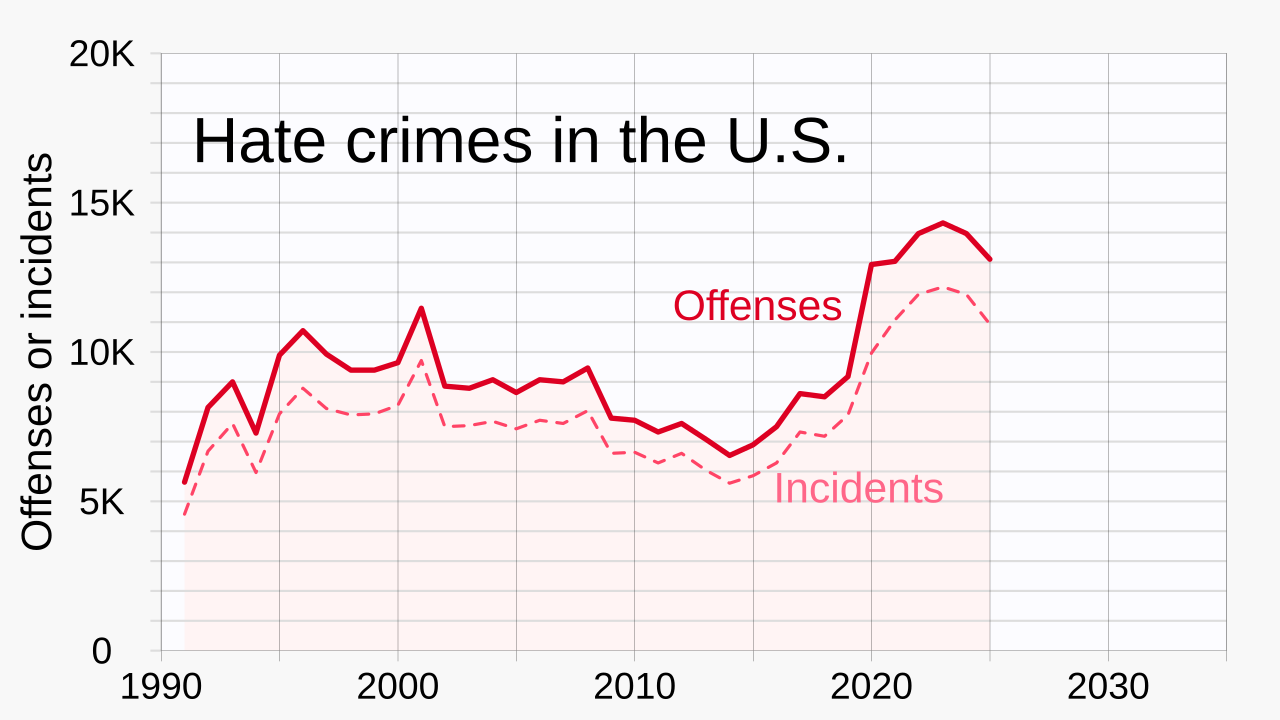
A hate crime is a standard criminal offense, such as assault or murder, that includes an added element of bias against a victim based on their physical appearance or perceived membership in a certain social group. The term emerged in the United States in the mid-1980s, reflecting increased consciousness of race, gender, and sexual orientation, and has since been adopted internationally by organizations such as the OSCE and the UN. Hate crime laws enhance penalties for conduct already criminal under other laws, distinguishing them from laws against hate speech.
Quick Facts
- First legislative use
- Hate Crime Statistics Act, 1990
Facts from the source article.
Lore & Background
The term 'hate crime' was used by U.S. Representatives Barbara Kennelly, John Conyers, and Mario Biaggi in 1990 via the 'Hate Crime Statistics Act'. Journalists and activists had used similar formulations earlier; the Anti-Defamation League began using 'hate crime' systematically around the same time. The term gained prominence following a 1986 incident in Howard Beach, New York, where a Black man was killed in a racially motivated attack. Internationally, the OSCE has worked to standardize terminology, with 'hate crime' as the preferred English term in its documents. The UN uses 'hate crime' alongside 'bias-motivated crime' and 'crimes motivated by prejudice'. Common law countries tend to use 'hate crime' or 'bias crime', while civil law European countries use 'aggravated discrimination'.
Reader's Guide
Hate crimes have significant psychological consequences beyond the initial offense, affecting not only direct victims but also members of the targeted group and other vulnerable groups. Victims often experience heightened vulnerability, depression, anxiety, and symptoms of trauma, including PTSD. A 1999 U.S. study found that homosexual victims of violent hate crimes experienced higher levels of psychological distress than victims of comparable non-bias crimes. Sociologists Jack McDevitt and Jack Levin identified four motives for hate crimes: thrill-seeking (66% of U.S. cases), defensive, retaliatory, and mission offenders. Mission offenders are considered the rarest and deadliest form, often overlapping with terrorism. Hate crimes can reduce educational attainment among affected groups and damage community cohesion, particularly in multicultural societies.
Gallery

Frequently Asked Questions
What is a hate crime?
A hate crime is a standard criminal act—like assault or homicide—that carries an additional bias element because the victim was targeted for their appearance or perceived membership in a social group. It is not a standalone offense but an aggravating layer applied to an already-illegal act.
Where did the term 'hate crime' originate?
The phrase entered U.S. public and legal discourse in the mid-1980s as awareness of race, gender, and sexual-orientation bias grew. It was subsequently adopted by international bodies such as the OSCE and the United Nations.
How do hate crime statutes differ from hate speech laws?
Hate crime laws raise the penalty for conduct that is already criminal under general statutes, while hate speech laws regulate expression that may not be a crime at all. They operate on fundamentally different legal principles.
What was the first U.S. legislation to formally use the term 'hate crime'?
The Hate Crime Statistics Act of 1990 was the first federal law to incorporate the phrase, requiring the collection of data on bias-motivated offenses.
More in Violence & Conflict
Spotted an error? Know more?
Reader corrections go straight into our review queue. Suggest an edit · How this site is sourced