
Galaxian 2
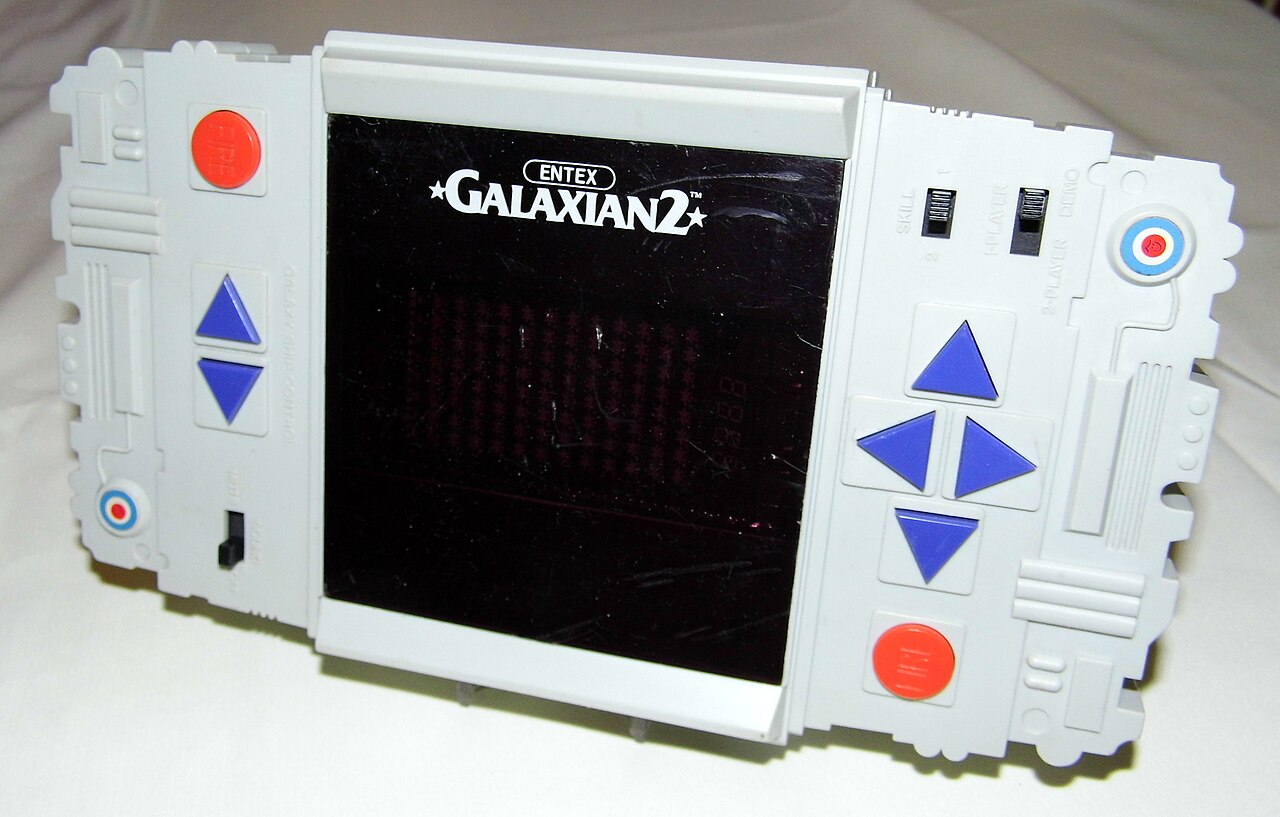
Handheld two-player space shooter with a Battlestar Galactica-style case.

Joe Haupt from USA · CC BY-SA 2.0
Galaxian 2 is a handheld electronic game released in 1981 by Entex Industries in the United States. It was also released the same year in Japan under the name Astro Galaxy and in Europe under the name Astro Invader, and under the Futuretronics brand in Australia. The game is notable for its two-player mode, which distinguishes it from single-player handhelds of the era, and for its case designed to resemble the exterior of a spaceship reminiscent of Battlestar Galactica.
Quick Facts
- Title
- Galaxian 2
- Released
- NA · 1981
- Publisher
- Entex Industries
- Series
- Galaxian
- Modes
- Single-player, multiplayer
- Genre
- Fixed shooter
- Platform
- Handheld
Facts from the source article.
Lore & Background
Galaxian 2 is based on the Galaxian arcade game, where the player shoots at waves of attacking aliens that launch kamikaze attacks. The player's ship is called the Galaxy ship. In two-player mode, one player controls the Galaxy ship and the other player acts as the opponent, controlling the attacking aliens. The game offers two user-selectable skill levels. The maximum score displayable is 9,999 points, which wraps around to 0000. The case is designed to look like the exterior of a spaceship, reminiscent of Battlestar Galactica. Holding down the 'missile' button while turning the game on initiates a graphical test, and the game has simple sound effects that can be turned off.
Reader's Guide
Galaxian 2 was included in Games magazine's 'Top 100 Games of 1981', with the comment that it 'goes light years beyond' Entex's Space Invaders. Jaro Gielens, author of the book Electronic Plastic, described the game as an 'Excellent 2-player space shooter, with very special case design'. The game's legacy includes an appearance of the Futuretronics version in the 2005 film Doom. Its two-player mode and distinctive spaceship-shaped case set it apart from other handheld electronic games of its time, and it remains a notable example of early portable gaming hardware that attempted to replicate arcade-style gameplay in a self-contained unit.
Did You Know?
- Galaxian 2 is not a sequel; there is no Entex Galaxian.
- The Futuretronics version of the game appears in the movie Doom (2005).
Design Philosophy & Creative Origins
Kazunori Sawano, an engineer who had previously contributed to Namco's electro-mechanical shooting galleries such as Shoot Away in 1977, was handed a high-stakes assignment. After Taito's Space Invaders swept Japan and turned the video game industry into a lucrative business, Namco president Masaya Nakamura pressured Sawano to deliver the definitive post-Invaders title. Although the formal development window spanned six months, Sawano had been sketching concepts roughly half a year before production officially began. His guiding principle was deceptively straightforward: simple is best. That philosophy led the team to discard ambitious large-scale ideas in favor of a tightly looped experience built around just two enemy types. The space combat sequences in Star Wars served as a major creative wellspring, and Sawano initially envisioned the alien enemies as replicas of the film's TIE Fighters. He also obsessed over audio, rejecting numerous sound-effect iterations until they captured the visceral feel of a space battle he had in mind. Notably, Galaxian became Namco's first arcade title to feature a fully synthesized musical score.
Combat Loop & Mechanical Rhythm
At its core, Galaxian is a fixed shooter in which the pilot commands the Galaxip starship against successive waves of hostile aliens arrayed in formation near the top of the screen. Each formation includes two escort vessels identified as the Galaxian Flagship, or Galboss, each requiring a single hit to destroy. The remaining enemies, called Galaga, periodically break from the formation to execute dive-bomb runs toward the player's ship while simultaneously firing projectiles. A key hardware constraint shapes the combat rhythm: the Galaxip can only have one shot in flight at any moment, so the player must wait for that bullet to either strike an enemy or vanish off the top of the screen before firing again. Collision with any alien or its projectile costs a life, and the run ends when all lives are exhausted. Destroying a full trio of a flagship plus its two red escorts earns a bonus, with the flagship itself carrying the highest point value. As rounds advance, tracked by small flag icons along the bottom edge, both enemy speed and the volume of hostile fire escalate. The attract-mode screen sets the tone with the tagline: WE ARE THE GALAXIANS. MISSION: DESTROY ALIENS.
Commercial Triumph & Industry Shake-Up
Galaxian marked a watershed moment for Namco, becoming the company's first major arcade video game hit. Released in Japanese arcades on September 15, 1979, it climbed to the second-highest-grossing arcade title in Japan for both 1979 and 1980. Its international rollout was equally impressive: after Namco demonstrated the game to Midway Manufacturing on October 17, 1979, Midway—then searching for a new publishing partner following the loss of its Taito relationship—secured the rights and unveiled the cabinet at a trade show in November. A broad North American launch followed in February 1980, a move that bolstered Midway's market position and directly challenged Atari's dominance. By 1982, roughly 50,000 arcade units had been sold, cementing Galaxian as one of the best-selling arcade games of all time. To sustain demand in Japan, Namco licensed cabinet production to other manufacturers, including Taito and Irem. The game's commercial triumph also spawned a lineage of sequels and reimaginings, most prominently Galaga in 1981, which ultimately eclipsed its predecessor in popularity, alongside numerous home-system ports and appearances in Namco compilation collections.
Hardware Innovation & Historical Legacy
Beyond its gameplay, Galaxian's lasting significance lies in the hardware and software innovations it introduced to the arcade landscape. It stands among the earliest video games to render true RGB color graphics, a visual leap that set it apart from the monochrome or limited-palette titles that preceded it. More fundamentally, it was the first game to employ a tile-based display architecture. Programmers constructed the screen from a grid of 8×8 pixel tiles, a design that slashed both processing load and memory consumption by as much as a factor of sixty-four compared to the framebuffer approach used in Space Invaders. This same hardware also enabled animated multi-color sprites and a scrolling capability, though in practice the scrolling was reserved for the drifting starfield backdrop while the combat itself remained fixed. The title also broke new ground in audio, becoming Namco's first arcade game to feature a fully synthesized musical score. In retrospect, these technical achievements, combined with its celebrated gameplay and vivid color presentation, have secured Galaxian's place as one of the most important titles of the golden age of arcade video games.
Gallery
Frequently Asked Questions
What is Galaxian 2?
Galaxian 2 is a handheld electronic space shooter produced in 1981 by Entex Industries for the U.S. market. It is a two-player game housed in a case styled to look like the hull of a spaceship, evoking the aesthetic of Battlestar Galactica.
What was Galaxian 2 called outside the United States?
The same 1981 handheld shipped as Astro Galaxy in Japan and Astro Invader across Europe. In Australia it was marketed under the Futuretronics brand name.
What made Galaxian 2 stand out among 1981 handhelds?
Its two-player mode set it apart from the mostly single-player LCD and VFD units of that era. Combined with its distinctive spaceship-shaped casing, it offered a more social and visually striking experience than typical pocket games of the time.
What kind of display does Galaxian 2 use?
The unit features a fixed three-color vacuum fluorescent display arranged in a grid of eight columns by twelve rows. This limited but colorful matrix is what renders the on-screen spacecraft and enemy formations.
Who published Galaxian 2 in the U.S.?
Entex Industries handled the 1981 U.S. release of the handheld. It was not a product of Namco or any arcade manufacturer, despite the 'Galaxian' branding in its title.
More in Video Game Consoles by Generation, Part 6 1-24
Spotted an error? Know more?
Reader corrections go straight into our review queue. Suggest an edit · How this site is sourced