
Entex Select-A-Game
A cartridge-based handheld with processor-in-cartridge design.

Jarkof01 · Public domain
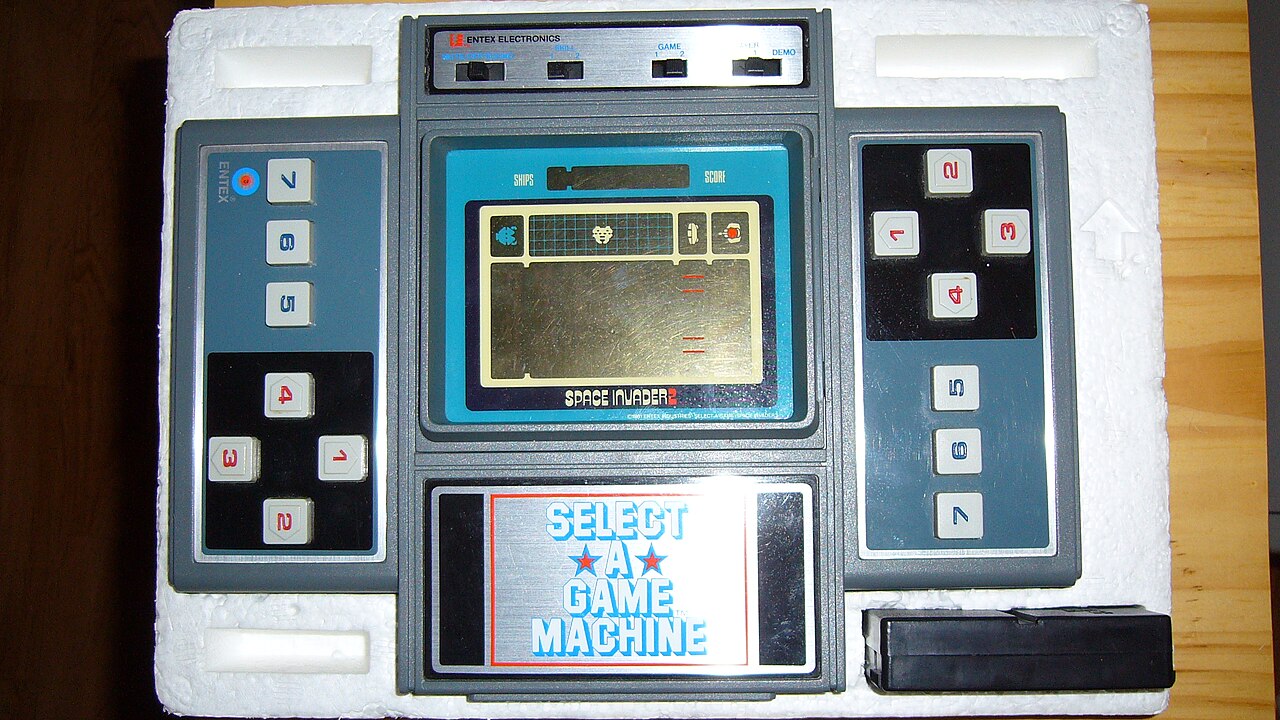
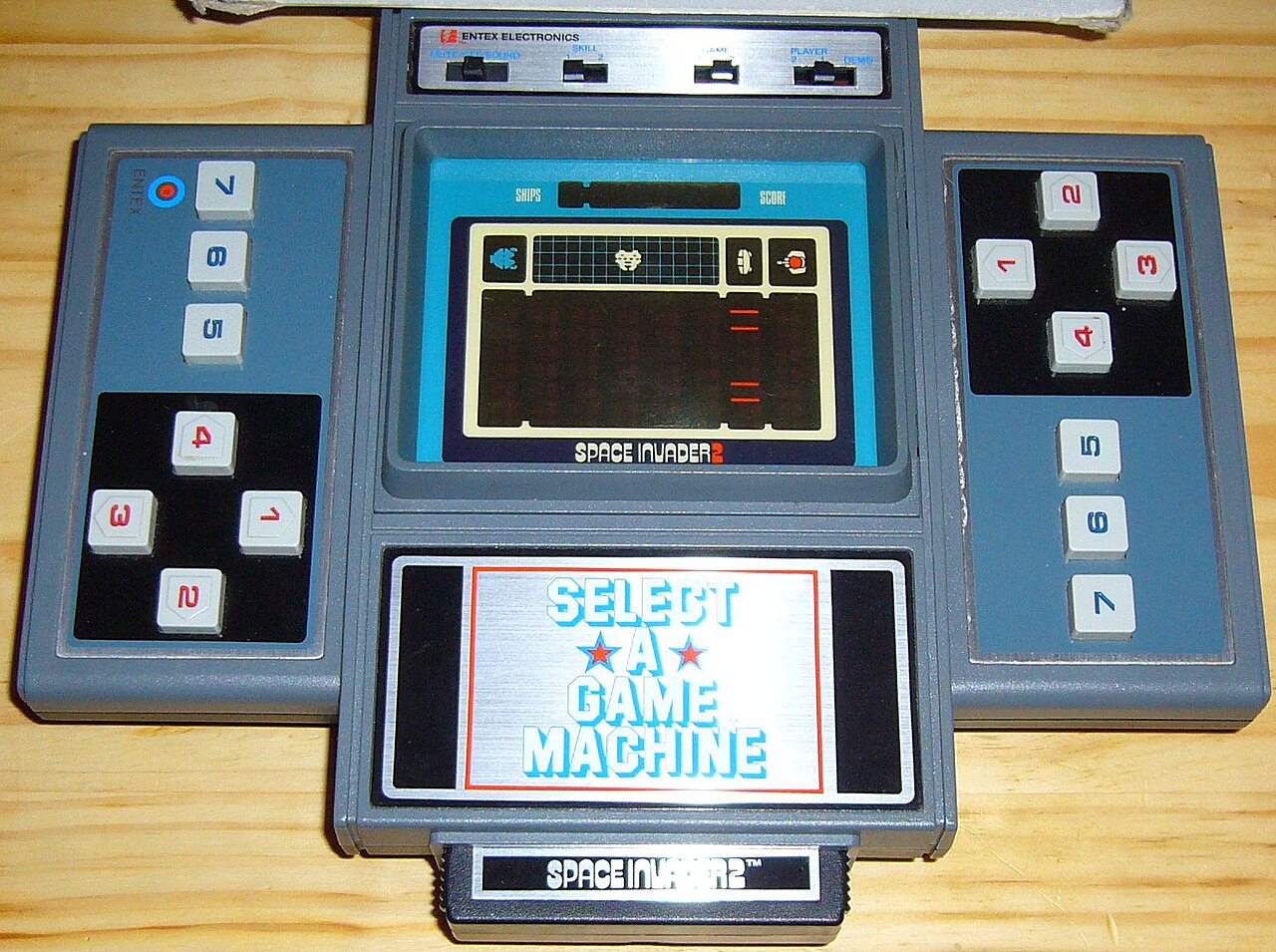
The Entex Select-a-Game is a handheld game system released in 1981 by Entex Industries. It uses a 7 x 16 vacuum fluorescent display (VFD) array of large dots that can display two colors, red and blue, combined with static overlays for each game. The system has no built-in processor; each game cartridge contains its own microprocessor programmed with the appropriate game code, a concept similar to Milton Bradley's Microvision system.
Quick Facts
- Manufacturer
- Entex Industries
- Generation
- Second generation
- Successor
- Entex Adventure Vision
Facts from the source article.
Lore & Background
The Entex Select-a-Game was released in 1981 by Entex Industries. The system's display is a 7 x 16 vacuum fluorescent display (VFD) array of large dots capable of showing red and blue, which are combined with static overlays for each game. The system itself contains no processor; instead, each game cartridge houses its own microprocessor programmed with the game code, making it architecturally similar to the Milton Bradley Microvision from a few years earlier. Power is supplied by four C batteries or an external A/C power supply available only by mail-order.
Six games were released for the system: Space Invader 2 (which came with the system), Basketball 3, Football 4, Pinball, Baseball 4, and Pacman 2. Two additional games, Battleship and Turtles, were not released. In late 1981, Entex was sued by Coleco, who held the licensing rights to handheld versions of Pac-Man at the time, for copyright infringement over the upcoming release of Pacman 2. The game was pulled shortly after release as part of the settlement, making Pacman 2 the rarest game released for the system. Entex dropped support for the Select-a-Game in 1982 in favor of the Entex Adventure Vision.
Reader's Guide
The Entex Select-a-Game is notable for its unusual architecture: rather than a central processor, each game cartridge contains its own microprocessor, a design shared with the earlier Milton Bradley Microvision. This approach allowed the base unit to remain simple, functioning primarily as a display and controller shell. The system's vacuum fluorescent display, capable of red and blue dots, was paired with static overlays to create game visuals. Entex released six cartridges before discontinuing the system in 1982 to focus on the Adventure Vision. The legal dispute with Coleco over Pacman 2 led to that game being pulled from shelves shortly after release, making it the rarest title in the library. The system's reliance on cartridge-contained processors and its short commercial life place it as a transitional design in early handheld gaming.
Did You Know?
- Pacman 2 was pulled shortly after release due to a copyright infringement lawsuit from Coleco.
- Two games, Battleship and Turtles, were planned but never released.
The Microprocessor Revolution
The second generation of home consoles (1976–1992) was defined by a single technological leap: the affordable microprocessor. Earlier arcade machines and first-generation home systems depended on discrete components—TTL-based integrated circuits or custom ASICs like the AY-3-8500—that baked one fixed logic program into silicon. Once shipped, a unit's behavior was essentially frozen, with only minor adjustments possible via jumper positions. Atari's leadership saw that spending $100,000 to $250,000 and months of engineering on a dedicated hardware unit that would be outdated in about three months was not a viable business model. Intel's 4004 microprocessor, introduced in 1971, offered a way out: instead of hardwiring game logic into circuits, engineers could write software around a general-purpose chip. As microprocessor prices fell, teams at Atari's Cyan Engineering subsidiary and at Alpex Computer Corporation recognized the potential for home consoles. Alpex partnered with Fairchild Camera and Instrument to ship the Fairchild Channel F in 1976, built on the Fairchild F8 and establishing the ROM cartridge as the standard software delivery format. Atari followed in 1977 with the VCS, powered by the MOS Technology 6507, and rival manufacturers soon adopted the same programmable approach.
The Cartridge Ecosystem and the Birth of Third-Party Development
At the start of the second generation, every game was developed and produced in-house by the console manufacturer. That changed in 1979 when four former Atari programmers, frustrated by management conflicts that arose after Warner Communications acquired Atari in 1976, founded Activision to publish their own VCS titles. Activision became the first true third-party video game developer, a small operation through the 1980s that would eventually grow into a 21st-century gaming giant. The cartridge format made this possible: the Fairchild Channel F had established the model of a ROM chip mounted on a circuit board inside a hard casing designed to survive repeated insertion and static discharge, and most subsequent systems adopted similar technology. The popularity of game cartridges surged after the Atari 2600's release, and from the late 1970s through the mid-1990s, cartridges remained the dominant delivery method until optical discs eventually replaced them. In the early 1980s, the visible success of the home market—especially the VCS—spurred many large corporations to launch or acquire subsidiaries dedicated to producing console software, dramatically expanding the number of titles available to consumers.
Arcade Roots and the Home Console Pipeline
The second generation existed in close dialogue with the golden age of arcade video games, and that relationship shaped what players experienced at home. Because the era was partly fueled by arcade popularity, many games for second-generation home consoles were direct ports of arcade titles. Space Invaders holds a special place as the first so-called killer app arcade game to be ported to a home system, arriving for the Atari 2600 in 1980, though earlier Atari-published arcade titles had been adapted for the 2600 before that. Coleco took a different approach when it launched the ColecoVision in August 1982, bundling Nintendo's Donkey Kong with the console to give buyers an immediate marquee title. The generation also expanded the medium's reach into handheld territory. Nintendo's entry into gaming, guided by Gunpei Yokoi's Blue Ocean philosophy, produced the Game & Watch in 1980, while Milton Bradley, a toy company, released the Microvision in 1979—the inaugural handheld system to use game cartridges. By the end of the era, more than fifteen different consoles had entered the market, and improvements in screen resolution, color graphics, audio, and AI simulation had pushed home experiences closer to their arcade counterparts.
Saturation and the 1983 Crash
The very success of the second generation sowed the seeds of its collapse. By 1982, toy store shelves were overflowing with an overabundance of consoles, over-hyped game releases, and low-quality titles from new third-party developers who had rushed into the market. The combination of over-saturation and poor understanding of consumer demand proved fatal. The video game industry crash of 1983, beginning in December 1982 and stretching through all of 1984, caused major disruption to the North American market. Some developers collapsed entirely, and the development of new console games slowed to a crawl. By mid-1985, the number of console games announced for release in the United States had effectively dropped to zero. The market did not fully recover until the arrival of the third generation. The second generation itself drew to a close in 1992, marked by the discontinuation of the Atari 2600—the last major system of that era to be retired. The crash left a scar on the industry that would influence how future generations approached market expansion, quality control, and consumer trust.
Gallery
Frequently Asked Questions
What is the Entex Select-A-Game?
It is a handheld game console that Entex Industries released in 1981. It features a 7-by-16 vacuum fluorescent dot-matrix screen that renders graphics in red and blue, with a printed plastic overlay on each cartridge defining the specific game's visuals.
How does the Entex Select-A-Game's cartridge system work?
The handheld body itself contains no central processor whatsoever. Each game cartridge carries its own dedicated microchip with the game's code already programmed in, a design approach very similar to Milton Bradley's Microvision from the same period.
What games were released for the Entex Select-A-Game?
Six titles reached the market: Space Invader 2, Basketball 3, Football 4, Pinball, Baseball 4, and Pacman 2. Two additional games, Battleship and Turtles, were planned but never actually shipped to consumers.
How is the Entex Select-A-Game powered?
For portable use it runs on four C-size batteries. An external A/C power adapter was also offered, but it could only be obtained through a mail-order catalog rather than purchased in a retail store.
Why is the Entex Select-A-Game notable among early handhelds?
Its two-color red-and-blue vacuum fluorescent display was a visually distinctive choice for 1981, setting it apart from the monochrome LCD screens of most contemporaries. The processor-in-cartridge architecture also made it a rare American example of that particular design philosophy.
More in Video Game Consoles by Generation, Part 6 1-24
Spotted an error? Know more?
Reader corrections go straight into our review queue. Suggest an edit · How this site is sourced