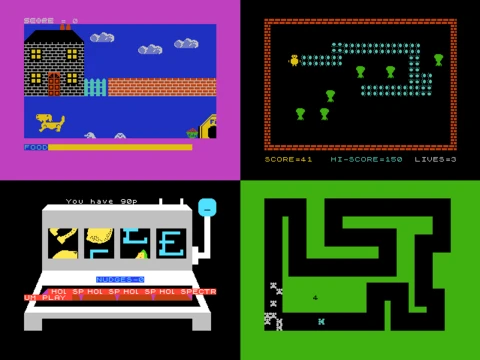
Video game compilation
Bundled collections preserving multiple video games.

A video game compilation bundles multiple games together for sale as a single collection. These games are typically stored on one physical disc or cartridge, or within a single digital download, and are accessed through a menu that lets players pick which title to play. Such collections serve as a means of preserving video games.
For the Nintendo Entertainment System, official multicart compilations reissued earlier titles, including *Super Mario Bros. / Duck Hunt / World Class Track Meet*. In the early 1990s, unlicensed publisher Codemasters used multicarts to release new games through its Quattro series. Active Enterprises’ *Action 52* became notorious for its poor quality. Pirate NES compilations often featured ROM hacks that swapped character sprites.
A resurgence of interest in retro gaming during the 1990s led companies to commercially re-release their back catalogs as compilations, such as *Microsoft Arcade* (1993) for Windows, and the 1995 releases of the first *Atari 2600 Action Pack* titles for home computers and the *Namco Museum* series for the PlayStation. Console compilations gathered older arcade games, like *Arcade's Greatest Hits* and *Williams Arcade's Greatest Hits*, while Windows computers got collections of console games, such as *Sonic & Knuckles Collection*. The 1991 arcade machine *Three Wonders* is notable for being a single arcade title with three distinct game modes, not a compilation of separate pre-existing games.
Renewed retro gaming interest in the 2010s and 2020s spurred further compilations, including *Teenage Mutant Ninja Turtles: The Cowabunga Collection* and the *Irem Collection* series.
- Field
- Video game packaging and preservation
- Known for
- Bundling multiple games into one product
- First notable example
- Super Mario Bros. / Duck Hunt / World Class Track Meet (Nintendo Entertainment System)
Lore & Background
The Nintendo Entertainment System received official multicart compilations that re-released earlier games, such as Super Mario Bros. / Duck Hunt / World Class Track Meet. In the early 1990s, Codemasters, an unlicensed publisher, used multicarts to release new games in their Quattro compilations. Action 52, released by Active Enterprises, is infamous for its low quality. Pirate Nintendo compilations often included ROM hacks that replaced character sprites.
Following a new interest in retro gaming in the 1990s, companies began re-releasing their back catalog in video game compilations commercially, such as Microsoft Arcade (1993) for Windows, and the 1995 releases of the first games in the Atari 2600 Action Pack series for home computers and the Namco Museum series for the PlayStation. Video game consoles saw compilations of older arcade games, such as Arcade's Greatest Hits and Williams Arcade's Greatest Hits, while Windows computers received compilations of console games, such as the Sonic & Knuckles Collection. Three Wonders is often mistaken for a compilation, but it is actually a single arcade title with three game modes, not a collection of distinct previously released games.
Renewed interest in retrogaming has motivated the release of multiple compilations in the 2010s and 2020s, such as Teenage Mutant Ninja Turtles: The Cowabunga Collection and the Irem Collection series.
Reader's Guide
Video game compilations serve as a key method of video game preservation, allowing older titles to remain accessible on modern platforms. They emerged on the Nintendo Entertainment System with official multicarts and expanded through unlicensed publishers like Codemasters, whose Quattro compilations offered new games. The infamous Action 52 highlighted quality issues, while pirate compilations often altered game content. The 1990s retro gaming boom drove commercial re-releases of back catalogs, including Microsoft Arcade for Windows and the Atari 2600 Action Pack and Namco Museum series. Consoles received arcade compilations like Arcade's Greatest Hits, and Windows got console game collections such as Sonic & Knuckles Collection. The arcade machine Three Wonders was notable as a compilation of three games. In the 2010s and 2020s, renewed retrogaming interest spurred collections like Teenage Mutant Ninja Turtles: The Cowabunga Collection and the Irem Collection series. These compilations help preserve gaming history by bundling multiple titles into one package, often with menu interfaces for easy selection.
Commercial Triumph and Industry Recognition
Contra's 1987 arcade launch proved to be a global commercial phenomenon. In the United States alone, it climbed into the top four highest-grossing dedicated arcade titles for that year, a remarkable achievement for a new entrant in the run-and-gun space. Konami capitalized on that momentum by shipping a home version for the Nintendo Entertainment System in 1988, followed by ports to a range of home computer platforms, including the MSX2. The NES release was met with both critical praise and strong consumer demand; Electronic Gaming Monthly singled it out as the Best Action Game of 1988, a distinction that underscored how well the arcade experience translated to a living-room setting. The franchise's staying power was evident in the fact that Konami went on to produce several sequels, ensuring that the red-falcon-themed commandos remained a fixture of gaming culture well beyond their initial debut.
A Revolution in Player Control and Perspective
Few arcade titles of the late 1980s demanded as much from their players as Contra. The game shifts between three distinct camera perspectives across its stages: a classic side-scrolling view, a pseudo-3D mode where the soldier advances toward the background while also strafing left and right, and a fixed-screen format in which the gun defaults to an upward aim. The control scheme pairs an eight-way joystick with two action buttons—one for firing, one for jumping—and the joystick simultaneously governs movement and aiming. A signature quirk is the jump itself: rather than a conventional hop, the character tucks into a full somersault, and while airborne the player can fire in all eight directions, including straight down. Pressing the stick downward while grounded drops the commando into a prone position, letting him duck under enemy fire and target low-lying threats. This layered input system, combined with the ability for two players to operate Bill and Lance simultaneously, gave Contra a depth of mechanical expression that set it apart from its contemporaries.
Seven Stages of Escalating Chaos
The arcade build of Contra unfolds across seven stages, each pairing a traversal section with a base assault and a boss confrontation. Stage one drops the player into a jungle, pushing through enemy lines to a large sensor that guards the first base. Stage two flips to a pseudo-3D view inside that base, where a timer and a map display track progress through passageways; destroying a generator at the far end of each corridor deactivates an electric barrier. Stage three locks the camera on the base's core, where the player must dismantle a defense system before facing a giant eyeball that hurls fireballs. Stages four through six repeat this three-beat structure with new settings: a vertically scrolling waterfall climb, another 3D base crawl, and a boss fight against a pair of heads that split into two images each and can only be damaged when those images realign. The seventh stage returns to side-scrolling, carrying the player through a snowfield, an energy plant, and a hangar before the alien lair, where otherworldly creatures replace human soldiers. The final target is a cardiac creature that must be destroyed to complete the mission.
A Name That Crossed Borders
Contra's journey across international markets produced a fascinating patchwork of names and regional tweaks. In Europe, the arcade and home-computer versions were rebranded as Gryzor, while the NES edition shipped under the title Probotector in the PAL region. The Japanese arcade cabinet displayed the title in kanji characters, distinguishing it cosmetically from the American build, though the two were otherwise virtually identical. A more substantive regional difference appeared in the European arcade version of Gryzor: rather than allowing two players to fight side by side in simultaneous co-op, it restricted the experience to alternating turns, one player at a time. These localization choices—new titles, altered text, and in one case a fundamental shift in how multiplayer functioned—meant that players in different parts of the world encountered meaningfully different versions of what was, at its core, the same 1987 Konami arcade experience. The home ports, including the MSX2 and various other computer formats, further widened the game's geographic and demographic reach.
Frequently Asked Questions
What is a video game compilation?
A video game compilation is a single retail or digital product that packages several separate games together, typically on one disc, cartridge, or download. Players choose which title to launch through a shared menu rather than needing a separate physical item for each game.
What was the first notable video game compilation?
The Super Mario Bros. / Duck Hunt / World Class Track Meet multicart for the Nintendo Entertainment System is widely regarded as one of the earliest official examples of the format. It reissued three earlier NES titles on a single cartridge.
How do video game compilations work in practice?
All bundled games are stored on one physical medium or delivered as a single digital download, and a common menu lets the player pick which title to load. This eliminates the need to own or swap out multiple discs or cartridges.
Why are video game compilations important for preservation?
By keeping several games accessible in one ongoing product, compilations help ensure older titles remain available to new and returning players. They serve as a practical preservation mechanism, especially for games that might otherwise go out of print.
Did unlicensed publishers use video game compilations?
Yes. In the early 1990s, Codemasters employed multicart compilations to ship new games on the NES through its Q-series line, showing the format extended well beyond official first-party releases.
More in Video game compilations 1-24
Spotted an error? Know more?
Reader corrections go straight into our review queue. Suggest an edit · How this site is sourced