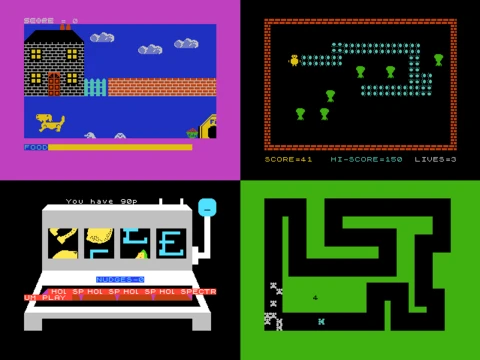
Cassette 50
A 50-game BASIC compilation notorious for its poor quality.

Cassette 50, sold in Spain as *Galaxy 50 - 50 Excitantes Juegos*, was a game compilation released by Cascade Games in 1983 for various 8-bit home computers. Its marketing emphasized the sheer number of titles included, though all were written in BASIC and widely considered low quality. The instructions claimed the games would "provide many hours of entertainment for all the family at a fraction of the cost of other computer games." The compilation saw heavy advertising in home computer magazines, and each purchase came with a free Timex digital calculator watch.
In an interview, Matthew Lewis, who created the game *Galaxy Defence*, said he wrote it at age 14 after responding to a small, anonymous ad in a local newspaper. He was paid £10 for his work but had to surrender all rights. The game took 12 hours to code, and his father, Ernest Lewis, handled the graphics.
The games included varied by platform, all coded in BASIC. Some titles, like *Star Trek* and *Maze Eater*, appeared on every version. Others, such as *Lunar Lander*, were ports or clones of earlier or popular games, while some came from independent developers. Certain games with the same name were completely different depending on the platform, and some suffered from playability issues.
On the Acorn Electron version, the games *Exchange* and *The Force* were listed on the inlay but missing from the cassette, leaving only 48 games. The Dragon 32 version had a second release with altered versions of some games. In the Commodore 64 version, *Tunnel Escape* is credited as such on the inlay but appears as *Escape or Bust* in the game itself. The BBC Micro version mistakenly lists *Dice Thrower* as *Do Your Sums* on the inlay. On the ZX Spectrum, the cassette booklet shows *Star Trek* as *Startrek* and *Jet Mobile* as *Jetmobile*.
Reception was overwhelmingly negative. The games, nearly all in BASIC, were described as "so bad it caused physical discomfort," "beyond awful," and "a piece of crap collection." Their poor quality inspired annual Crap Games Competitions, such as those on comp.sys.sinclair and the C64 Crap Game Compo, as well as a now-defunct website dedicated to reviewing bad games.
- Publisher
- Cascade Games
- Year
- 1983
- Platforms
- Acorn Electron, Amstrad CPC, Atari 8-bit, BBC Micro, Commodore 64, Dragon 32, Oric-1, Oric Atmos, VIC-20, ZX81, ZX Spectrum
- Notable for
- Compilation of 50 low-quality BASIC games, often cited as one of the worst game collections
- Included gift
- Timex digital calculator watch
Lore & Background
Cassette 50 was published by Cascade Games in 1983 for multiple 8-bit home computers. The games were all written in BASIC and were of poor quality. According to the instructions, 'the games will provide many hours of entertainment for all the family at a fraction of the cost of other computer games'. The compilation was heavily advertised in home computer magazines, and buyers received a Timex digital calculator watch with each purchase.
The games featured differed depending on the platform. Some like Star Trek and Maze Eater appeared on all versions. Others like Lunar Lander were ports or clones of very early or popular games, while others were sourced from independent developers. Some games that had the same title were entirely different depending on which version. Some games also had playability issues.
In an interview, Matthew Lewis, the author of Galaxy Defence, said he wrote the game when he was 14 and submitted it in response to a small, anonymous ad in a local newspaper. He was paid £10 for his game, but he had to give up all rights to it. Galaxy Defence took 12 hours to code and the graphics were done by his father, Ernest Lewis.
Reader's Guide
Cassette 50 is significant primarily as a cautionary example of low-quality video game compilations from the early 1980s. Its games, almost without exception written in BASIC, were deemed to be of poor quality. They have been described as 'so bad it caused physical discomfort', 'beyond awful', and 'a piece of crap collection'. The poor quality of the games inspired the annual Crap Games Competitions (for example the comp.sys.sinclair Crap Games Competition and the C64 Crap Game Compo) and a now-defunct site reviewing bad games. The compilation's legacy is tied to its role in spawning these competitions and its notoriety among retro gaming enthusiasts. It is often compared to other infamous compilations like Action 52 and Caltron 6 in 1. The compilation also illustrates the early practice of sourcing games from amateur developers for minimal payment, as seen with Matthew Lewis's Galaxy Defence.
Did You Know?
- Matthew Lewis, author of Galaxy Defence, was paid £10 for his game and had to give up all rights to it.
- The games Exchange and The Force are missing from the Acorn Electron version, meaning only 48 games actually appeared on that cassette.
Origins & The Promise of Value
Cassette 50 was a 1983 compilation released by Cascade Games across multiple 8-bit home computer platforms, marketed under the name Galaxy 50 (50 Excitantes Juegos) in Spain. The product's entire selling proposition rested on sheer volume: fifty games bundled onto a single cassette, all programmed in BASIC. The marketing materials promised families hours of entertainment at a fraction of what individual titles cost, and the product was heavily promoted through home computer magazines of the era. To sweeten the deal, every buyer received a Timex digital calculator watch as a bonus. Behind the scenes, the compilation was assembled from a patchwork of sources—some titles were ports or clones of well-known early games, others came from independent developers, and some appeared across every platform while others were exclusive to specific versions. The result was a product that prioritized quantity over quality, a strategy that would ultimately define its reputation.
A Teenager's Twelve-Hour Gamble
One of the most striking stories behind Cassette 50 belongs to Matthew Lewis, who at just fourteen years old wrote a game called Galaxy Defence. He responded to a small, anonymous advertisement placed in a local newspaper, submitted his work, and was paid a mere ten pounds for his effort. In exchange, he surrendered all rights to the code. The entire game took him only twelve hours to program, and the visual elements were handled by his father, Ernest Lewis. Lewis's experience encapsulates the broader reality of how Cascade Games assembled its product: a grab-bag approach that sourced material from wherever it could find it, including from young hobbyist programmers who had no real leverage in negotiations. The fact that a teenager could write a functional BASIC game in a single afternoon speaks to the accessibility of the 8-bit era, even as the commercial exploitation of that labor left little compensation or lasting credit to the creators.
Inconsistencies Across the Tape
No two copies of Cassette 50 were quite the same, depending on which platform you owned. While titles like Star Trek and Maze Eater appeared across every version, the rest of the lineup shifted from machine to machine. Some games shared a name but were entirely different programs on different systems. Naming errors were common: the BBC Micro inlay listed a game as "Do Your Sums" when it was actually called Dice Thrower, and the ZX Spectrum booklet printed "Startrek" and "Jetmobile" as single words. On the Commodore 64, a game listed as Tunnel Escape in the inlay actually displayed the title "Escape or Bust" when loaded. The Acorn Electron version was missing two games entirely—Exchange and The Force—leaving only forty-eight titles despite the fifty-game promise. The Dragon 32 edition even received a second pressing with altered versions of certain games. Playability issues further compounded the confusion, making the experience of loading and playing through the tape a genuinely inconsistent affair.
The Legacy of Awful
Despite—or perhaps because of—its uniformly poor quality, Cassette 50 carved out a permanent place in computing culture. Critics and players alike described the games in terms ranging from "beyond awful" to "a piece of crap collection," with one memorable assessment noting the experience was "so bad it caused physical discomfort." Rather than being simply forgotten, the compilation became a cultural touchstone for the "so bad it's good" phenomenon in gaming. Its reputation directly inspired recurring community events such as the annual Crap Games Competitions, including the comp.sys.sinclair Crap Games Competition and the C64 Crap Game Compo, where enthusiasts would submit their own deliberately terrible entries. A now-defunct website dedicated to reviewing bad games also drew its inspiration from products like this one. Cassette 50 now sits alongside other notorious compilations like Don't Buy This, Action 52, and Caltron 6 in 1 as a cautionary tale of 1980s software publishing, preserved in archives and emulators for a new generation to experience firsthand.
Frequently Asked Questions
What is Cassette 50?
Cassette 50 is a 1983 game compilation published by Cascade Games that bundled fifty BASIC-written titles onto a single cassette for 8-bit home computers. It is routinely cited by retro gamers as one of the worst collections ever released.
What platforms was Cassette 50 available on?
The compilation was ported across a broad lineup of 8-bit machines, including the Commodore 64, ZX Spectrum, BBC Micro, Acorn Electron, Amstrad CPC, Atari 8-bit, Dragon 32, Oric-1, Oric Atmos, VIC-20, and ZX81.
Why is Cassette 50 so notorious?
Every one of its fifty titles was written in BASIC and is widely regarded as extremely low quality, making the collection a frequent punchline in retro-gaming circles. Its marketing leaned on the sheer number of games and a family-friendly value pitch, which contrasted sharply with the actual product.
What free gift came with Cassette 50?
Each purchase included a Timex digital calculator watch as a promotional bonus. The title also received heavy advertising in home-computer magazines of the era to drive sales.
What was Cassette 50 called in Spain?
In the Spanish market the same compilation was sold under the title *Galaxy 50 – 50 Excitantes Juegos*.
More in Video game compilations 1-24
Spotted an error? Know more?
Reader corrections go straight into our review queue. Suggest an edit · How this site is sourced