
Merops (weapon)
Short-range drone defense system using reusable AI-guided interceptors.

Sgt. Luis Garcia / 10th Army Air and Missile Defense Command / United States Arm · Public domain
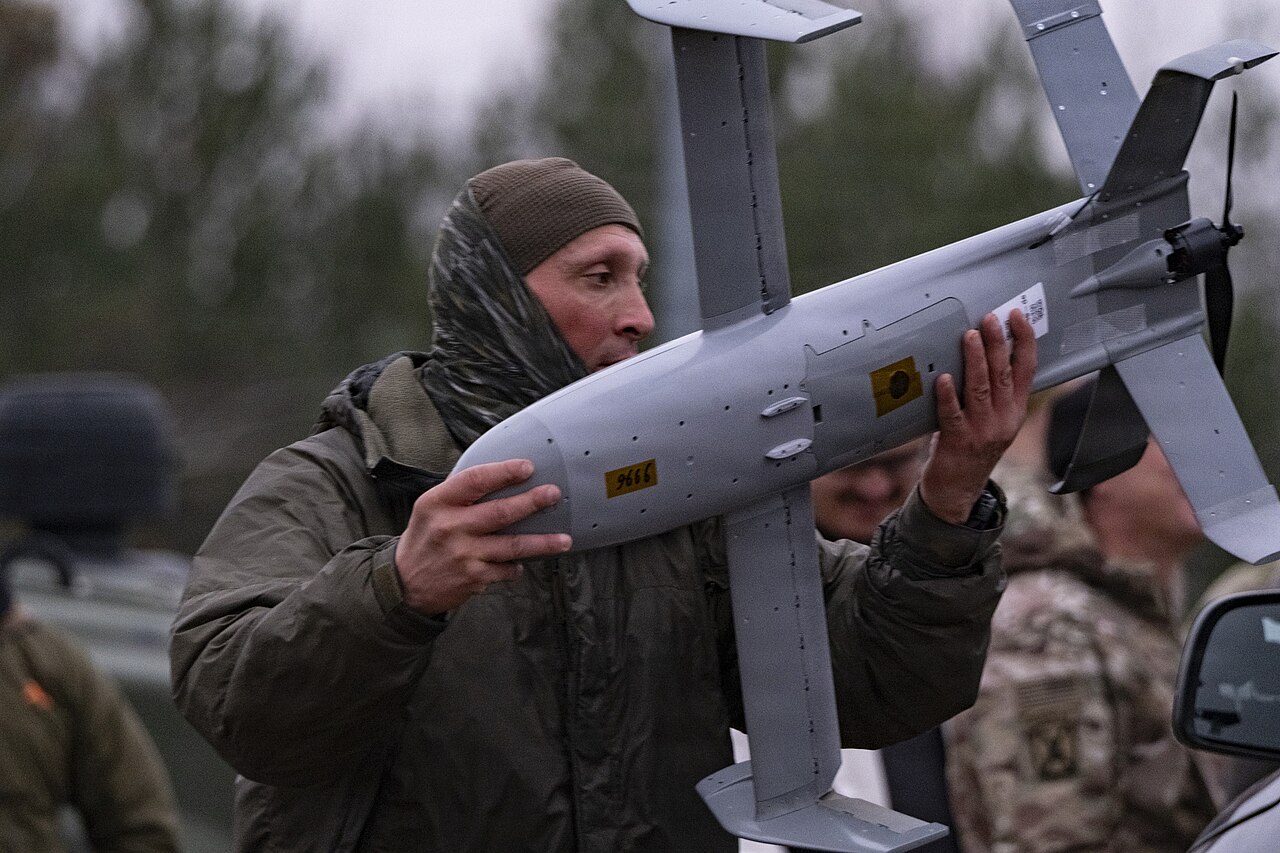
Merops is a system for countering enemy unmanned aerial systems, or drones, developed by the California-based Project Eagle, a venture of former Google CEO Eric Schmidt. It is notable for its cost-effective design, use of a reusable interceptor drone called Surveyor, and its deployment by Ukrainian forces against Russian drones during the invasion of Ukraine.
- Interceptor name
- Surveyor
- Interceptor length
- 3 feet
- Interceptor speed
- 175 mph (282 km/h)
- Interceptor cost
- $15,000
- Crew size
- 4
- Training duration
- 2 weeks
- First deployment
- June 2024
- Drones destroyed by nov 2025
- more than 1,900
- Percentage of downed shaheds
- some 40%
Lore & Background
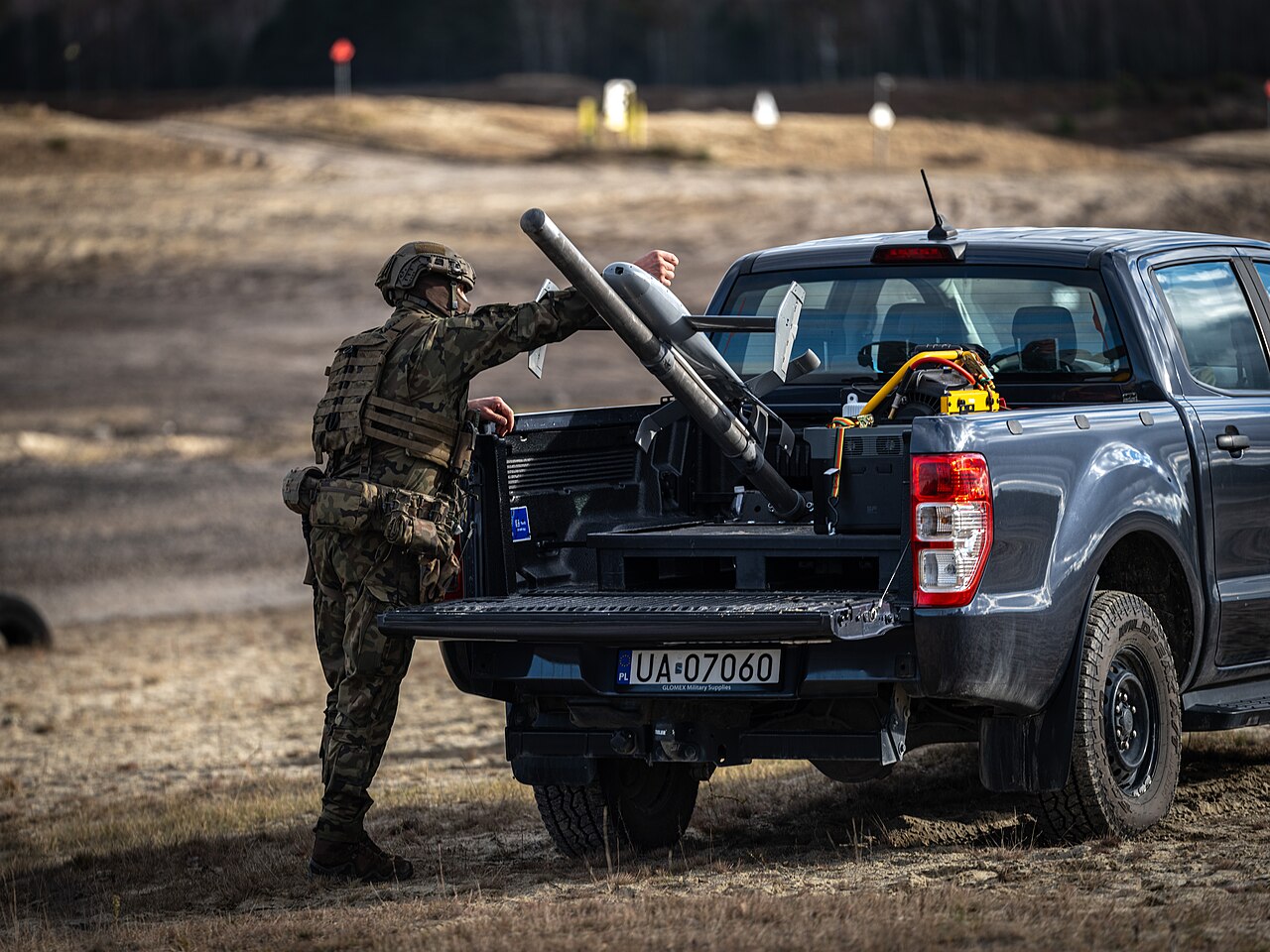
The Merops system consists of radar and electro-optical sensors, controller gear, and a drone launcher. The sensors detect and locate incoming drones, then pass targeting data to the interceptor or to other friendly systems. Small enough to fit in the bed of a pickup truck, Merops launches a three-foot, fixed-wing, propeller-driven interceptor drone called Surveyor that flies at speeds up to 175 mph. The $15,000 interceptor can be controlled by a human operator or, when satellite and radio links are jammed or unavailable, autonomously home into its target using artificial intelligence and thermal, radio-frequency, or radar sensors. It can ram its target or carry a small warhead. If it misses, the interceptor can open a parachute to return to earth for reuse. It is operated by a four-person crew: commander, pilot, and two technicians, and training takes just two weeks. The system is designed for short-range defense against larger drones, such as Iranian-designed, Russian-made Shaheds.
The development of Merops is intended to give the U.S. military and its allies a more cost-effective means of destroying enemy drones than existing interceptor missiles. The effort was funded by Eric Schmidt as part of his Project Eagle initiative. In 2023, Schmidt launched the initiative as White Stork, which hired former Pentagon innovation chief Will Roper and at least a dozen employees from Apple, SpaceX, Google, federal government agencies, and Schmidt Futures. In February 2024, the company was renamed Project Eagle. That year, initial products were being tested at Hillspire, the headquarters of Schmidt's family ventures in Menlo Park, California; and in Ukraine.
Reader's Guide
The Merops system's significance lies in its cost-effective approach to countering enemy drones, particularly the Iranian-designed, Russian-made Shaheds used in the Ukraine war. As of November 2025, it had reportedly destroyed more than 1,900 incoming Russian drones and accounted for some 40% of downed Shaheds, according to U.S. Army Brigadier General Curtis King. Its deployment by Ukrainian forces around June 2024 marked the first operational use. By November 2025, Merops was also deployed by Polish and Romanian militaries along their borders, and Denmark declared its intent to acquire it. Brig. Gen. Thomas Lowin described NATO members' deployment as the 'first phase' of a two- to five-year effort to build defenses to deter a Russian invasion. On March 6, 2026, U.S. officials told the Associated Press that the system would be deployed to the Middle East for use in the 2026 Iran war. Army Secretary Daniel Driscoll stated that within eight days, the US purchased about 13,000 Merops drones and praised its performance, expressing intent to scale up production to reduce the cost from $15,000 to below $10,000 per unit. The system's legacy is tied to its role in providing a reusable, AI-capable interceptor that can operate in jammed environments, offering a cheaper alternative to traditional interceptor missiles.
Did You Know?
- The interceptor drone, called Surveyor, is three feet long and propeller-driven.
- Training to operate Merops takes just two weeks.
- The US purchased about 13,000 Merops drones within eight days in March 2026.
From Decoys to Dominance: The Proliferation of Unmanned Warfare
The early 21st century saw drone strikes largely as a United States military tool, with air-to-surface missiles targeting ground positions across Afghanistan, Libya, Pakistan, Somalia, Syria, and Yemen during the war on terror. The 1991 Gulf War marked a foundational milestone: the Army's UAV Platoon stationed at Fort Huachuca flew RQ-2 Pioneer surveillance and target-acquisition missions, while the Air Force launched waves of BQM-74C target drones to saturate the airspace above Baghdad, baiting Iraqi integrated air defenses into activating their tracking radars so Wild Weasel units could strike the exposed installations. By the 2010s and 2020s, this capability had spread far beyond American hands. Azerbaijan, China, Iran, Israel, Russia, Turkey, and Ukraine all began fielding drones with increasing ubiquity. Even non-state actors—militant organizations like the Islamic State and the Houthis, and organized crime groups such as Mexican cartels—adopted unmanned platforms for both offensive strikes and logistical support. What began as a specialized American instrument of war became a globally proliferated force multiplier.
The Russo-Ukrainian War: A New Doctrine Born
The Russo-Ukrainian conflict has been widely recognized as the world's first true drone war, distinguished by the unprecedented scale and intensity of unmanned attacks and their transformative effect on conventional military tactics. Both belligerents fielded a broad spectrum of UAVs, from long-range fixed-wing platforms to short-range multirotor FPV drones employed for aerial reconnaissance and artillery spotting. The operational lessons proved so profound that Ukraine established the first military branch dedicated entirely to drone warfare—the Unmanned Systems Forces—in June 2024, with Russia creating its own equivalent in November 2025. Analysts have drawn parallels to the introduction of gunpowder, arguing that drones have disrupted traditional military doctrines in a comparably revolutionary fashion. The war's experience is now shaping how nations conceptualize the decisive role unmanned systems will play in every future conflict, from intelligence, surveillance, target acquisition, and reconnaissance missions to facilitating direct attacks through manned-unmanned teaming and kill-chain integration.
Weaponizing the Commercial Sky
A commercial UCAV is essentially any off-the-shelf civilian drone modified after purchase to carry guided bombs, cluster munitions, incendiary devices, air-to-surface or air-to-air missiles, anti-tank guided weapons, autocannons, or machine guns. These weaponized platforms can fire ordnance, drop explosives, or simply crash into and detonate above a vulnerable target. Their payloads extend well beyond conventional explosives to include hand grenades, mortar shells, IEDs, and even shrapnel, chemical, radiological, or biological hazards. Because they are relatively inexpensive, they present a uniquely challenging threat to defenders. In the Russo-Ukrainian war, multirotor FPV drones from the commercial sector were used extensively by both armies for reconnaissance and artillery spotting. Larger commercial platforms can serve a mothership role, deploying sub-drones or providing electronic warfare capabilities such as radio relay, while heavy-lift variants airlift supplies or evacuate wounded personnel across a battlefield. This democratization of aerial strike capability has fundamentally altered the cost calculus of modern warfare, making drone swarms a viable tactic for simultaneous multi-target attacks.
The Counter-Drone Dilemma
The proliferation of cheap, weaponized commercial drones has forced states to develop counter-UAV systems, splitting the effort into two primary vectors: kinetic interception and electronic warfare suppression. Kinetic solutions—automated laser systems, specialized net-interceptors, and rapid-fire munitions—offer definitive physical neutralization but often suffer from poor cost-to-damage ratios when the target is a low-cost commercial platform. Non-kinetic electronic countermeasures take a different approach, jamming global navigation satellite systems and severing radio frequency control links to trigger automated emergency landing sequences. The debate over the optimal countermeasure strategy remains intense. As academic James Rogers has observed, the challenge spans from hobbyist drones causing minor nuisances to the far more sinister prospect of terrorist actors deploying them against adversaries. The fundamental asymmetry—expensive interceptors versus inexpensive targets—means that no single solution has yet emerged, leaving a persistent defensive gap that adversaries continue to exploit with growing confidence.
Gallery
More in Unmanned Aerial Vehicles, Part 3 1-23
Spotted an error? Know more?
Reader corrections go straight into our review queue. Suggest an edit · How this site is sourced