
Bhargavastra
First guided micro-missile counter-drone system developed by Indian private sector.

Flyhigh2020 · CC0
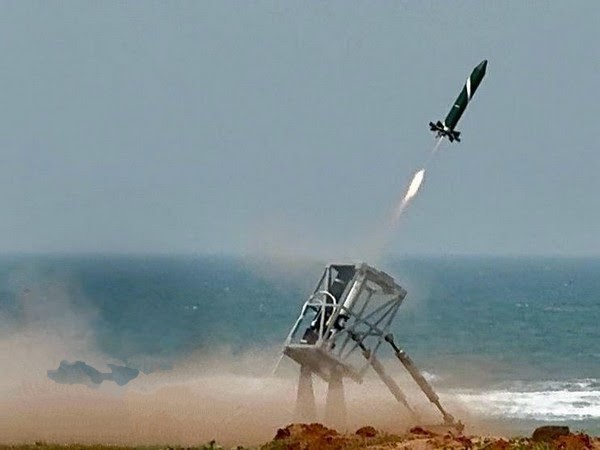
Bhargavastra is a multi-layer micro-missile Anti-Drone/Counter-Unmanned Aerial System (C-UAS) designed and developed by the Indian private sector company Solar Defence and Aerospace Limited. It is based on small lightweight guided and unguided micro-missiles and micro-rockets specially developed to tackle threats from loitering munitions and weaponized autonomous swarm drones that cannot be jammed or spoofed. This is the first guided micro-missile counter-drone system of its sort in the world, intended to stop drone strikes at a lower cost than surface-to-air missiles.
Quick Facts
- Is Missile
- yes
- Designer
- Solar Defence and Aerospace Limited
- Design Date
- 2025
- Manufacturer
- System: Solar Defence and Aerospace Limited / Rocket/Munition: Economic Explosives Limited
- Origin
- India
- Engine
- Solid-propellant rocket
- Propellant
- Solid fuel
- Weight
- 2.5 kg
- Vehicle Range
- Detection: 6-10 km (>5 km for 0.01m² object) / Interception: 2.5 km
- Guidance
- IIR/CCD
- Detonation
- Hit-to-kill
- Launch Platform
- Road mobile (7.5-ton class all-terrain vehicle), Naval Platforms
Facts from the source article.
Lore & Background
The Bhargavastra counter-drone system was developed by Solar Defence and Aerospace Limited, a subsidiary of the Solar Group, in response to increasing dangers from weaponized drones and loitering munitions faced by the Indian Army. The project began after analyzing the Russian invasion of Ukraine and the Nagorno-Karabakh conflict, which involved loitering munitions and swarm drones. The system was developed without a formal request for proposals from the Indian Armed Forces; Solar Group developed the technology on its own initiative and will make it available to the military after research and testing are complete. The company intends to export the system overseas.
According to Solar Defence and Aerospace, every part—from strike mechanisms to detecting sensors—is developed in India. Multiple sensor systems such as radar, electro-optical, and radio frequency receivers can be integrated thanks to the open architecture, allowing layered air defense cover customized to individual missions. The system employs a multi-layer counter-drone defense with inexpensive micro-rockets and micro-missiles for hard kill, and can integrate with existing military networks like the Akashteer and the Integrated Air Command and Control System for network-centric warfare. A single launcher carries 64 units in 8 x 8 cassettes, allowing multiple launches in 10 seconds with 360-degree coverage. The system can fire 64 micro-rockets/micro-missiles in salvo mode, and its modular design allows enhancement with a soft-kill layer incorporating spoofing and jamming.
Reader's Guide
The Bhargavastra system represents a notable development in counter-drone technology, being the first guided micro-missile counter-drone system of its kind globally. Its significance lies in addressing the emerging threat of loitering munitions and weaponized autonomous swarm drones that cannot be jammed or spoofed, offering a hard-kill solution at a lower cost than traditional surface-to-air missiles. The system's multi-layer approach—using unguided micro-rockets for close-range swarm destruction and guided micro-missiles for precise engagement of evasive targets—provides a coordinated defense against diverse aerial threats. The system's development was driven by lessons from recent conflicts, including the Russian invasion of Ukraine and the Nagorno-Karabakh conflict, and was undertaken on the company's own initiative without a formal military request. The successful trials in January and May 2025 demonstrated its capability against stationary and moving targets, as well as salvo firing. The addition of an electronic soft-kill option further enhances its versatility. Bhargavastra's open architecture and ability to integrate with existing military networks position it as a flexible, indigenous solution for layered air defense, with potential for both domestic use and export.
Did You Know?
- Bhargavastra can fire 64 micro-rockets or micro-missiles in salvo mode from a single launcher.
- The system can detect extremely small drones at a distance of 6 km and medium to large UAVs at 10 km.
- It takes less than 16 seconds from target recognition to interception.
- The system successfully completed its maiden firing trial on 12 January 2025 against a stationary target at 2.5 km and 400 meters altitude.
Gallery
More in Unmanned Aerial Vehicles, Part 3 1-23
Spotted an error? Know more?
Reader corrections go straight into our review queue. Suggest an edit · How this site is sourced