
Golden Dome (missile defense system)
A planned U.S. space-based missile shield extending from Earth to orbit.

The White House · Public domain
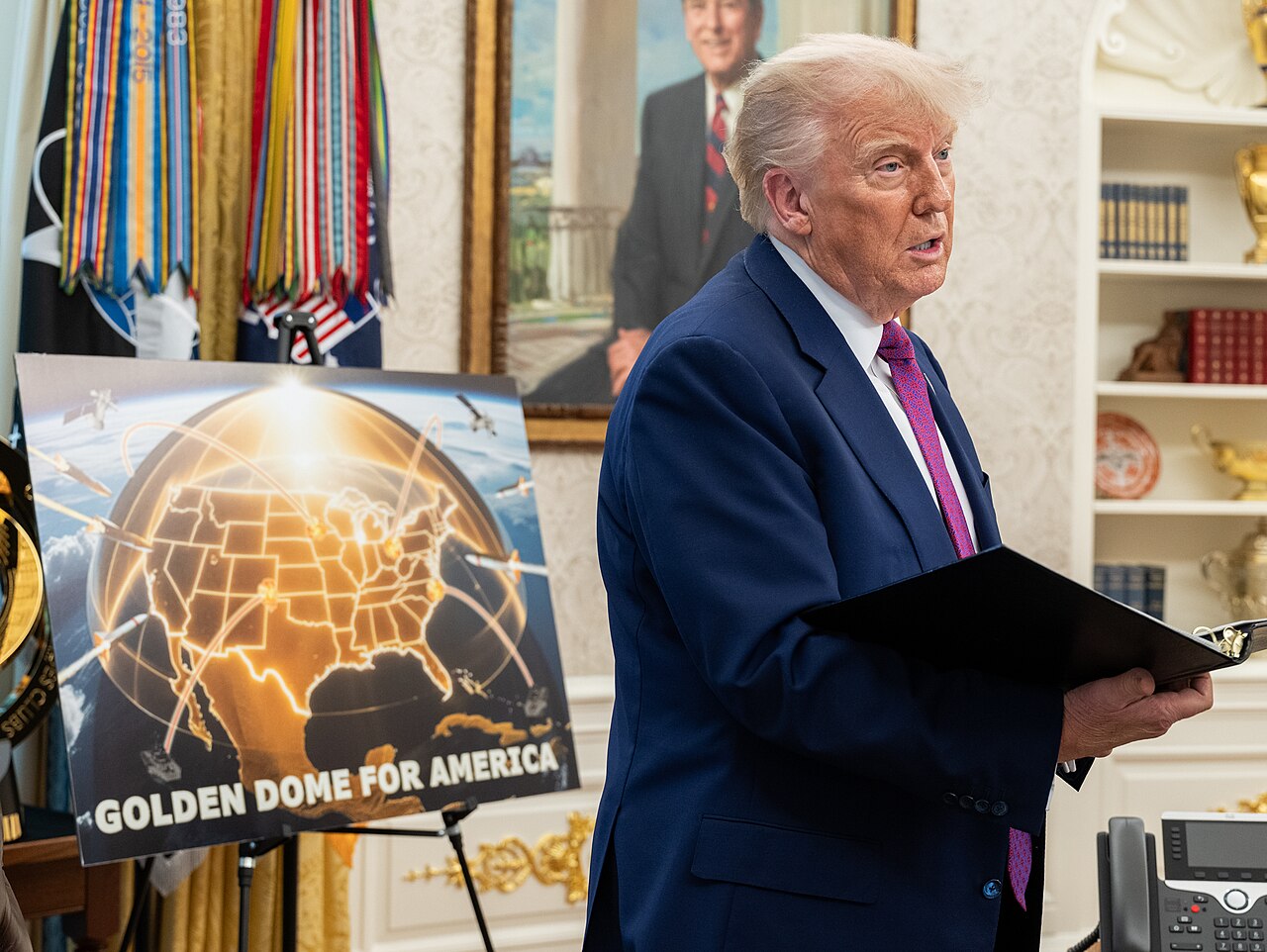
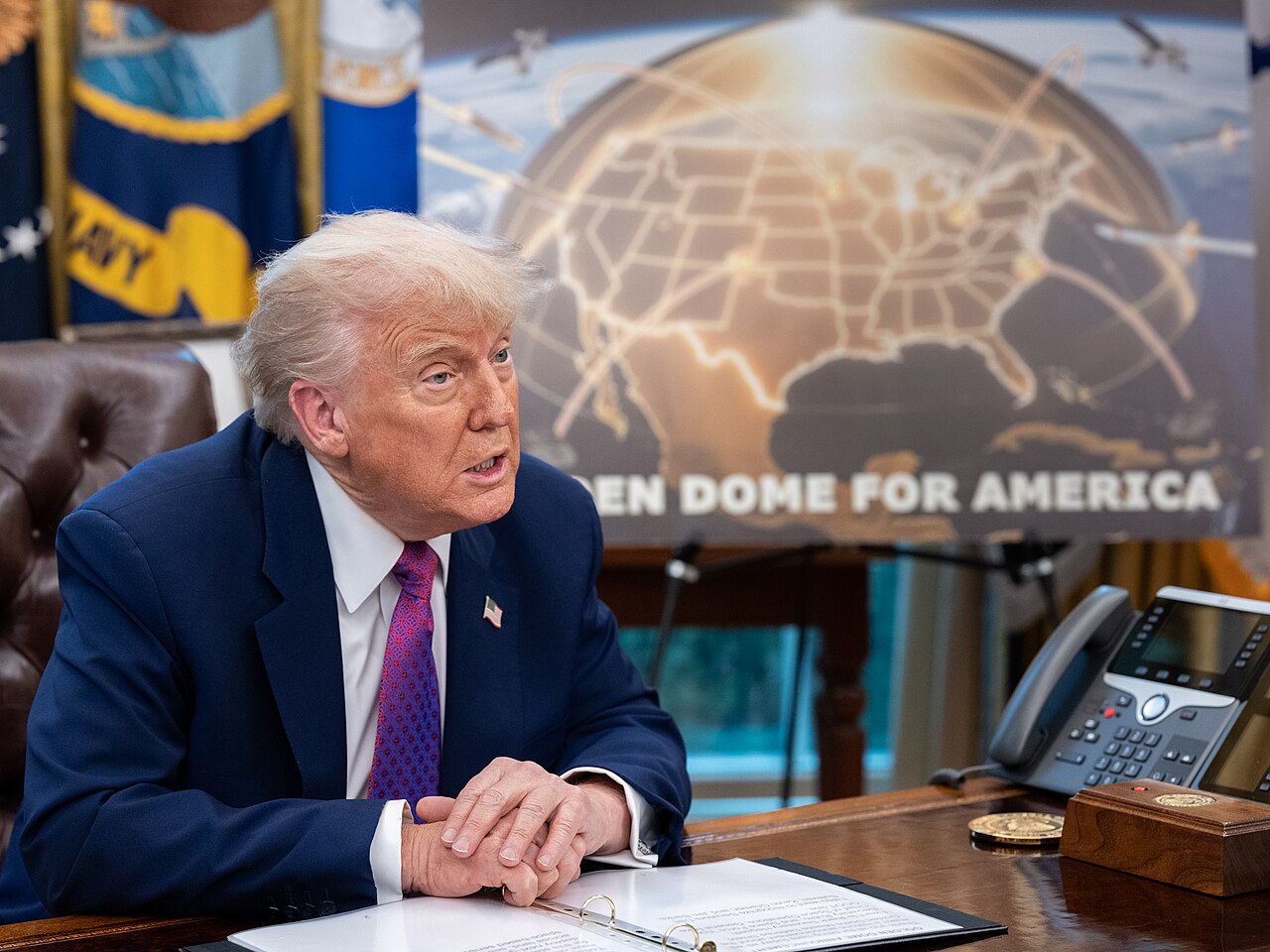
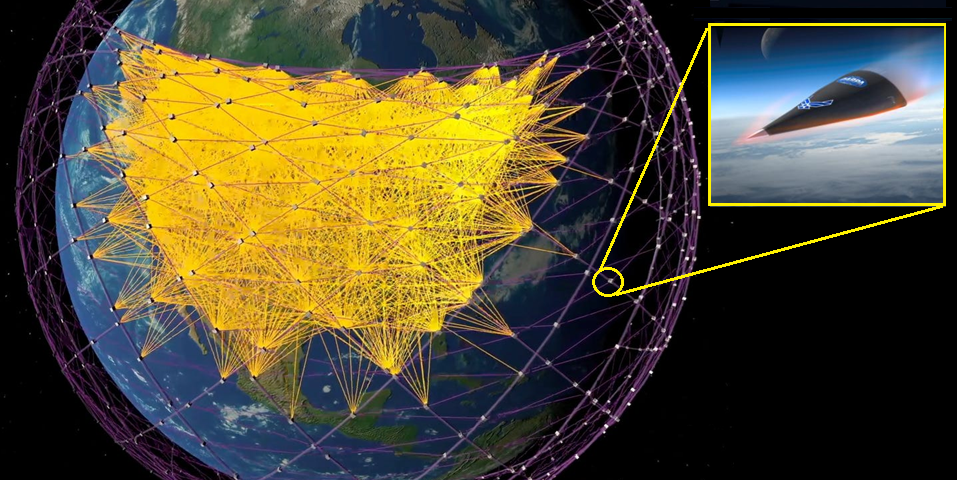
The Golden Dome is a planned multi-layer missile defense system for the United States, intended to detect and destroy ballistic, hypersonic, and cruise missiles before they launch or during their flight. It would rely on a constellation of thousands of satellites carrying sensors and interceptors, marking the first deployment of American space-based weapons. The name references Israel’s Iron Dome, but the Golden Dome is intended to cover the entire planet, far exceeding that system’s scope. The project builds on earlier programs, including Prompt Global Strike, the Proliferated Warfighter Space Architecture, and the Strategic Defense Initiative (SDI). On January 27, 2025, President Donald Trump signed an executive order directing the secretary of defense to submit a plan for what was initially called the “Iron Dome for America,” later renamed Golden Dome. The concept echoes SDI, proposed by President Ronald Reagan in 1983, which also envisioned a space-based global shield. The system would use automated command and control via data centers in space, linked by an AI-enabled cross-domain network. Interceptors would orbit just outside the atmosphere, but only a small fraction would be positioned to engage any given threat at the right time—a limitation critics say makes it less efficient than regional defenses like Israel’s Iron Dome. In 2019, Trump stated the satellites would also carry offensive weapons. Cost estimates vary widely: $175 billion from the White House, $1.2 trillion from the Congressional Budget Office, and $3.6 trillion from the American Enterprise Institute, depending on architecture. The range hinges largely on the number of space-based missiles and the cost of replacing satellites whose low orbits degrade quickly from atmospheric drag. The One Big Beautiful Bill Act in 2025 directed $24.4 billion in federal funding to the Golden Dome, with another $13 billion allocated for fiscal year 2026, totaling 2.2% of the federal discretionary budget that year.
**Background** The Strategic Defense Initiative, announced by Reagan in 1983, was influenced by strategic analyses like the 1976 Team B report—which claimed U.S. intelligence had underestimated Soviet threats—and ideas from the Citizens' Advisory Council on National Space Policy.
Quick Facts
- Production Date
- 2029– (White House estimate) / 2035– (CSIS estimate)
- Origin
- United States
- Is Missile
- yes
- Vehicle Range
- Global
- Launch Platform
- Satellites, ground-based
- Unit Cost
- $1.2 trillion (CBO estimate) / $175 billion (White House estimate)
Facts from the source article.
Lore & Background
The Golden Dome extends former programs such as Prompt Global Strike, the Proliferated Warfighter Space Architecture, and the Strategic Defense Initiative (SDI). The initial name alluded to Israel's short-range Iron Dome system, but the Golden Dome would encompass the entire Earth, more like the SDI proposed by President Ronald Reagan in 1983. The modern groundwork was laid in 2017 by Michael D. Griffin, former SDI Deputy of Technology and prominent Team B leader, who formed the Space Development Agency during the first Trump administration.
Reader's Guide
The Golden Dome represents a vast increase in U.S. missile-defense goals, from limited protection against 'rogue states' to a system intended to defeat larger strikes from peer-level countries. Cost estimates range widely from $175 billion to $3.6 trillion, depending on architectural details such as the number of space-based missiles and satellite replacement costs due to low-orbit decay. Critics argue the concept is less efficient than traditional regional missile defenses because only a small fraction of interceptors would be available at the right time and place for any given threat. The program has faced scrutiny over conflicts of interest involving Elon Musk, whose Department of Government Efficiency slashed resources of the Director, Operational Test and Evaluation office after it determined oversight applied to the Golden Dome. In May 2025, 42 members of Congress asked the DoD Inspector General to review Musk's involvement, citing deviations from standard acquisition processes and a dome subscription model that could give Musk undue influence. General Michael A. Guetlein was nominated to run the program in June 2025 and assumed the position on July 21, 2025. As of December 2025, no contract awards had been publicly announced, though the Wall Street Journal reported SpaceX was 'set to receive' a $2 billion contract for a 600-satellite constellation for missile targeting.
Did You Know?
- The Golden Dome was initially called the 'Iron Dome for America' before being renamed.
- The system would be the first U.S. space weapons in orbit, employing thousands of satellites with sensors and interceptors.
- Cost estimates range from $175 billion (White House) to $3.6 trillion (American Enterprise Institute).
- In 2019, Donald Trump said the satellites would also carry offensive weapons.
The Blurring Boundary Between Tactical and Strategic Defense
The original purpose of missile defense was straightforward: shield a nation from incoming intercontinental ballistic missiles and other strategic nuclear threats. Yet the operational landscape has shifted dramatically over the decades. The steady proliferation of missile technology has effectively erased the once-clear boundary between intercepting short- to intermediate-range tactical missiles carrying conventional payloads and engaging long-range strategic weapons armed with nuclear warheads. Today, high-performance tactical ballistic missiles possess enough destructive capability to alter the strategic balance in any conflict zone. In turn, advanced tactical defense systems now shape how militaries plan their force deployments and positioning. The breadth of participation underscores the universality of the challenge: the United States, Russia, China, India, France, Israel, Italy, the United Kingdom, and Iran have each developed their own missile defense architectures, making layered interception a defining feature of modern military strategy worldwide.
China's Multi-Layered Shield and Milestone Tests
China's People's Liberation Army fields one of the most extensive layered missile defense architectures in the world. The lineage stretches back to the Cold War-era Project 640, which produced the experimental FJ ABM series before being ultimately shelved. Today, four S-300 variants serve in the force, with the S-300PMU2's 48N6E2 interceptor offering the strongest probability of defeating a short-range ballistic missile. The domestically developed HQ family spans multiple engagement ranges: the HQ-9, in service since 2001, handles terminal interception of short- and medium-range threats; the HQ-16, fielded in 2008, targets tactical ballistic missiles; and the HQ-19, operational since 2018, reaches medium, intermediate, and intercontinental ballistic missiles while also engaging low-orbit satellites. The HQ-22, added in 2019, covers short-range terminal interception, and the HQ-29, announced operational in 2025, extends coverage to intermediate and intercontinental threats. On the testing front, China executed a kinetic anti-satellite strike on 11 January 2007 using a KT-1 missile, and in 2010 became the second nation after the United States to demonstrate exoatmospheric interception, with follow-up successes in 2013 and 2017.
Europe's Collective Air and Missile Defense Evolution
European missile defense has evolved from trilateral programs into a broader multinational framework. In the late 1990s, the United Kingdom, France, and Italy collaborated on PAAMS, known in British service as Sea Viper, to arm the joint Horizon-class frigate. After the UK withdrew from the frigate program because collective differences remained unresolved, it pursued its own Type 45 destroyer while retaining PAAMS. France and Italy then adapted the underlying technology into SAMPT, a truck-launched anti-ballistic missile system. The threat environment has since broadened to include drones, cruise missiles, and ballistic systems. Since October 2022, twenty-two European states have joined the German-led European Sky Shield Initiative to procure and maintain air defense collectively. NATO members, particularly Germany, are adopting layered Integrated Air and Missile Defense architectures inspired by the U.S. IBCS concept but adapted for a geographically dispersed alliance under NATINAMDS. A further proposal, European Sky Shield for Ukraine, envisions stationing European fighter jets beyond the frontlines rather than relying solely on ground-based interceptors.
India's Tiered Dome and the Post-Kargil Imperative
India's missile defense architecture rests on two principal pillars: the Air Defence Ground Environment System, which provides wide-area radar coverage and detects most aerial incursions into Indian airspace, and the Base Air Defence Zones, a denser concentration of radars, interceptors, surface-to-air missiles, and anti-aircraft units guarding vital targets. The overall deployment follows a strict tiered logic. The long-range tier relies on the S-400 and Project Kusha, the medium tier on Barak 8 and Akash NG, and the short-range point-defense tier on systems including QRSAM, Akash, S-125 Pechora, and SPYDER. The dedicated Ballistic Missile Defence Programme, launched in 1999 in the wake of the Kargil War, made India the first nation in South Asia to pursue a defense dome. Designed against the ballistic missile threat from Pakistan, it is a double-tiered system pairing the Prithvi Air Defence interceptor for high-altitude engagement with a complementary lower-tier missile to cover the remaining envelope.
Gallery



More in Unmanned Aerial Vehicles, Part 3 1-23
Spotted an error? Know more?
Reader corrections go straight into our review queue. Suggest an edit · How this site is sourced