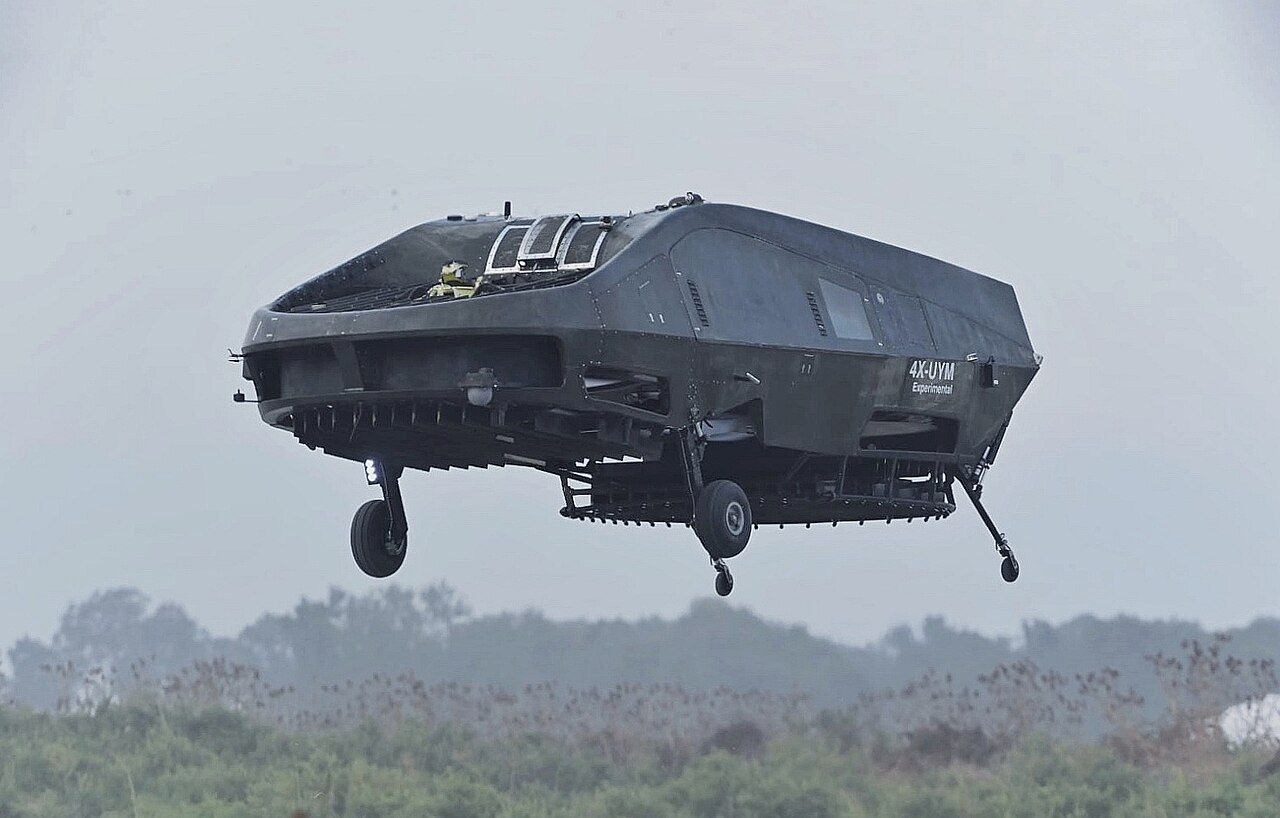
Tactical Robotics Cormorant
Ducted-fan UAV for medical evacuation and urban rescue.

Rafi Yoeli · CC BY-SA 4.0
The Tactical Robotics Cormorant, formerly known as the AirMule or Mule and assigned the Israel Defense Forces (IDF) codename Pereira (Hebrew for 'Dragonfly'), is an unmanned aerial vehicle (UAV) built by Tactical Robotics Ltd., a subsidiary of Urban Aeronautics Ltd., in Yavne, Israel. It is a ducted-fan flying car designed for search and rescue operations in environments too dangerous or inaccessible for conventional helicopters, such as evacuating people from upper stories of burning buildings or delivering and extracting personnel in narrow streets, close to structures, or through holes into confined spaces.
Quick Facts
- Aircraft Type
- Flying car
- Manufacturer
- Tactical Robotics LTD
- Designer
- Rafi Yoeli
- Primary User
- Israel Defense Forces
- Number Built
- 2 prototypes
- Introduction
- Before 2020
Facts from the source article.
Lore & Background
The Cormorant's development was spurred by the 2006 Lebanon War, after which the IDF identified a need for an unmanned vehicle capable of evacuating wounded from behind enemy lines without the landing-area constraints of helicopters. The initial concept was civilian, but shifted to military use following plans to equip US Marines with human-transporting UAVs. A scaled-down technology demonstrator, the Panda, first flew in June 2008. The first full-size prototype, then called the AirMule, completed its tethered maiden flight on January 12, 2010, reaching an altitude of 2 feet. By April 21, 2010, it achieved sustained tethered hovering at up to 9.8 feet, leading to untethered flight later that year. The second prototype, begun in October 2011, incorporated double-redundant hydraulics and stealth features. On May 29, 2018, the Cormorant completed its first live demonstration.
Reader's Guide
The Cormorant represents a response to the operational limitations of helicopters in urban and confined environments. Its ducted-fan design shields the rotors, allowing it to operate in creeks, city streets, alleyways, and refugee camp warrens where a conventional helicopter cannot land or safely maneuver. As of 2012–2014, it was the only design meeting NATO and IDF requirements for an unmanned medical evacuation (MEDEVAC) and casualty evacuation (CASEVAC) vehicle. The UAV can evacuate up to two casualties from a battlefield and transfer them to a field hospital, with air-conditioned side cells designed to receive stretchers and equipped for transfusions during flight. Its significance lies in addressing the tactical gap between the need for rapid evacuation and the risks to manned helicopters in fire-heavy or weapon-exposed zones. The design is protected by 37 granted patents, with 12 more pending, and the Fancraft technology is licensed separately for military (Tactical Robotics) and civilian air-taxi and rescue markets (Metro Skyways).
Did You Know?
- The Cormorant's IDF codename Pereira means 'Dragonfly' in Hebrew.
- The initial prototype used four-blade rotors, later upgraded to six-blade rotors to increase payload by about 200 kg.
- The fuselage is constructed from carbon composite and generates over 50% of lift at high speed via an airfoil shape.
- Early hover tests measured interior cabin noise at 95 decibels without acoustic treatment.
Note on Source Material
The reference material provided for this entry does not contain any information about a 'Tactical Robotics Cormorant.' The supplied text is a country-by-country catalogue of unmanned aerial vehicles (spanning Algeria, Argentina, Armenia, Australia, Austria, Azerbaijan, Belarus, Belgium, Brazil, Canada, Chile, China, Colombia, Costa Rica, Croatia, the Czech Republic, Denmark, Egypt, Finland, and France), listing platform names, manufacturers, roles, and development years. No entry, manufacturer, or description in that source mentions Tactical Robotics or a platform called Cormorant. Because the editorial brief requires every sentence to be grounded strictly in the supplied facts and forbids inventing specifics, I am unable to produce four substantive sections on that subject without fabricating details. If a different or additional source passage covering Tactical Robotics Cormorant can be provided, I will gladly draft the four 120–200-word sections in the requested JSON format.
Gallery
Frequently Asked Questions
What is the Tactical Robotics Cormorant?
The Cormorant is an Israeli ducted-fan unmanned aerial vehicle built for search-and-rescue missions, previously known as the AirMule or simply Mule, and assigned the IDF codename Pereira, which translates to 'Dragonfly' in Hebrew.
What is the Cormorant's primary mission?
It is purpose-built for medical evacuation and urban rescue in environments where conventional helicopters cannot operate safely, such as extracting people from upper floors of burning buildings, narrow streets, or through openings in structures.
Who builds the Tactical Robotics Cormorant?
The aircraft is manufactured by Tactical Robotics Ltd., a subsidiary of Urban Aeronautics Ltd., with operations based in Yavne, Israel.
When did the Cormorant first take to the air?
Its initial tethered flight occurred on January 12, 2010, and it achieved its first untethered flight later in 2010, after April 21. The vehicle's first live public demonstration was held on May 29, 2018.
What powers the Cormorant?
The UAV is driven by a Turbomeca Arriel 1D1 turbofan in early prototypes, with the design subsequently upgrading to the Turbomeca Arriel 2.
More in Unmanned Aerial Vehicles by Country, Part 3 1-24
Spotted an error? Know more?
Reader corrections go straight into our review queue. Suggest an edit · How this site is sourced