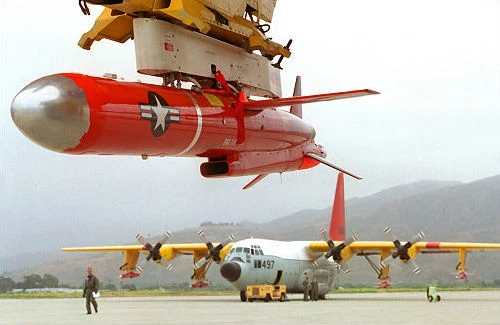
Aisheng ASN-209
Chinese tactical UAV with rocket launch and parachute recovery.

The Aisheng ASN-209 is a Chinese medium-altitude medium-endurance (MAME) tactical unmanned aerial vehicle developed by Xi'an Aisheng Technology Group Co., Ltd (also known as the Northwestern Polytechnical University UAV Research Institute or 365th Institute). It is notable for its twin-boom pusher layout, rocket-assisted takeoff, parachute recovery, and a design philosophy that reduces reliance on proprietary technologies, making it more cost-effective than comparable US systems.
Quick Facts
- Aircraft Type
- Reconnaissance UAV
- National Origin
- China
- Manufacturer
- Xi’an ASN Technology Group / CATIC / AOI
- Primary User
- People's Liberation Army
- More Users
- Algerian Air Force / Egyptian armed forces
Facts from the source article.
Lore & Background
The ASN-209 was developed in 2011 by ASN Technology Group. A derivative known as the Silver Eagle (or Silver Hawk) entered service with the Chinese Navy, distinguished by four vertically installed antennas—two atop the fuselage and one near each wingtip. The Silver Eagle made its maiden flight on 1 June 2011 in the coastal region of northeastern China, lasting 3.5 hours. It is launched from a 6×6 truck using rocket-assisted takeoff, with a separate vehicle likely housing the ground control station. Official Chinese sources have only revealed that Silver Eagle is a shore-based naval UAV; unconfirmed postulates suggest it may serve as a communication relay, electronic intelligence platform, or aerial jammer.
The ASN-209 system comprises the aircraft platform, avionics, airborne mission payload, data link, ground control station, and launch and recovery equipment. It uses a digital flight control and navigation system with manual, program, and emergency control modes. The UAV can be fitted with synthetic aperture radar, electro-optical payloads, and multifunction payloads for civil applications such as forest fire prevention, anti-drug operations, communication, disaster forecasting, ground observation, atmospheric measurement, aerial photography, resource detection, climate observation, and artificial rainmaking. Military configurations support ground moving target indication, electronic intelligence, electronic warfare, ground target designation, and communication relay. The system can operate two UAVs consecutively for 24-hour coverage by switching them at their 10-hour endurance limit.
Reader's Guide
The ASN-209 represents a deliberate Chinese approach to UAV development that prioritizes affordability and operational flexibility over proprietary technology. By using fewer proprietary components, the system costs 30 percent less than comparable US designs while performing many of the same tasks. Its rocket-assisted launch and parachute recovery eliminate the need for an airport, allowing deployment from a modified truck and control from a cargo van. This reduces dependence on foreign maintenance and parts, a contrast to US systems that require such support.
Egypt became a notable operator and co-producer: an agreement with China covered the construction of twelve ASN-209s with technology transfer. By May 2012, six Egyptian-built drones were operational, with the Arab Organization for Industrialization claiming 99.5 percent local component manufacture and entry into a second phase of mass production. The ASN-209 has also been adopted by the People's Liberation Army and the Algerian Air Force. Its twin-boom pusher layout and electromagnetic compatibility design allow it to carry diverse payloads, from electronic countermeasures to weather detection. The system's ability to supervise large areas within a 200 km radius and sustain 24-hour operations using two alternating UAVs underscores its tactical utility for persistent surveillance and reconnaissance.
Did You Know?
- The Silver Eagle variant of the ASN-209 has four vertically installed antennas, two atop the fuselage and one near each wingtip.
- The ASN-209 uses rocket-assisted takeoff and parachute recovery, requiring no airport for operations.
- Egypt claimed 99.5% local component manufacture for its ASN-209s by May 2012.
Identity and Designation
The Aisheng ASN-209 is identified in the available record as an unmanned aerial vehicle, a category of aircraft that operates without a human pilot on board. Its full designation pairs the manufacturer name Aisheng with the model number ASN-209, a naming convention that follows the common pattern of combining a producer's brand with a numeric type code. Within the broader catalog where it appears, the ASN-209 is grouped alongside hundreds of other unmanned aircraft systems from nations spanning every inhabited continent. The listing itself is a comprehensive survey of UAVs that have been developed and operated in countries around the world, and the ASN-209 occupies a single entry within that extensive international inventory.
Egyptian Association
In the international UAV listing from which this entry is drawn, the Aisheng ASN-209 is catalogued under the heading for Egypt, placing it within a national grouping of unmanned aircraft. It is not the sole Egyptian entry; rather, it appears as the fourth and final item in a short roster that also includes the 6th of October, the NUT, and the 30 June. The three companion entries in the Egyptian section carry names that reference dates or acronyms, whereas the ASN-209 follows a manufacturer-plus-model-number format, a stylistic difference that sets it apart from its Egyptian neighbors in the list. No additional contextual details about procurement, service history, or mission profile are provided in the available record.
Position in the Global UAV Landscape
The Aisheng ASN-209 sits within a vast multinational catalogue that documents unmanned aerial vehicles from at least twenty distinct countries, stretching from Algeria in North Africa through South American states such as Argentina and Brazil, across European nations including France, Belgium, and Denmark, and to Asian and Middle Eastern countries. This breadth underscores that UAV development is a genuinely worldwide endeavor, with airframes ranging from tiny quadcopters to heavy-lift multi-role platforms. Within that sprawling inventory, the ASN-209 is one of thousands of entries, each representing a distinct design or program. The listing spans decades of development, with some entries dating back to the late 1960s and others still in development or testing phases. The ASN-209's inclusion in this global survey confirms its recognition as a distinct unmanned aircraft system worthy of cataloguing alongside far more extensively documented platforms from larger aerospace industries.
The Egyptian UAV Roster and the ASN-209's Place
Egypt's section in the international UAV listing contains exactly four entries, a modest number compared to countries like Brazil, Australia, or France, which each list dozens of unmanned aircraft. The four Egyptian entries are the 6th of October, the NUT, the 30 June, and the Aisheng ASN-209. The first three bear names that appear to reference calendar dates or serve as short acronyms, while the ASN-209 stands apart with its explicit manufacturer attribution and alphanumeric model code. This naming distinction suggests the ASN-209 may be a product of a specific industrial entity, Aisheng, rather than a purely military or government designation. The compact size of Egypt's listing, with only four airframes, contrasts sharply with the extensive rosters of neighboring or peer nations in the catalogue. The ASN-209, as the final entry in the Egyptian group, completes a short but recognizable national portfolio of unmanned aerial systems as recorded in this particular source.
Frequently Asked Questions
What is the Aisheng ASN-209?
It is a Chinese medium-altitude, medium-endurance tactical UAV produced by Xi'an Aisheng Technology Group, a unit linked to Northwestern Polytechnical University's UAV research division. Its most recognizable visual trait is a twin-boom pusher layout that distinguishes it from typical single-fuselage drones.
How does the ASN-209 launch and recover without a runway?
The aircraft uses a rocket booster to climb off the ground and, after its mission, is brought back down by parachute recovery. This combination lets operators deploy it from austere or forward positions with virtually no ground infrastructure.
What are the ASN-209's key performance figures?
The Silver Eagle variant logged a 3.5-hour maiden flight on 1 June 2011 with an estimated 150 km range, while the broader platform is rated for roughly 10 hours of endurance and a 200 km coverage radius.
Why is the ASN-209 considered more cost-effective than comparable U.S. drones?
Its design philosophy deliberately limits reliance on proprietary or hard-to-source technologies, keeping the parts chain simpler and easier to source domestically. Analysts estimate this approach cuts the unit cost by about 30 percent relative to similar American tactical UAVs.
Who developed the ASN-209 and when did it first fly?
Xi'an Aisheng Technology Group, operating under the 365th Institute at Northwestern Polytechnical University, built the aircraft, and the Silver Eagle variant completed its maiden flight on 1 June 2011.
More in Unmanned Aerial Vehicles by Country, Part 3 1-24
Spotted an error? Know more?
Reader corrections go straight into our review queue. Suggest an edit · How this site is sourced