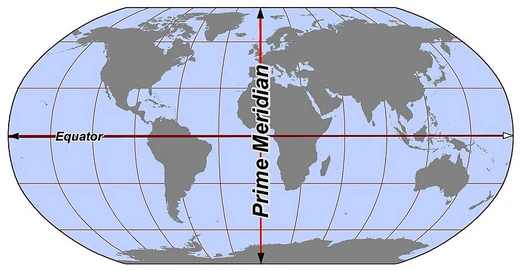
Northern Hemisphere
The Northern Hemisphere contains most of the world's continents and major landmasses.
Last updated

Sean Baker ( Marvin01 | talk ) · via Wikipedia: Northern Hemisphere · CC BY 2.0
The Northern Hemisphere is the half of Earth that lies north of the Equator. Its surface is 60.7% water, a lower proportion than the Southern Hemisphere, and it contains 67.3% of the planet's landmass. This land includes all of North America and mainland Eurasia, about two-thirds of Africa, and a small portion of South America. The hemisphere’s climate is shaped by Earth’s axial tilt of 23.439281°, which creates seasonal variations in day length and temperature, with temperature changes lagging behind daylight changes.
Winter is conventionally observed from the December solstice to the March equinox, and summer from the June solstice to the September equinox, though these dates shift slightly each year due to differences between the calendar and astronomical years. Oceanic currents, influenced by phenomena such as El Niño–Southern Oscillation, can alter weather patterns along northern coasts. Trade winds blow east to west just above the Equator, pulling surface water westward; the Coriolis effect then bends these currents to the right, northward.
Around 30° north latitude, westerlies push the currents back east, forming a closed clockwise loop. The Coriolis effect also causes large-scale air and water flows to turn right, creating clockwise gyres in the North Atlantic and North Pacific. High-pressure weather cells rotate clockwise, while low-pressure systems like hurricanes spin counterclockwise. During the Pleistocene, lasting about 2.5 million years, the Northern Hemisphere experienced numerous glacial periods, with continental ice sheets advancing in Europe and North America at intervals of roughly 40,000 to 100,000 years.
These cold phases were separated by shorter, temperate interglacials lasting 10,000–15,000 years. The last glacial episode ended about 10,000 years ago, and Earth is now in the Holocene interglacial. The Arctic, centered on the North Pole, has cold winters and cool summers, with precipitation mainly as snow.
Within the Arctic Circle, the Sun may not set for days in summer or rise for days in winter. Between the Arctic Circle and the Tropic of Cancer lies the Northern temperate zone, where seasonal changes are generally mild. Tropical regions between the Tropic of Cancer and the Equator are hot year-round, with rainy summers and dry winters. A sundial’s shadow moves clockwise north of the subsolar point.
Quick Facts
- Surface water percentage
- 60.7%
- Land percentage
- 67.3% of Earth's land
- Key climate zones
- Arctic
- Northern temperate
- Tropical
- Major ocean currents
- clockwise-turning gyres in North Atlantic and North Pacific
Facts from the source article.
Lore & Background
The Northern Hemisphere is defined by the Equator as its southern boundary. It includes most of the world's land area, as the Land Hemisphere is centered near 47°N, 1°E, near the city of Nantes, France, and contains the largest possible area of land, including most of the world's continents and major landmasses. The Water Hemisphere, centered near 47°S, 179°W in the South Pacific Ocean, contains the largest possible area of water, including most of the Indian, Pacific, and Southern Oceans. The Northern Hemisphere's geography is shaped by these divisions, with the Equator serving as the primary latitudinal marker for north-south division.
Reader's Guide
When studying Earth's geographic distribution, cultural differences, and other geographic, demographic and socioeconomic features, the Northern Hemisphere is a key division. It is one of the two halves created by the Equator, which splits the globe into northern and southern halves. The Prime meridian divides the globe into western and eastern halves.
Alternative hemisphere schemes can divide the planet along cultural or religious lines, or to maximize the prominence of geographic features, such as the land-water division. The Land Hemisphere, centered near 47°N, 1°E, contains the largest possible area of land, including most of the world's continents and major landmasses. The Water Hemisphere, centered near 47°S, 179°W, contains the largest possible area of water, including most of the Indian, Pacific, and Southern Oceans.
Frequently Asked Questions
What exactly is the Northern Hemisphere?
It is the portion of Earth that sits above the equator line. In the wider Solar System, 'north' is defined by whichever side of the invariable plane Earth's North Pole occupies, and the Northern Hemisphere is the half on that same side.
What major climate zones does the Northern Hemisphere span?
Stretching from the Arctic through the Northern temperate belt down into the Tropical zone near the equator, the Northern Hemisphere covers three primary climate regions. That breadth of zones is a key reason it supports far more varied ecosystems than the ocean-heavy Southern Hemisphere.
How do the big ocean gyres behave in the Northern Hemisphere?
The North Atlantic and North Pacific each host large, clockwise-rotating surface-current systems. These gyres arise because the Coriolis effect deflects moving water to the right on the northern side of the planet, locking the circulation into a consistent clockwise spin.
Also in the Codexery
More in Lines & Hemispheres
Related in Lines & Hemispheres
Links follow this subject's own source article.
Sources
Compiled from Wikipedia and the sources listed below. Text from Wikipedia is available under CC BY-SA 4.0; this entry is adapted from it.
- Wikipedia: Northern Hemisphere (CC BY-SA 4.0).
- Word definitions: the Codexery glossary, each quoted from its Wikipedia article.
Spotted an error? Know more?
Reader corrections go straight into our review queue. Suggest an edit · How this site is sourced