Classical Kuiper belt object
Low-eccentricity Kuiper belt objects not in resonance with Neptune.

A classical Kuiper belt object, or cubewano, is a type of Kuiper belt object (KBO) with a low-eccentricity orbit that lies beyond Neptune and is not governed by an orbital resonance with that planet. These objects have semi-major axes between 40 and 50 AU and, unlike Pluto, never cross Neptune’s path; their orbits are low in eccentricity and sometimes low in inclination, similar to those of the classical planets. The term "cubewano" comes from the first trans-Neptunian object discovered after Pluto and Charon: 15760 Albion, which until January 2018 was known only by its provisional designation (15760) 1992 QB1. Later finds of similar objects were often called "QB1-os" or "cubewanos," though "classical" is more common in scientific literature.
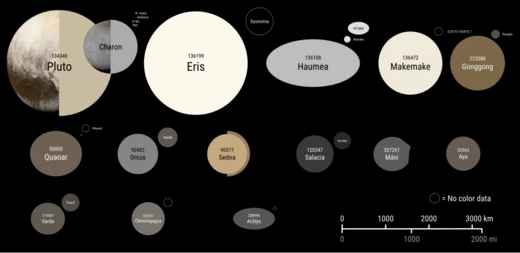
Notable cubewanos include 15760 Albion, the dwarf planet Makemake, Quaoar and 20000 Varuna (each once considered the largest known TNO), as well as 19521 Chaos, 58534 Logos, 53311 Deucalion, 66652 Borasisi, 88611 Teharonhiawako, (33001) 1997 CU29, (55636) 2002 TX300, 55565 Aya, 55637 Uni, and 486958 Arrokoth. Haumea was provisionally listed as a cubewano by the Minor Planet Center in 2006 but was later found to be in a resonant orbit.
Classical KBOs fall into two dynamical groups: a "cold" population with relatively unperturbed orbits and a "hot" population with markedly perturbed orbits. Most cubewanos lie between Neptune’s 2:3 orbital resonance (home to plutinos) and the 1:2 resonance. For instance, 50000 Quaoar has a near-circular orbit close to the ecliptic, while plutinos have more eccentric orbits that can bring some closer to the Sun than Neptune. The cold population, making up the majority, has low inclinations (under 5°) and near-circular orbits between 42 and 47 AU. The smaller hot population features highly inclined, more eccentric orbits. The terms "hot" and "cold" refer to orbital motion, not temperature, drawing an analogy to gas molecules that speed up when heated. The Deep Ecliptic Survey describes two distributions: a "Core" with inclinations centered at 4.6° and a "Halo" extending beyond 30°.
More than two-thirds of KBOs have inclinations below 5° and eccentricities under 0.1, with semi-major axes favoring the middle of the main belt; smaller objects near the limiting resonances may have been captured or had their orbits altered by Neptune.
- Semi major axis range
- 40–50 AU
- First discovered
- 15760 Albion (1992 QB1)
- Number of objects with q > 40 au and q <
- 870
- Inclination cut off between cold and hot
- 12° (per recent studies)
- Cold population inclination center
- 4.6° (Core)
- Hot population inclination range
- beyond 30° (Halo)
Lore & Background
The term 'cubewano' originates from the provisional designation of 15760 Albion, (15760) 1992 QB1, and similar objects were often called 'QB1-os' or 'cubewanos', though 'classical' is more frequent in scientific literature. Notable cubewanos include the dwarf planet Makemake, Quaoar, 20000 Varuna, 19521 Chaos, 58534 Logos, 53311 Deucalion, 66652 Borasisi, 88611 Teharonhiawako, (33001) 1997 CU29, (55636) 2002 TX300, 55565 Aya, 55637 Uni, and 486958 Arrokoth. Haumea was provisionally listed as a cubewano by the Minor Planet Center in 2006 but was later found to be in a resonant orbit.
There are two basic dynamical classes: the 'cold' population with low inclinations (<5°) and near-circular orbits between 42 and 47 AU, and the 'hot' population with highly inclined, more eccentric orbits. The terms refer to orbital characteristics, not temperature. The Deep Ecliptic Survey reports distributions with a Core centered at 4.6° and a Halo extending beyond 30°. The two populations also differ physically: the cold population is homogeneously red, while the hot population is more heterogeneous and bluish. Binaries are common on low-inclination orbits and typically similar-brightness, while on high-inclination orbits they are less common and components differ in brightness.
Reader's Guide
Classical Kuiper belt objects are significant as they represent a relatively undisturbed population of trans-Neptunian objects, offering insights into the early solar system. The distinction between cold and hot populations suggests at least two overlapping populations with different physical properties and orbital histories. The first known collisional family in the classical Kuiper belt is the Haumea family, which includes Haumea, its moons, 2002 TX300, and seven smaller bodies, all sharing similar orbits and surface composition rich in water ice. As of January 2019, only one classical KBO, 486958 Arrokoth, has been observed up close by spacecraft, visited by New Horizons on 1 January 2019 at a distance of 3,500 kilometers. The lack of an official definition for 'cubewano' or 'classical KBO' leads to differing classifications by the Minor Planet Center and the Deep Ecliptic Survey, with some objects like Makemake classified differently by each. The traditional usage includes objects between the 2:3 and 1:2 resonances (39.4 to 47.8 AU), but the boundary with the scattered disk remains blurred.
Did You Know?
- The name 'cubewano' derives from the provisional designation (15760) 1992 QB1 of the first trans-Neptunian object found after Pluto and Charon.
- More than 30% of all cubewanos are in low-inclination, near-circular orbits.
- The cold and hot populations differ in color: the cold population is red, while the hot population is more heterogeneous and bluish.
- As of 2023, there are 870 objects with perihelion > 40 AU and aphelion < 48 AU.
More in Trans-Neptunian Objects, Part 3 1-24
Spotted an error? Know more?
Reader corrections go straight into our review queue. Suggest an edit · How this site is sourced