2014 ST373
A detached TNO with the 8th highest perihelion known.

2014 ST373 is a trans-Neptunian object located in the outer Solar System, classified as a detached object. Its orbit brings it no closer than 50.2 AU from the Sun, a perihelion that ranks it among the top ten minor planets with the highest known perihelia. It is neither a scattered-disc object nor an extreme trans-Neptunian object.
The object orbits the Sun at distances ranging from 50.2 AU to 158.9 AU, with a semi-major axis of 104.53 AU. Its orbit has an eccentricity of 0.52 and an inclination of 43.16° relative to the ecliptic. One full orbit takes about 1069 years. Because its perihelion is well beyond Neptune’s orbit (30.1 AU), 2014 ST373 has never been close enough to Neptune to be gravitationally disturbed, distinguishing it from scattered-disc objects, which typically have perihelia under 38 AU. However, it does not qualify as an extreme trans-Neptunian object, which generally have higher perihelia or eccentricities. Instead, it occupies a sparsely populated region at a perihelion of 50 AU and an eccentricity of 0.5.
The Kozai mechanism, which can transfer orbital eccentricity into higher inclination, may have influenced 2014 ST373. If so, the object might once have been part of the extreme detached disc—objects with eccentricities above 0.8 and semi-major axes of at least 250 AU for a perihelion of 50 AU—and the Kozai effect could have gradually reduced its aphelion from over 450 AU to its current 159 AU while increasing its inclination. 2014 ST373 appears to belong to the same group as 2004 XR190.
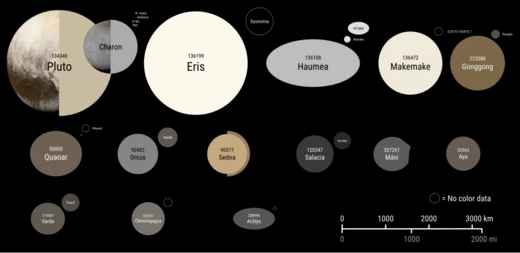
Based on an absolute magnitude of 5.4 and an assumed albedo of 0.09, its diameter is estimated at about 370 kilometers (230 miles). Its color, rotation period, pole orientation, and shape remain unknown. The object was first observed on 25 September 2014 using the Dark Energy Camera (DECam) at Cerro Tololo Inter-American Observatory in Chile.
Quick Facts
- Minorplanet
- yes
- Background
- #C2E0FF
- Discoverer
- CTIO-DECam / (first observed only)
- Discovered
- 25 September 2014
- Mpc Name
- 2014 ST · 373
- Mp Category
- TNOdetached / distant
- Epoch
- 31 May 2020 (JD 2459000.5)
- Uncertainty
- 53
- Observation Arc
- 792 d
- Aphelion
- 158.86 AU
- Perihelion
- 50.20 AU
- Time Periastron
- ≈ 14 July 2039 / ±4 months
Facts from the source article.
Lore & Background
2014 ST373 orbits the Sun at a distance of 50.2–158.9 AU once every 1069 years, with a semi-major axis of 104.53 AU. Its orbit has an eccentricity of 0.52 and an inclination of 43.16° with respect to the ecliptic. As of February 2020, it has the 8th highest perihelion of all known minor planets. Based on its perihelion of 50.2 AU, it is not a member of the scattered disc population, as those objects typically have perihelia of less than 38 AU and are gravitationally disturbed by Neptune; 2014 ST373's orbit has never brought it close enough to Neptune to be disturbed. It is also not an extreme trans-Neptunian object, as those generally have higher perihelia and/or higher eccentricities. Instead, it occupies a virtually unpopulated region at a perihelion of 50 AU and an eccentricity of 0.5.
The Kozai mechanism is capable of transferring orbital eccentricity to a higher inclination, and it can be speculated that this dynamical phenomenon affected the orbit of 2014 ST373. If so, and if the object had once belonged to the extreme detached disc objects (with eccentricities above 0.8 and semi-major axes of at least 250 AU), the Kozai effect would have slowly decreased its aphelion from over 450 AU to currently 159 AU while increasing its inclination. 2014 ST373 seems to belong to the same group as 2004 XR190.
Based on an absolute magnitude of 5.4 and an assumed albedo of 0.09, its diameter is approximately 370 kilometers. The body's color, rotation period, pole, and shape remain unknown.
Reader's Guide
2014 ST373 is significant as a detached object that occupies a sparsely populated region of the outer Solar System, with a perihelion of 50.2 AU that places it among the top 10 minor planets with the highest known perihelia. Its orbit, with a semi-major axis of 104.53 AU and eccentricity of 0.52, has never brought it close enough to Neptune to be gravitationally disturbed, distinguishing it from scattered disc objects. It is also not classified as an extreme trans-Neptunian object, as those typically have higher perihelia or eccentricities. The Kozai mechanism is speculated to have influenced its orbit, potentially reducing its aphelion from over 450 AU to 159 AU while increasing its inclination, linking it to the same group as 2004 XR190. Its legacy lies in helping to define the boundaries between different TNO populations and in illustrating the dynamical processes that shape the outer Solar System. The object was first observed in 2014 using the Dark Energy Camera at Cerro Tololo Inter-American Observatory, and its physical characteristics beyond diameter remain unknown.
Did You Know?
- 2014 ST373 has the 8th highest perihelion of all known minor planets as of February 2020.
- It is speculated that the Kozai mechanism may have decreased its aphelion from over 450 AU to 159 AU.
More in Trans-Neptunian Objects, Part 3 1-24
Spotted an error? Know more?
Reader corrections go straight into our review queue. Suggest an edit · How this site is sourced