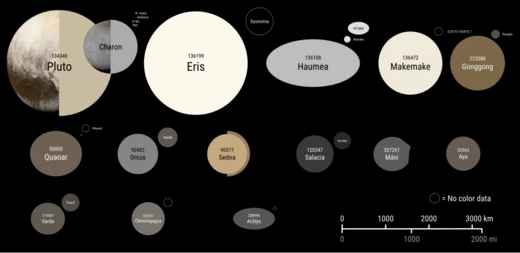
(84522) 2002 TC302
A red, icy possible dwarf planet in the scattered disk.

(84522) 2002 TC302 is an unnamed trans-Neptunian object in the scattered disk, orbiting the Sun on a highly distant and elliptical orbit. It is notable for being in a 2:5 orbital resonance with Neptune, for its large size of approximately 500 km in diameter, and for its cold, icy surface rich in complex organic compounds called tholins, which give it a red color. It is considered a possible dwarf planet.
Quick Facts
- Minorplanet
- yes
- Discovered
- 9 October 2002
- Discovery Site
- Palomar Observatory
- Mpc Name
- (84522) 2002 TC · 302
- Mp Category
- TNOSDO · 2:5 res.distant
- Epoch
- 21 November 2025 (JD 2461000.5)
- Uncertainty
- 2
- Observation Arc
- 25+ yr
- Earliest Precovery Date
- 5 August 2000
Facts from the source article.
Lore & Background
2002 TC302 was discovered on 9 October 2002 at Palomar Observatory by Chad Trujillo, Michael E. Brown, and the Near-Earth Asteroid Tracking program. Its discovery was announced by the Minor Planet Center on 7 November 2002, and precovery images from as early as 5 August 2000 were later found by Reiner Stoss. The object follows a highly tilted and elliptical orbit (eccentricity 0.29, inclination 35°) at distances ranging from 39.0 to 71.5 AU, with a semi-major axis of 55.3 AU. It is locked in a 2:5 mean-motion resonance with Neptune, meaning for every two orbits of 2002 TC302, Neptune makes exactly five. Simulations show it has a high probability of remaining in this stable resonance for at least 5 billion years.
Physically, 2002 TC302 has a mean diameter of about 500 km, with stellar occultation observations from 2018 revealing an oblate spheroid shape (major diameter 543 ± 18 km, minor diameter 460 ± 11 km). Its surface is very cold (up to 44 K at perihelion) and composed of frozen water, carbon dioxide, carbon monoxide, methanol, and tholins. Near-infrared spectroscopy by the James Webb Space Telescope identified these materials, and the object is classified as a "cliff1"-type or methanol-rich TNO. It rotates slowly, with a period of approximately 56 hours, and may have a large unresolved moon based on indirect evidence. Its density has not been measured, but is predicted to be around 0.8 g/cm³ or possibly at least 1.15 g/cm³ if in hydrostatic equilibrium.
Reader's Guide
2002 TC302 holds significance as a mid-sized trans-Neptunian object that bridges the gap between small, irregular bodies and dwarf planets. Its 2:5 orbital resonance with Neptune is one of the most common resonance types in the TNO population, and its stable orbit over billions of years provides insights into the dynamical evolution of the outer Solar System. The object was once thought to be much larger—early thermal emission measurements suggested a diameter up to 1,200 km—but revised downward after 2020, likely due to an unseen moon making it appear brighter. Its rich organic surface composition, including methanol and tholins, makes it a key target for understanding the chemistry of icy bodies beyond Neptune. The successful stellar occultations in 2018 and 2021 accurately determined its size and shape, and its possible status as a dwarf planet remains under study, pending further data on its density and shape irregularities. As of May 2026, it remains unnamed, awaiting a mythological name per IAU guidelines.
Did You Know?
- 2002 TC302 is in a 2:5 orbital resonance with Neptune, meaning its orbital period is exactly 2.5 times that of Neptune.
- Its surface contains frozen water, carbon dioxide, carbon monoxide, methanol, and complex organic compounds called tholins, which color it red.
- The first successful stellar occultation by 2002 TC302 was observed on 28 January 2018 by 12 telescopes across Europe.
Discovery and the Long Road to Confirmation
The story of 2002 TC302 began in the autumn of 2002, when astronomers Chad Trujillo and Michael E. Brown pointed the 1.2-meter Samuel Oschin telescope at Palomar Observatory toward the distant reaches beyond Neptune. Working in partnership with the Near-Earth Asteroid Tracking program, their team spotted the faint moving object on 9 October. The Minor Planet Center formally announced the find on 7 November, after multiple observatories confirmed the detection. At that point, however, the object's orbit remained poorly defined because so few observations existed. That changed in December when Reiner Stoss uncovered precovery images from NEAT archives dating back to 5 August 2000—more than two years before the official discovery—finally anchoring the orbital solution. For nearly two decades after that, the object's true size and shape stayed uncertain. That changed dramatically on 28 January 2018, when twelve European telescopes captured a stellar occultation, yielding the first precise measurements of its dimensions. A second occultation in November 2021, observed by nineteen telescopes across Europe and the United States, confirmed those results and cemented our understanding of this remote world.
A Resonant Dance with Neptune
Orbiting in the scattered disk far beyond Neptune, 2002 TC302 traces a tilted, elliptical path that carries it from 39.0 to 71.5 astronomical units from the Sun over a 411-year cycle. Its semi-major axis of 55.3 AU places it in a precise 2:5 mean-motion resonance with Neptune: for every two laps this object completes, Neptune finishes exactly five. This particular resonance is among the most frequently observed in the trans-Neptunian population. Neptune's gravitational pull continuously reshapes the orbit, and computer simulations project that over ten million years the semi-major axis could drift between 54.7 and 56.4 AU while the eccentricity swings from 0.29 to 0.45. Despite that variability, the resonance appears remarkably robust; the object has a high probability of remaining locked for at least five billion years—longer than the Solar System's current age. As of mid-2026, it sits 42.7 AU above the ecliptic plane, and its next perihelion passage is expected in October 2058.
Icy Surface and the Question of Roundness
Stellar occultation data reveal that 2002 TC302 is roughly 500 kilometers across, about one-fifth the diameter of Pluto, and takes the form of a flattened sphere—an oblate spheroid with a major axis near 543 km and a minor axis near 460 km. Its surface is a frozen tapestry of water ice, carbon dioxide, carbon monoxide, and methanol, laced with complex organic molecules known as tholins. These tholins, produced when solar and cosmic radiation bombards the ices, paint the surface a distinctive reddish hue. The object tumbles slowly, completing one rotation in roughly 56 hours, and indirect telescope evidence hints at a large, unresolved satellite in its vicinity. Because its mass may be sufficient to pull itself into hydrostatic equilibrium, researchers including Michael E. Brown and Noemi Pinilla-Alonso have floated the idea that it could qualify as a dwarf planet. Yet the unknown density and the fact that occultations have not entirely excluded surface irregularities keep that classification tentative.
An Unnamed Giant in the Outer Dark
Despite being one of the most prominent trans-Neptunian objects identified in the 2000s, 2002 TC302 still goes by its provisional designation. The Minor Planet Center assigned it the permanent number 84522 on 4 May 2004, yet as of May 2026 no official name has been bestowed. Under the International Astronomical Union's naming guidelines for small bodies, trans-Neptunian objects are expected to receive names drawn from mythology, but that step has not yet been taken. In the early years after discovery, thermal emission measurements suggested a diameter as large as 1,200 kilometers—roughly half that of Pluto—which briefly placed it among the largest known objects beyond Neptune. Subsequent occultation observations in 2018 and 2021 revised that estimate downward to the current ~500 km figure, reclassifying it as a mid-sized TNO. The gap between those early, optimistic size estimates and the more modest reality underscores how little we once knew about this distant body, and how much the occultation era has changed our picture.
More in Trans-Neptunian Objects, Part 3 1-24
Spotted an error? Know more?
Reader corrections go straight into our review queue. Suggest an edit · How this site is sourced