2014 FZ71
A distant scattered-detached object with an unusually circular orbit.

2014 FZ71 is a trans-Neptunian object in the scattered and detached category, found in the Solar System’s far outer reaches. Its orbit stands out because it is unusually circular for a scattered-disc object, and its perihelion—nearly 56 AU—is quite high. This places it among a rare, poorly understood set of very distant bodies that have moderate orbital eccentricities.
The object was first spotted on March 24, 2014, during a survey for distant Solar System objects beyond the Kuiper Cliff. The observing team, led by American astronomer Scott Sheppard, used wide-field cameras at the Cerro Tololo Inter-American Observatory in Chile. It takes 2014 FZ71 about 660 years to circle the Sun, traveling between roughly 55.8 and 95.8 AU, with an orbital eccentricity of 0.26 and an inclination of 26° relative to the ecliptic. Its orbit suggests it may be in a 1:4 resonance with Neptune, similar to a few other objects, but with a lower eccentricity and thus a higher perihelion.
Because traditional scattered-disc objects typically have highly eccentric orbits and perihelia under 38 AU, the low eccentricity and distant perihelion of 2014 FZ71 challenge current models of how such bodies form. Possible explanations include past close stellar passages, interactions with an unseen planet or rogue planetary embryos in the early Kuiper belt, or resonance effects from a migrating Neptune. The Kozai mechanism could also play a role by shifting orbital eccentricity into inclination.
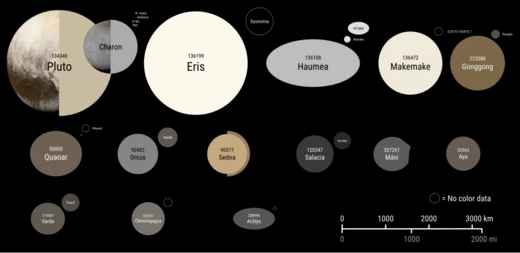
In terms of size, 2014 FZ71 is estimated to be between 125 and 185 kilometers across—about a quarter the diameter of the similar object 2004 XR190, and far smaller than Pluto. This means it does not qualify as a dwarf planet candidate.
Quick Facts
- Minorplanet
- yes
- Background
- #C2E0FF
- Discoverer
- CTIO
- Discovery Site
- CTIO / (first observed only)
- Discovered
- 24 March 2014
- Mpc Name
- 2014 FZ · 71
- Mp Category
- TNO · detached · SDO · distant
- Epoch
- 27 April 2019 (JD 2458600.5)
- Uncertainty
- 6
- Observation Arc
- 1.96 yr (716 d)
- Aphelion
- 95.791 AU
- Perihelion
- 55.849 AU
Facts from the source article.
Lore & Background
2014 FZ71 was first observed on 24 March 2014 by a team led by American astronomer Scott Sheppard at the Cerro Tololo Inter-American Observatory in Chile, as part of a survey for distant Solar System objects beyond the Kuiper Cliff. It orbits the Sun at a distance of 55.8–95.8 AU once every 660 years and 3 months, with a moderate eccentricity of 0.26 and an inclination of 26°. The object belongs to the same orbital group as 2004 XR190 ('Buffy'), 2014 FC72, 2015 FJ345, and 2015 KQ174, and appears to be in a 1:4 resonance with Neptune, similar to 2003 LA7 and 2011 UP411, but with a lower eccentricity and higher perihelion.
Considered a scattered and detached object, 2014 FZ71 is particularly unusual because it has an unusually circular orbit for a scattered-disc object. Traditional scattered-disc objects are thought to have been ejected into their current orbits by gravitational interactions with Neptune, but the low eccentricity of its orbit and its perihelion distance (SDOs generally have highly eccentric orbits and perihelia less than 38 AU) seem hard to reconcile with such celestial mechanics. This has led to uncertainty in the theoretical understanding of the outer Solar System, with proposed explanations including close stellar passages, unseen planets or rogue planetary embryos in the early Kuiper belt, and resonance interaction with an outward-migrating Neptune. The Kozai mechanism may also transfer orbital eccentricity to a higher inclination.
Reader's Guide
2014 FZ71 holds significance as a member of a small and poorly understood group of very distant trans-Neptunian objects with moderate eccentricities. Its unusually circular orbit for a scattered-disc object challenges the standard model of scattered-disc formation via gravitational interactions with Neptune, as its perihelion of almost 56 AU and low eccentricity (0.26) are difficult to reconcile with that mechanism. The object's classification as both scattered and detached highlights the ambiguity in current theoretical frameworks. Its orbital characteristics, including a 1:4 resonance with Neptune, link it to a handful of other distant objects such as 2004 XR190, 2014 FC72, 2015 FJ345, and 2015 KQ174. The uncertainty surrounding its origin—whether from close stellar passages, unseen planets, or resonance migration—underscores the gaps in understanding the outer Solar System's dynamical history. At roughly 150 kilometers in diameter, it is not a dwarf planet candidate, but its physical and orbital properties make it a key object for studying the boundary between scattered and detached populations.
Did You Know?
- 2014 FZ71 has an unusually circular orbit for a scattered-disc object, with an eccentricity of only 0.26.
- Its perihelion of almost 56 AU is much higher than typical scattered-disc objects, which usually have perihelia less than 38 AU.
- It is not a dwarf planet candidate, with an estimated diameter of approximately 150 kilometers.
Discovery and the Push Beyond the Kuiper Cliff
2014 FZ71 entered the catalog of known Solar System bodies on 24 March 2014, when a research group directed by Scott Sheppard of the Carnegie Institution for Science detected it during a dedicated survey aimed at finding extremely distant objects residing beyond the so-called Kuiper Cliff. The observation campaign made use of newly installed wide-field camera systems mounted on two major research telescopes: the Subaru telescope and the Cerro Tololo Inter-American Observatory in Chile. Sheppard's team had specifically structured this survey to extend the reach of detection into the far outer regions of the Solar System, where objects are sparse and challenging to identify. The fact that 2014 FZ71 was captured during this targeted effort highlights how the most remote stretches of our planetary neighborhood continue to be charted, one careful imaging session at a time, by teams equipped with the latest wide-field optical technology. The discovery adds another data point to the growing inventory of bodies orbiting far beyond Neptune.
An Unusually Circular Path in the Scattered Disc
2014 FZ71 traces an elliptical path around the Sun spanning from 55.8 to 95.8 astronomical units, completing one full revolution in approximately 660 years and three months, corresponding to a semi-major axis of 75.82 AU. Its orbital eccentricity of 0.26 is considered moderate, and the orbit is tilted 26 degrees relative to the ecliptic plane. The perihelion sits at nearly 56 AU, placing it well outside the typical range for scattered-disc objects, whose perihelia generally fall below 38 AU. Astronomers have noted a possible 1:4 mean-motion resonance with Neptune, a relationship also shared by 2003 LA7 and 2011 UP411, though 2014 FZ71 exhibits a lower eccentricity and consequently a higher perihelion than those resonant companions. It shares its orbital family with 2004 XR190, nicknamed Buffy, along with 2014 FC72, 2015 FJ345, and 2015 KQ174. Despite its scattered-disc designation, the object's notably circular orbit and distant perihelion make it a striking outlier within its classification.
A Modest Body in a Distant Neighborhood
Estimates place the diameter of 2014 FZ71 somewhere between 125 and 185 kilometers, with a central figure of approximately 150 kilometers frequently cited. For context, the object is roughly one-quarter the size of 2004 XR190, the larger trans-Neptunian body nicknamed Buffy, which is estimated at around 500 kilometers in diameter. It is also approximately a quarter the size of Pluto, the most recognized dwarf planet in the outer Solar System. These dimensions firmly place 2014 FZ71 among the smaller trans-Neptunian objects rather than in the class of larger bodies that might be considered for dwarf-planet designation. It is explicitly noted in the literature as not being a dwarf planet candidate, a status consistent with its modest physical scale. The object belongs to a small and poorly understood group of very distant bodies with moderate orbital eccentricities, and its relatively compact size means it contributes a modest but valuable data point to our statistical picture of the population of small bodies populating the outermost reaches of the Solar System.
Challenging the Textbook Story of Scattered-Disc Dynamics
The orbital characteristics of 2014 FZ71 pose a genuine challenge to prevailing models of how scattered-disc objects acquired their current trajectories. Standard theory holds that traditional scattered-disc bodies were flung into their elongated orbits through gravitational encounters with Neptune. Yet 2014 FZ71's low eccentricity of 0.26 and its perihelion at nearly 56 AU sit awkwardly within that framework, since most SDOs display far more eccentric paths with perihelia well under 38 AU. This tension has generated uncertainty in the broader theoretical understanding of the outer Solar System. Several alternative explanations have been proposed to account for objects like 2014 FZ71: close passages by passing stars, the gravitational influence of unseen rogue planets or planetary embryos that once populated the early Kuiper belt, and resonant interactions with a Neptune that migrated outward over time. The Kozai mechanism, which can convert orbital eccentricity into higher inclination, has also been invoked as a possible contributor. Until a coherent model accounts for this class of objects, 2014 FZ71 remains a reminder that the outer Solar System still harbors dynamical puzzles.
More in Trans-Neptunian Objects, Part 3 1-24
Spotted an error? Know more?
Reader corrections go straight into our review queue. Suggest an edit · How this site is sourced