(145480) 2005 TB190
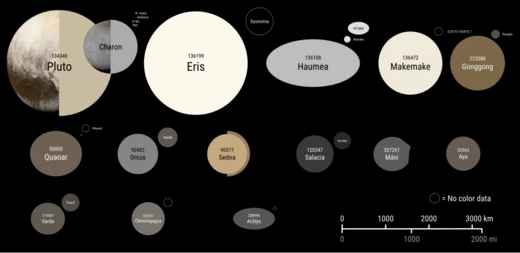
A scattered-extended TNO with a 507 km diameter.

(145480) 2005 TB190 is a trans-Neptunian object with an absolute magnitude of 4.4. The Deep Ecliptic Survey classifies it as scattered-extended, meaning its orbit is far enough from Neptune that the planet’s current orbit does not significantly affect it gravitationally. However, if Neptune migrated outward and had a higher eccentricity at some point, the object could have been influenced then. Its aphelion is 104 AU. A 2007 simulation by Emelʹyanenko and Kiseleva found less than a 1% chance that it is in a 4:1 resonance with Neptune. Over seven oppositions, it has been observed 202 times, with precovery images dating back to November 2001. It reached perihelion in January 2017. The Herschel Space Telescope measured its thermal flux in 2010, initially estimating a size range of 335 to 410 km, later revised to about 507 km (315 mi). Its visible light shows a moderately red spectral slope. In 2009, its rotation period was determined to be 12.68 ± 3 hours, typical for a TNO of its size; for comparison, the similarly sized (120348) 2004 TY364 has a rotation period of 11.7 ± 3 hours.
Quick Facts
- Minorplanet
- yes
- Background
- #C2E0FF
- Discoverer
- Becker, A. C., Puckett, A. W., Kubica, J at Apache Point (705)
- Discovered
- 11 October 2005
- Mpc Name
- (145480) 2005 TB · 190
- Mp Category
- Ext-SDO (DES)
- Epoch
- 13 January 2016 (JD 2457400.5)
- Uncertainty
- 3
- Aphelion
- 104.14 AU (Q)
- Perihelion
- 46.197 AU (q)
- Semimajor
- 75.166 AU (a)
- Eccentricity
- 0.38540 (e)
Facts from the source article.
Lore & Background
2005 TB190 was observed 202 times over seven oppositions, with precovery observations dating back to November 2001. It came to perihelion in January 2017. Simulations by Emelʹyanenko and Kiseleva in 2007 showed that it appears to have less than a 1% chance of being in a 4:1 resonance with Neptune. If Neptune migrated outward, there would have been a period when Neptune had a higher eccentricity.
In 2010, thermal flux from 2005 TB190 in the far-infrared was measured by the Herschel Space Telescope. Initially, its size was estimated to lie within a range from 335 to 410 km; upon further analysis, its size was estimated to be around 507 km. In visible light, it has a moderately red spectral slope. The TNO was found in 2009 to have a rotation period of 12.68 ± 3 hours, a common value for trans-Neptunian objects of its size.
Reader's Guide
The significance of (145480) 2005 TB190 lies in its classification as a scattered-extended object, which places it in a dynamical class that may preserve clues about Neptune's migration history. The article notes that if Neptune migrated outward with higher eccentricity, such objects could have been affected. Its size estimate of around 507 km, derived from Herschel thermal measurements, places it among the larger known TNOs. The rotation period of 12.68 ± 3 hours is typical for objects of its size, as exemplified by similarly sized (120348) 2004 TY364. The low probability (less than 1%) of a 4:1 resonance with Neptune further distinguishes its orbital history. The object's moderately red spectral slope adds to the understanding of surface compositions in the outer Solar System.
Did You Know?
- 2005 TB190 has an absolute magnitude of 4.4.
- Its aphelion lies at 104 AU.
- Its size was estimated to be around 507 km after further analysis of Herschel data.
More in Trans-Neptunian Objects, Part 3 1-24
Spotted an error? Know more?
Reader corrections go straight into our review queue. Suggest an edit · How this site is sourced