(79983) 1999 DF9
A classical Kuiper belt object discovered in 1999.

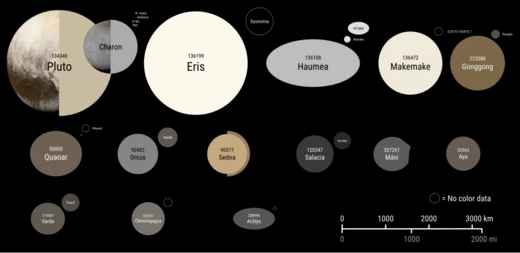
(79983) 1999 DF9 is a trans-Neptunian object of the Kuiper belt, classified as a non-resonant cubewano. It measures approximately 270 kilometers in diameter and was discovered on 20 February 1999 by American and British astronomers Jane Luu, Chad Trujillo and David C. Jewitt at the U.S. Kitt Peak National Observatory in Arizona.
Quick Facts
- Minorplanet
- yes
- Background
- #C2E0FF
- Discovered
- 20 February 1999
- Discoverer
- J. X. Luu / C. Trujillo / D. C. Jewitt
- Discovery Site
- Kitt Peak National Obs.
- Mpc Name
- (79983) 1999 DF · 9
- Mp Category
- TNOcubewano
- Epoch
- 4 September 2017 (JD 2458000.5)
- Uncertainty
- 2
- Observation Arc
- 17.06 yr (6,231 days)
- Aphelion
- 53.567 AU
- Perihelion
- 39.830 AU
Facts from the source article.
Lore & Background
The minor planet was discovered on 20 February 1999 by Jane Luu, Chad Trujillo and David C. Jewitt at Kitt Peak National Observatory. No precoveries were taken, so its observation arc begins with the discovery observation. It is a classical Kuiper belt object, or cubewano, meaning it is not in orbital resonance with Neptune and does not cross that planet's orbit. Its orbit has a semi-major axis ranging from 39.8 to 53.6 AU, an eccentricity of 0.15, and an inclination of 10° relative to the ecliptic. This eccentricity is relatively high for a cubewano, which typically have eccentricities of 0.10 or less.
In February 2001, a rotational lightcurve was published from photometric observations by Portuguese astronomer Pedro Lacerda and Jane Luu. The lightcurve analysis gave a rotation period of 6.65 hours with a brightness variation of 0.40 magnitude. The Collaborative Asteroid Lightcurve Link assumes a low albedo of 0.10 and calculates a mean-diameter of 265 kilometers based on an absolute magnitude of 6.0, while Johnston's Archive gives a diameter of 306 kilometers for an albedo of 0.09. The minor planet was numbered by the Minor Planet Center on 4 May 2004, and as of 2025 it has not been named.
Reader's Guide
The significance of (79983) 1999 DF9 lies in its classification as a classical Kuiper belt object, or cubewano, which are not in orbital resonance with Neptune. Its relatively high eccentricity of 0.15, compared to the typical 0.10 or less for cubewanos, makes it a notable example of a more eccentric member of this population. The object's diameter is uncertain, with estimates ranging from 265 to 306 kilometers depending on assumed albedo, reflecting the challenges in characterizing distant trans-Neptunian objects. The rotational lightcurve, published in 2001, provides a rotation period of 6.65 hours, contributing to the understanding of the physical properties of Kuiper belt objects. Its discovery by a team including Jane Luu, Chad Trujillo, and David C. Jewitt—key figures in Kuiper belt research—adds to its legacy. As of 2025, it remains unnamed, which is common for many minor planets in this region.
Did You Know?
- Its rotation period is 6.65 hours, determined from photometric observations published in February 2001.
- The object has a relatively high orbital eccentricity of 0.15 for a classical Kuiper belt object.
- It was numbered by the Minor Planet Center on 4 May 2004 and has not been named as of 2025.
More in Trans-Neptunian Objects, Part 3 1-24
Spotted an error? Know more?
Reader corrections go straight into our review queue. Suggest an edit · How this site is sourced