(690420) 2014 FC72
A scattered-detached object with an unusually circular orbit.

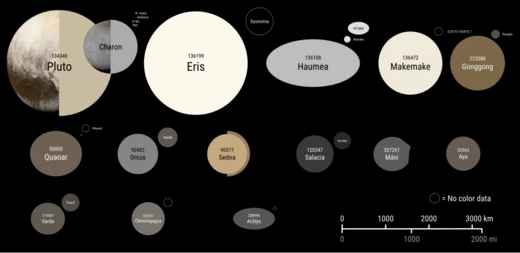
(690420) 2014 FC72 is a trans-Neptunian object in the outer Solar System, categorized as both a scattered and detached object. It was first spotted on March 24, 2014, by the Pan-STARRS survey at Hawaii’s Haleakala Observatory. Its orbit keeps it far from Neptune at its closest approach, placing it in a small, poorly understood group of objects with moderate eccentricities. Based on a low albedo, its diameter is estimated at 500 km. The object orbits the Sun at distances ranging from 51.7 to 100.6 AU, completing one revolution every 664 years (242,547 days) along a semi-major axis of 76.11 AU. Its orbit has a moderate eccentricity of 0.32 and is tilted 30° relative to the ecliptic. It shares an orbital group with objects like (612911) 2004 XR190 (“Buffy”), 2014 FZ71, 2015 FJ345, and 2015 KQ174. With its 664-year period, it appears to be in a 1:4 resonance with Neptune, similar to 2003 LA7 and 2011 UP411, though with lower eccentricities and higher perihelia. What makes 2014 FC72 unusual is its unusually circular orbit for a scattered-disc object. Traditional scattered-disc objects are thought to have been flung into their current paths by Neptune’s gravity, typically resulting in highly eccentric orbits with perihelia under 38 AU. The low eccentricity and distant perihelion of this object challenge that picture, leading to uncertainty about how the outer Solar System formed. Proposed explanations include close stellar flybys, an unseen planet or rogue planetary embryos in the early Kuiper belt, or resonance interactions with an outward-migrating Neptune. The Kozai mechanism could also transfer orbital eccentricity into a higher inclination. Physically, 2014 FC72 has a diameter estimated at 500 km, roughly a fifth the size of Pluto. Johnston’s Archive gives a diameter of 431 kilometers (268 miles) assuming an albedo of 0.124, while Mike Brown’s estimate of 506 kilometers (314 miles) assumes an albedo of 0.07. However, Brown’s estimate relies on an outdated absolute magnitude of 5.0, rather than the more recent values of 4.68 or 4.70.
Quick Facts
- Minorplanet
- yes
- Background
- #C2E0FF
- Discoverer
- Pan-STARRS 1
- Discovery Site
- Haleakala Obs.
- Discovered
- 24 March 2014 / (first observed only)
- Mpc Name
- (690420) 2014 FC · 72
- Mp Category
- TNO · detached · SDO · distant
- Epoch
- 27 April 2019 (JD 2458600.5)
- Uncertainty
- 3
- Observation Arc
- 16.91 yr (6,178 d)
- Aphelion
- 100.57 AU
- Perihelion
- 51.663 AU
Facts from the source article.
Lore & Background
2014 FC72 was first observed on 24 March 2014 by astronomers with the Pan-STARRS survey at Haleakala Observatory, Hawaii, United States. It orbits the Sun at a distance of 51.7–100.6 AU once every 664 years, with a semi-major axis of 76.11 AU, a moderate eccentricity of 0.32, and an inclination of 30° with respect to the ecliptic. The object belongs to the same orbital group as (612911) 2004 XR190 ("Buffy"), 2014 FZ71, 2015 FJ345, and 2015 KQ174, and may be a resonant trans-Neptunian object in a 1:4 resonance with Neptune, similar to 2003 LA7 and 2011 UP411 but with lower eccentricities and higher perihelia. Considered a scattered and detached object, 2014 FC72 is particularly unusual because it has an unusually circular orbit for a scattered-disc object. Traditional scattered-disc objects are thought to have been ejected into their current orbits by gravitational interactions with Neptune, but the low eccentricity of its orbit and the distance of its perihelion seem hard to reconcile with such celestial mechanics. This has led to some uncertainty in the current theoretical understanding of the outer Solar System. Proposed explanations include close stellar passages, unseen planet or rogue planets or planetary embryos in the early Kuiper belt, and resonance interaction with an outward-migrating Neptune. The Kozai mechanism is also capable of transferring orbital eccentricity to a higher inclination. Physical characteristics: 2014 FC72 has a diameter estimated at 400 to 500 kilometers, making it approximately 18% to 21% the size of the dwarf planet Pluto. Johnston's Archive estimates 431 kilometers, and Mike Brown estimates 506 kilometers, assuming albedos of 0.124 and 0.07 respectively. However, Mike Brown's estimate uses an outdated absolute magnitude of 5.0, not the newer 4.68 nor 4.70.
Reader's Guide
The significance of (690420) 2014 FC72 lies in its challenge to the standard model of scattered-disc object formation. Its unusually circular orbit and high perihelion distance are difficult to explain solely by gravitational interactions with Neptune, which typically produce highly eccentric orbits with perihelia less than 38 AU. This discrepancy has led to uncertainty in the theoretical understanding of the outer Solar System, prompting alternative theories such as close stellar passages, the presence of an unseen planet or rogue planets or planetary embryos in the early Kuiper belt, and resonance interaction with an outward-migrating Neptune. The Kozai mechanism is also considered as a possible explanation. As a member of a small group of objects with moderate eccentricities, 2014 FC72 contributes to the ongoing debate about the dynamical history and evolution of the trans-Neptunian region. Its estimated diameter of 400 to 500 kilometers places it among the larger known trans-Neptunian objects, though its exact size remains uncertain due to differing albedo assumptions and absolute magnitude values.
Did You Know?
- Its diameter is estimated at 400 to 500 kilometers, about 18% to 21% the size of Pluto.
- It may be in a 1:4 orbital resonance with Neptune, similar to 2003 LA7 and 2011 UP411.
More in Trans-Neptunian Objects, Part 3 1-24
Spotted an error? Know more?
Reader corrections go straight into our review queue. Suggest an edit · How this site is sourced