(674118) 2015 KH162
A large scattered-disc object at twice Neptune's distance.

(674118) 2015 KH162 is a sizable minor planet located in the scattered disc, a region of the outer Solar System beyond Neptune. Discovered in 2015, it ranks among the most remote known objects from the Sun, sitting at about 60.6 astronomical units (AU)—roughly double Neptune's average orbital distance. On 2 June 2026, the Hubble Space Telescope captured images of it while surveying large trans-Neptunian objects for potential moons.
Quick Facts
- Minorplanet
- yes
- Discoverer
- S. Sheppard / D. Tholen / C. Trujillo
- Discovery Site
- Mauna Kea Obs.
- Discovered
- 18 May 2015
- Mpc Name
- (674118) 2015 KH · 162
- Mp Category
- TNOSDO / near-scattered (DES)
- Epoch
- 1 July 2021 (JD 2459396.5)
- Uncertainty
- 2
- Observation Arc
- 11.36 yr (4,149 d)
- Aphelion
- 82.117 AU
- Perihelion
- 41.513 AU
- Semimajor
- 61.815 AU
Facts from the source article.
Lore & Background
2015 KH162 was first observed on 18 May 2015, in the constellation of Serpens by astronomers at the Mauna Kea Observatories using the Subaru Telescope. The discovery was announced by Scott Sheppard, David Tholen and Chad Trujillo on 23 February 2016. At the time, this minor planet was at a distance of 59.0 AU from the Sun and had a relatively bright magnitude of 21.4 for its enormous distance.
The object orbits the Sun at a distance of 41.5–82.1 AU once every 486 years (177,517 days; semi-major axis of 61.82 AU). Its orbit has an eccentricity of 0.33 and an inclination of 29° with respect to the ecliptic. It is classified as a scattered disc object, or "near-scattered" object in the classification of the Deep Ecliptic Survey, that still gravitationally interacts with Neptune (30.1 AU) due to its relatively low perihelion of 41.5 AU, contrary to the extended-scattered/detached objects and sednoids.
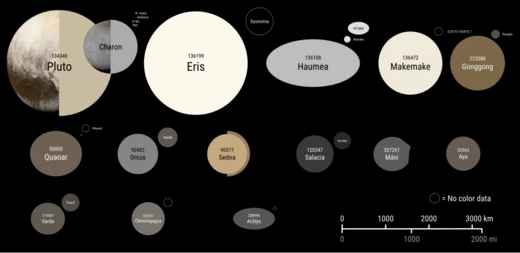
Based on a generic magnitude-to-diameter conversion, 2015 KH162 measures approximately 566 kilometers (350 miles) in diameter, for an assumed albedo of 0.124 and a magnitude of 4.1. As of 2021, no rotational lightcurve for this object has been obtained from photometric observations. The body's rotation period and pole as well as its albedo and surface composition remain unknown.
Reader's Guide
2015 KH162 is notable as one of the most distant known minor planets in the Solar System, currently at about 61.9 AU—twice as far from the Sun as Neptune. Its orbit, with a perihelion of 41.5 AU, places it in the near-scattered disc category, meaning it still gravitationally interacts with Neptune, unlike more detached objects. The object last came to perihelion around 1930 and is moving away from the Sun; it will reach aphelion at 82.1 AU in 2415. The Hubble Space Telescope photographed it on 2 June 2026 during a search for moons around large trans-Neptunian objects, highlighting ongoing interest in its physical nature. Despite its large estimated diameter of about 566 kilometers, its rotation period, pole, albedo, and surface composition remain unknown as of 2021, underscoring the need for further photometric observations. Its discovery by Sheppard, Tholen, and Trujillo using the Subaru Telescope in 2015, and announcement in 2016, contributed to the census of distant Solar System bodies.
Did You Know?
- It is currently about 61.9 AU from the Sun, twice as far as Neptune.
- Its estimated diameter is approximately 566 kilometers, based on an assumed albedo of 0.124.
More in Trans-Neptunian Objects, Part 3 1-24
Spotted an error? Know more?
Reader corrections go straight into our review queue. Suggest an edit · How this site is sourced