(612911) 2004 XR190
A distant, highly inclined trans-Neptunian object with a circular orbit.

(612911) 2004 XR190, nicknamed Buffy by its discovery team, is a trans-Neptunian object classified as both a scattered disc object and a detached object. It is notable for its unusually circular orbit and high inclination of 47°, making it one of the largest known highly inclined objects in the outer Solar System.
Quick Facts
- Minorplanet
- yes
- Background
- #C2E0FF
- Discoverer
- CFEPS
- Discovery Site
- Maunakea Obs.
- Discovered
- 11 December 2004
- Mpc Name
- (612911) 2004 XR · 190
- Mp Category
- TNO · detached · SDO · distant
- Epoch
- 2025 Ṃay 05 (JD 2460800.5)
- Uncertainty
- 2
- Observation Arc
- 20.00 yr (8,036 d)
- Earliest Precovery Date
- 6 December 2002
- Aphelion
- 64.05 AU
Facts from the source article.
Lore & Background
2004 XR190 was first observed on 11 December 2004 by astronomers with the Canada–France Ecliptic Plane Survey at the Mauna Kea Observatories. The discovery team, led by Rhiannon Lynne Allen of the University of British Columbia, included Brett Gladman, John Kavelaars, Jean-Marc Petit, Joel Parker, and Phil Nicholson. They nicknamed it Buffy after the fictional vampire slayer Buffy Summers, and proposed several Inuit-based official names to the International Astronomical Union in 2005. In 2015, six precovery images from 2002 and 2003 were found in Sloan Digital Sky Survey data.
Its orbit has a moderate eccentricity of 0.11 and a high inclination of 47°, with a perihelion of 51 AU and aphelion of 63.4 AU. It came to aphelion around 1901. The object belongs to a small group of distant objects with large perihelia and moderate eccentricities, including 2014 FC72, 2014 FZ71, 2015 FJ345, and 2015 KQ174. Its unusually circular orbit for a scattered-disc object challenges traditional models, as scattered-disc objects typically have highly eccentric orbits and perihelia less than 38 AU. Theories to explain its orbit include close stellar passages, unseen planets or planetary embryos in the early Kuiper belt, and resonance interaction with an outward-migrating Neptune; the Kozai mechanism may also transfer orbital eccentricity to higher inclination.
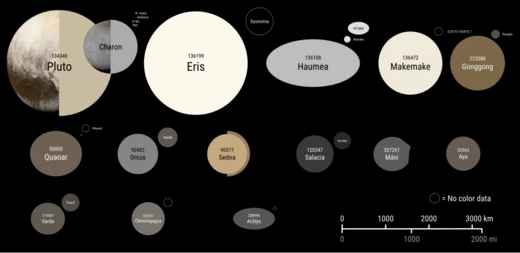
Physically, with assumed albedos between 0.04 and 0.25 and absolute magnitudes from 4.3 to 4.6, its estimated diameter ranges from 335 to 850 km, with a mean of 562 km—about a quarter the diameter of Pluto. As of 2018, no well-documented spectral type, color indices, or rotational lightcurve have been obtained, though Johnston's Archive lists a taxonomic type of "BR" and a B-R magnitude of 1.24. Its rotation period, pole, and shape remain unknown.
Reader's Guide
2004 XR190 is significant primarily because its nearly circular orbit at a high inclination and large perihelion challenges the prevailing understanding of how scattered-disc objects form. Traditional models hold that such objects are ejected into eccentric orbits by gravitational interactions with Neptune, but this object's low eccentricity and perihelion of 51 AU do not fit that pattern. This discrepancy has led to uncertainty in theoretical models of the outer Solar System, prompting alternative explanations such as close stellar passages, the presence of unseen planets or planetary embryos in the early Kuiper belt, or resonance interactions with an outward-migrating Neptune. The Kozai mechanism, which can exchange orbital eccentricity for inclination, is also considered. As one of the largest known objects with an inclination greater than 45°, it travels more vertically than horizontally relative to the ecliptic. Its discovery as part of the Canada–France Ecliptic Plane Survey highlights the ongoing effort to map the outer Solar System and understand the dynamical history of its most distant members. The object's legacy lies in its role as a puzzle piece that may refine or revise theories of Solar System evolution.
Did You Know?
- 2004 XR190 was nicknamed Buffy by the discovery team after the fictional vampire slayer Buffy Summers.
- It has an unusually circular orbit for a scattered-disc object, with an eccentricity of only 0.11.
- Its estimated mean diameter is 562 km, about a quarter the diameter of Pluto.
More in Trans-Neptunian Objects, Part 3 1-24
Spotted an error? Know more?
Reader corrections go straight into our review queue. Suggest an edit · How this site is sourced