(612584) 2003 QX113
A scattered-disc object discovered near aphelion in 2003.

(612584) 2003 QX113 is a scattered-disc object in the outer Solar System, beyond Neptune. Astronomers with the Canada–France Ecliptic Plane Survey at Hawaii’s Mauna Kea Observatories spotted it on 31 August 2003, when it was close to its farthest point from the Sun. It holds the distinction of being the most distant object found by that survey.
The object follows an elliptical orbit that takes it between 37.7 and 62.2 astronomical units (AU) from the Sun, completing one circuit every 353 years. Its path is tilted about 7° relative to the plane of the planets, with an eccentricity of 0.25. It last reached its closest point to the Sun (perihelion) around 1882 and has been moving outward ever since; it is currently about 60.5 AU away and will reach aphelion around 2058. Because its perihelion is relatively low at 37.7 AU, it still interacts gravitationally with Neptune, which orbits at 30.1 AU. This distinguishes it from more detached objects that never approach Neptune so closely. The Canada–France survey classified it as a “detached classical belt object,” meaning its semi-major axis lies beyond the 2:1 mean-motion resonance with Neptune (beyond 47.8 AU) and its eccentricity exceeds 0.24.
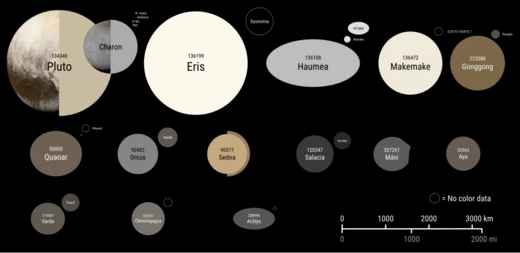
Based on a generic brightness-to-size conversion assuming an albedo of 0.9 and a magnitude of 5.1, its diameter is estimated at roughly 423 kilometers. As of 2021, no rotational lightcurve has been obtained, so its rotation period, pole orientation, and shape remain unknown.
Quick Facts
- Minorplanet
- yes
- Background
- #C2E0FF
- Discoverer
- CFEPS8
- Discovery Site
- Mauna Kea Obs.
- Discovered
- 31 August 2003
- Mpc Name
- (612584) 2003 QX · 113
- Mp Category
- TNOSDO / near-scattered (DES)
- Epoch
- 1 July 2021 (JD 2459396.5)
- Uncertainty
- 23
- Observation Arc
- 14.34 yr (5,236 d)
- Aphelion
- 62.238 AU
- Perihelion
- 37.674 AU
Facts from the source article.
Lore & Background
2003 QX113 orbits the Sun at a distance of 37.7–62.2 AU once every 353 years and 1 month, with a semi-major axis of 49.96 AU. Its orbit has an eccentricity of 0.25 and an inclination of 7° with respect to the ecliptic. It last came to perihelion around 1882, moving away from the Sun ever since, and is currently about 60.5 AU from the Sun; it will reach its aphelion around 2058.
It is classified as a scattered disc object, or "near-scattered" object in the classification of the Deep Ecliptic Survey, that still gravitationally interacts with Neptune (30.1 AU) due to its relatively low perihelion of 37.7 AU, contrary to extended-scattered/detached objects and sednoids. It has also been described as a "detached classical belt object" by the discovering Canada–France Ecliptic Plane Survey (CFEPS), defined as objects with a semi-major axis beyond the 2:1 mean-motion resonance (beyond the twotino population at 47.8 AU) and with an eccentricity larger than 0.24.
Based on a generic magnitude-to-diameter conversion, 2003 QX113 measures approximately 423 kilometers in diameter, for an assumed albedo of 0.9 and a magnitude of 5.1. As of 2021, no rotational lightcurve has been obtained; its rotation period, pole, and shape remain unknown.
Reader's Guide
2003 QX113 holds significance as the furthest object discovered in the Canada–France Ecliptic Plane Survey, a survey that contributed to understanding the outer Solar System's population. Its orbit places it in the scattered disc, but its classification is nuanced: the Deep Ecliptic Survey labels it a "near-scattered" object because its perihelion of 37.7 AU allows gravitational interaction with Neptune, distinguishing it from more detached objects. Meanwhile, the discovering CFEPS describes it as a "detached classical belt object," defined by a semi-major axis beyond the 2:1 resonance with Neptune and an eccentricity above 0.24. This dual classification highlights the ongoing refinement of trans-Neptunian object taxonomy. The object's estimated diameter of about 423 kilometers places it among the larger known scattered-disc objects, yet its physical properties remain poorly constrained—no rotational lightcurve has been obtained, so its rotation period, pole, and shape are unknown. Its discovery near aphelion in 2003, and its current distance of about 60.5 AU, underscore the challenges of observing such distant bodies. The object's legacy lies in its role as a benchmark for surveys mapping the outer Solar System and for illustrating the gradations between scattered-disc and detached populations.
Did You Know?
- 2003 QX113 was discovered when it was near aphelion on 31 August 2003.
- Its estimated diameter is approximately 423 kilometers (260 miles), based on an assumed albedo of 0.9.
- No rotational lightcurve has been obtained for this object as of 2021.
More in Trans-Neptunian Objects, Part 3 1-24
Spotted an error? Know more?
Reader corrections go straight into our review queue. Suggest an edit · How this site is sourced