(574372) 2010 JO179
A large, resonant trans-Neptunian object possibly qualifying as a dwarf planet.

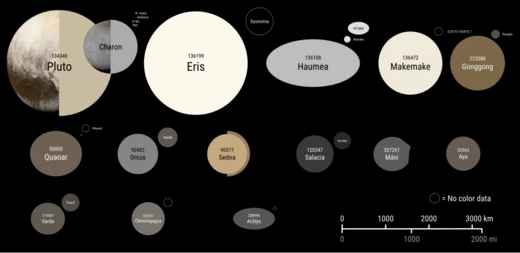
(574372) 2010 JO179 is a large object in the outer Solar System, orbiting beyond Neptune in a high-order resonance. Its diameter is estimated at 600 to 900 kilometers, and it may be massive enough to qualify as a dwarf planet. No high-resolution images have been taken, and no moons have been detected. The Hubble Space Telescope is scheduled to observe it in 2026, which should reveal whether it has any sizable satellites.
The object was first officially observed on May 10, 2010, by the Pan-STARRS survey at Haleakala Observatory in Hawaii. Precovery images from the Palomar Observatory Sky Survey, taken in February 1951, extend the observation arc by about 60 years; those images date from the same year the object reached perihelion. Its orbit carries it from 39.6 to 118 AU from the Sun, with a semi-major axis of 78.8 AU, an eccentricity of 0.50, and an inclination of 32° relative to the ecliptic. One orbit takes roughly 699 years and 5 months. The Minor Planet Center numbered it 574372 on August 10, 2021, but as of early 2026 it remains unnamed.
Photometric observations show a slow rotation period of 30.6 hours, with a monomodal lightcurve that suggests a roughly spherical shape with uneven surface brightness. A less likely bimodal alternative would double the period and imply an elongated shape with an axis ratio of at least 1.58. Color indices (g-r = 0.88±0.21, r-i = 0.34±0.26, r-z = 0.13±0.22) indicate a moderately red surface. Its diameter estimate of 600–900 km assumes an albedo between 0.21 and 0.07; Johnston’s archive gives a diameter of 647 km assuming an albedo of 0.124.
Quick Facts
- Minorplanet
- yes
- Discoverer
- Pan-STARRS 1
- Discovery Site
- Haleakala Obs.
- Discovered
- 10 May 2010
- Mpc Name
- (574372) 2010 JO · 179
- Mp Category
- TNOSDO5:21 res. / p-DPdistant
- Epoch
- 31 May 2020 (JD 2459000.5)
- Uncertainty
- 2
- Observation Arc
- 69.54 yr (25,399 days)
- Earliest Precovery Date
- 4 February 1951 (POSS-I)
- Aphelion
- 117.997 AU
- Perihelion
- 39.590 AU
Facts from the source article.
Lore & Background
The Minor Planet Center credits the first official observation of 2010 JO179 on 10 May 2010 to Pan-STARRS (F51) at Haleakala Observatory, Hawaii, as part of its Outer Solar System Survey. Precovery images from 4 February 1951, taken by the Palomar Observatory Sky Survey, extend the observation arc by about 60 years; these images are from the same year the object reached perihelion. The object orbits the Sun at a distance of 39.6–118 AU once every 699 years and 5 months, with a semi-major axis of 78.8 AU, a high eccentricity of 0.50, and an inclination of 32° relative to the ecliptic. Long-term observations suggest it is in a meta-stable 5:21 resonance with Neptune, though other sources classify it as a scattered disc object.
Photometric observations reveal a monomodal lightcurve with a slow rotation period of 30.6 hours, suggesting a rather spherical shape with significant albedo patchiness; an alternative bimodal solution (doubling the period) is considered less likely and would imply an ellipsoidal shape with an axis-ratio of at least 1.58. Color indices (g-r 0.88±0.21, r-i 0.34±0.26, r-z 0.13±0.22) indicate a moderately red surface. The object's mean diameter is estimated at 600 to 900 kilometers based on an assumed albedo of 0.21 to 0.07; Johnston's archive gives a diameter of 647 kilometers assuming an albedo of 0.124. The minor planet was numbered 574372 on 10 August 2021, and as of February 2026 it has not been named.
Reader's Guide
The significance of (574372) 2010 JO179 lies in its status as a large, high-order resonant trans-Neptunian object, possibly large enough to be a dwarf planet. Its meta-stable 5:21 resonance with Neptune and classification as a scattered disc object by some sources highlight the ongoing uncertainty in dynamical classification of outer Solar System bodies. The object's slow rotation period of 30.6 hours and monomodal lightcurve suggest a spherical shape with patchy albedo, while the less likely bimodal alternative would imply an elongated shape. Its moderately red surface and estimated diameter of 600–900 km place it among the larger known TNOs. The planned Hubble Space Telescope imaging in 2026 will be a key milestone, potentially revealing moons and refining its size. The precovery images from 1951, extending the observation arc by 60 years, demonstrate the value of archival data in understanding long-period orbits. As of February 2026, it remains unnamed, awaiting further study.
Did You Know?
- The object's first official observation was on 10 May 2010 by Pan-STARRS at Haleakala Observatory.
- Precovery images from 1951 extend the observation arc by about 60 years and are from the same year it reached perihelion.
- It has a slow rotation period of 30.6 hours, suggesting a spherical shape with significant albedo patchiness.
- The Hubble Space Telescope is planned to image it in 2026 to search for moons.
More in Trans-Neptunian Objects, Part 3 1-24
Spotted an error? Know more?
Reader corrections go straight into our review queue. Suggest an edit · How this site is sourced