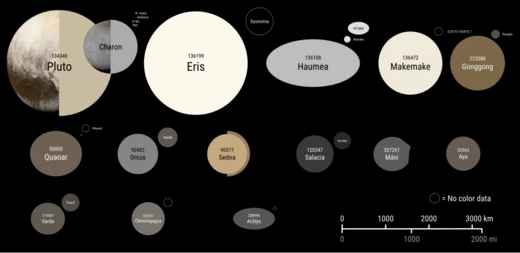
(55636) 2002 TX300
Bright Haumea family fragment, first KBO occultation observed.

(55636) 2002 TX300 is a frozen object in the Kuiper belt, orbiting the Sun. It measures roughly 300 kilometers across and has a very shiny surface composed of fresh water ice. It is the most luminous and potentially the largest known object in the Haumea family, a group of Kuiper belt bodies that split from the dwarf planet Haumea about 4.4 billion years ago.
The object was spotted on October 15, 2002, by the NASA-led Near-Earth Asteroid Tracking (NEAT) survey at Palomar Observatory. At first, its high brightness led astronomers to guess it might be a large dwarf planet nearly 1,000 kilometers wide. That idea was disproven in October 2009, when scientists measured its diameter for the first time by watching it block the light of a background star—a stellar occultation. This made 2002 TX300 the first Kuiper belt object (other than Pluto and its moon Charon) to be observed this way. It is now known to be too small to likely qualify as a dwarf planet, with its brightness coming mainly from its reflective surface.
**History**
**Discovery** 2002 TX300 was discovered on October 15, 2002, by the NEAT survey, a NASA project that used telescopes at several U.S. observatories to find near-Earth asteroids. The telescope that made the discovery was the 1.22-meter Samuel Oschin telescope at Palomar Observatory in San Diego County, California. The discovery observations involved Eleanor Helin, Steven Pravdo, Kenneth Lawrence, Michael D. Hicks, and R. Thicksten. Additional confirming observations came from Powell Observatory, Table Mountain Observatory, and Stephen P. Laurie at Church Stretton in the three days after the discovery.
The Minor Planet Center announced the discovery on October 22, 2002. Within a day, astronomer Reiner Stoss found pre-discovery images of 2002 TX300 in NEAT data from 2001 to 2002 and in Digitized Sky Survey images from 1954 to 1995. The earliest known pre-discovery observation is from Siding Spring Observatory images taken on August 27, 1954.
**Number and name** The object’s provisional designation, 2002 TX300, was given by the MPC in the discovery announcement, indicating the year and half-month of discovery. It received its permanent minor planet number, 55636, from the MPC on February 16, 2003. The Kuiper belt objects 55637 Uni and (55638) 2002 VE95 follow directly after 2002 TX300 in the catalog.
2002 TX300 has no proper name.
Quick Facts
- Minorplanet
- yes
- Background
- #C2E0FF
- Discoverer
- NEAT
- Discovery Site
- Palomar Obs.
- Discovered
- 15 October 2002
- Mpc Name
- (55636) 2002 TX · 300
- Mp Category
- TNO · classical (hot) · Haumea family · distant · Scat-Ext
- Epoch
- 5 May 2025 (JD 2460800.5)
- Uncertainty
- 0
- Observation Arc
- 70+ yr
- Earliest Precovery Date
- 27 August 1954
- Aphelion
- 48.587 AU
Facts from the source article.
Lore & Background
2002 TX300 was discovered on 15 October 2002 by the NASA-directed Near-Earth Asteroid Tracking (NEAT) survey at Palomar Observatory, using the 1.22-meter Samuel Oschin telescope. The discovery team included Eleanor Helin, Steven Pravdo, Kenneth Lawrence, Michael D. Hicks, and R. Thicksten. The Minor Planet Center announced the discovery on 22 October 2002, and pre-discovery observations were found in images from 1954 to 1995, the earliest from Siding Spring Observatory on 27 August 1954. It received the permanent number 55636 on 16 February 2003.
Its orbit is similar to that of Haumea, with a semi-major axis of 43.3 AU, eccentricity 0.12, and inclination 25.9°. It is classified as a classical Kuiper belt object (cubewano) and a dynamically hot member. Its surface is mostly fresh water ice, giving it a high reflectivity (albedo 50–80%) and a gray, spectrally neutral color. The spectrum shows deep water absorption bands at 1.5 and 2.0 μm, similar to Charon. The lack of tholins suggests a recent collision or comet activity.
Initially thought to be a large dwarf planet up to 1,000 km in diameter due to its brightness, this was disproven on 9 October 2009 when a stellar occultation measured its diameter as 286 km (later revised to about 320 km). It is too small to be in hydrostatic equilibrium and thus does not qualify as a dwarf planet. Its rotation period is either 8.04 or 16.08 hours.
Reader's Guide
2002 TX300 is significant as the brightest and possibly largest member of the Haumea family, providing key evidence for the collisional origin of that family. Its discovery and subsequent observations illustrate the challenges of estimating sizes of distant objects: initial brightness-based estimates suggested a diameter near 1,000 km, but thermal observations and a stellar occultation in 2009 revealed a much smaller object, with its brightness coming from a highly reflective icy surface rather than large size. It was the first Kuiper belt object (other than Pluto and Charon) observed via stellar occultation, a technique that directly measures size and albedo. Its surface composition—nearly pure water ice with minimal tholins—is unusual among KBOs and supports the idea that it is a fragment of Haumea. The object's high orbital inclination and classical Kuiper belt classification also contribute to understanding the dynamical history of the outer Solar System, including Neptune's migration.
Did You Know?
- 2002 TX300 was the first Kuiper belt object besides Pluto and Charon observed via stellar occultation.
- Its surface is mostly fresh water ice with an albedo between 50% and 80%, one of the most reflective among KBOs.
- The earliest known pre-discovery observation dates to 27 August 1954 from Siding Spring Observatory.
- It is a member of the Haumea family, which broke off from Haumea 4.4 billion years ago.
More in Trans-Neptunian Objects, Part 3 1-24
Spotted an error? Know more?
Reader corrections go straight into our review queue. Suggest an edit · How this site is sourced