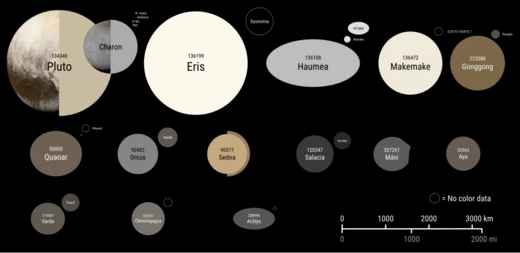
(528381) 2008 ST291
A large 1:6 resonant trans-Neptunian object discovered in 2008.

(528381) 2008 ST291 is a trans-Neptunian object locked in a 1:6 orbital resonance with Neptune, meaning it completes roughly one orbit for every six of Neptune's. It resides in the Solar System's outermost reaches, taking nearly a thousand years to circle the Sun. American astronomers Megan Schwamb, Michael Brown, and David Rabinowitz discovered it on September 24, 2008, using the Palomar Observatory in California; no earlier precovery images exist.
The Minor Planet Center assigned its permanent number on May 18, 2019, but as of 2025, it remains unnamed. Its orbit has a semi-major axis of 99.89 AU, ranging from 42.3 AU at perihelion to 157.5 AU at aphelion, with an eccentricity of 0.58 and an inclination of 21° to the ecliptic. It last reached perihelion in 1954 and currently sits about 60.9 AU from the Sun.
Estimates of its size vary depending on assumed albedo and absolute magnitude. Using an absolute magnitude of 4.4 and a typical albedo of 0.126 for Neptune-resonant objects, Johnston's Archive calculates a diameter of roughly 536 km. Astronomer Mike Brown, assuming an albedo of 0.09 and a fainter magnitude of 4.6, estimates 549 km. The Asteroid Dynamic Site, using a brighter magnitude of 4.3 and the same formula as Brown, gives 612 km. Averaging these magnitudes and applying a standard albedo range of 0.25 to 0.05 yields possible diameters between 345 and 773 km.
Quick Facts
- Minorplanet
- yes
- Background
- #C2E0FF
- Discoverer
- M. E. Schwamb / M. E. Brown / D. L. Rabinowitz
- Discovery Site
- Palomar Obs.
- Discovered
- 24 September 2008
- Mpc Name
- (528381) 2008 ST · 291
- Mp Category
- TNOSDO / res 1:6
- Epoch
- 27 April 2019 (JD 2458600.5)
- Uncertainty
- 3
- Observation Arc
- 9.27 yr (3,385 d)
- Aphelion
- 157.437 AU
- Perihelion
- 42.3114440 AU
Facts from the source article.
Lore & Background
2008 ST291 was discovered on 24 September 2008 by American astronomers Megan Schwamb, Michael Brown, and David Rabinowitz at the Palomar Observatory in California. No earlier precovery images are known. It was numbered by the Minor Planet Center on 18 May 2019, but as of 2025 it has not been named.
The object is in a 1:6 resonance with Neptune, meaning it completes roughly one orbit for every six orbits of Neptune. Its orbit has a semi-major axis of 99.89 AU, an eccentricity of 0.58, and an inclination of 21° to the ecliptic. It ranges from 42.3 AU at perihelion to 157.5 AU at aphelion, and takes 998 years and 4 months to orbit the Sun. It came to perihelion in 1954 and is currently 60.9 AU from the Sun.
Physical size estimates vary. Johnston's Archive gives a diameter of about 536 km assuming an absolute magnitude of 4.4 and an albedo of 0.126. Mike Brown estimates 549 km using a magnitude of 4.6 and albedo 0.09. The Asteroid Dynamic Site records a brighter magnitude of 4.3, yielding 612 km with the same albedo formula. Using the average of these magnitudes and a standard albedo range of 0.25–0.05, possible sizes range from 345 to 773 km.
Reader's Guide
As a 1:6 resonant trans-Neptunian object, 2008 ST291 is part of a rare dynamical class that helps constrain models of Neptune's migration and the early Solar System. Its large estimated size—potentially over 500 km—places it among the larger known TNOs, though estimates vary due to uncertain albedo. The lack of precovery images and its recent numbering in 2019 highlight the ongoing process of cataloging distant objects. Its discovery by a team including Michael Brown, known for finding many large TNOs, adds to its context. The object's orbit, taking nearly a millennium to complete, and its current distance of 60.9 AU from the Sun, underscore the vast timescales and distances involved in studying the outermost Solar System. The range of diameter estimates from different sources reflects the inherent uncertainties in characterizing such distant bodies.
Did You Know?
- It was discovered on 24 September 2008 at Palomar Observatory.
- Its estimated diameter ranges from 345 to 773 km depending on assumed albedo.
More in Trans-Neptunian Objects, Part 3 1-24
Spotted an error? Know more?
Reader corrections go straight into our review queue. Suggest an edit · How this site is sourced