(523692) 2014 EZ51
A large, rapidly rotating scattered-disc object with no known moons.

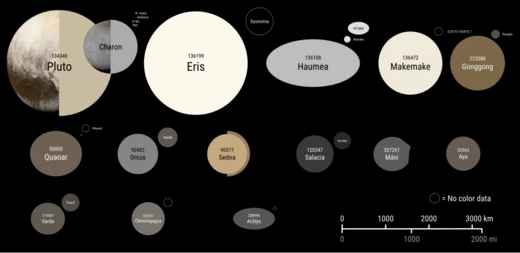
(523692) 2014 EZ51 is a large object in the scattered disc region beyond Neptune, with a diameter estimated between 575 and 1,300 kilometers. It spins very quickly, completing one rotation every 3.2 hours—faster than the dwarf planet Haumea, which takes about 3.92 hours. The object was discovered on 18 April 2010 by the Pan-STARRS 1 survey at Hawaii's Haleakala Observatory. No high-resolution images have been taken yet, and it has no known moons. The Hubble Space Telescope is scheduled to observe it in 2026, which could reveal whether it has any sizable satellites.
Quick Facts
- Minorplanet
- yes
- Discoverer
- Pan-STARRS 1
- Discovery Site
- Haleakala Obs.
- Discovered
- 18 April 2010
- Mpc Name
- (523692) 2014 EZ · 51
- Mp Category
- TNOSDOdistant
- Epoch
- 5 May 2025 (JD 2460800.5)
- Uncertainty
- 22
- Observation Arc
- 14.22 yr (5,193 d)
- Perihelion
- 39.972 AU
- Semimajor
- 51.852 AU
- Eccentricity
- 0.2291
Facts from the source article.
Lore & Background
2014 EZ51 was discovered on 28 April 2014 by the DECam at Coquimbo Region, Chile, with precovery observations back to 18 April 2010 by the Pan-STARRS 1 survey at Haleakala Observatory, Hawaii. It orbits the Sun at a distance of 40.7–64.4 AU once every 380.5 years, with an eccentricity of 0.23 and an inclination of 10°. The object is in a 9:4 resonance with Neptune. An occultation by 2014 EZ51 occurred in New Zealand on 25 February 2019, providing a lower diameter limit of 575 km and an equatorial diameter estimate of at least 1,260 km. Its geometric albedo must be less than 0.03 if the larger diameter is correct. In 2023, photometric observations by the Kepler space telescope revealed a rotation period of 3.200±0.002 hours and a light curve amplitude of 0.145±0.026 magnitudes, indicating an elongated shape. The object has not yet been imaged by high-resolution telescopes and has no known moons; the Hubble Space Telescope is planned to image it in 2026.
Reader's Guide
2014 EZ51 is significant as a large scattered-disc object with a rotation period shorter than that of the dwarf planet Haumea, suggesting a dense or cohesive structure. Its size remains uncertain, with estimates ranging from 575 km to over 1,260 km depending on albedo assumptions. The 2019 occultation provided critical lower bounds on its diameter, while the Kepler photometry confirmed rapid rotation and an elongated shape. The object's 9:4 resonance with Neptune places it among a class of resonant trans-Neptunian objects that offer clues to the dynamical evolution of the outer Solar System. The planned 2026 Hubble imaging may reveal whether it hosts moons, which would further inform its mass and formation history. As of January 2026, it has not been named.
Did You Know?
- 2014 EZ51 has a rotation period of 3.2 hours, shorter than Haumea's 3.92 hours.
- An occultation by 2014 EZ51 was observed in New Zealand on 25 February 2019.
- The Hubble Space Telescope is planned to image 2014 EZ51 in 2026 to search for moons.
- It is in a 9:4 orbital resonance with Neptune.
More in Trans-Neptunian Objects, Part 3 1-24
Spotted an error? Know more?
Reader corrections go straight into our review queue. Suggest an edit · How this site is sourced