(470308) 2007 JH43
A large trans-Neptunian object with precovery images from 1984.

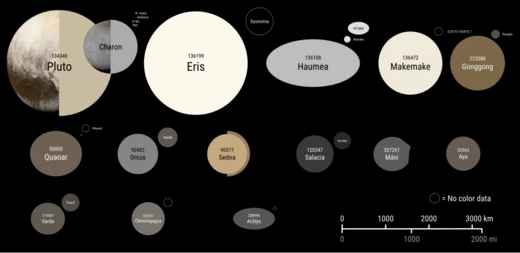
(470308) 2007 JH43 is a large object in the outer Solar System, beyond Neptune, with a diameter estimated between 500 and 600 kilometers. It was spotted on May 10, 2007, by astronomers Megan E. Schwamb, Michael E. Brown, and David L. Rabinowitz using the Palomar Observatory in California. This minor planet travels around the Sun at a distance ranging from 38.6 to 40.6 astronomical units, completing one orbit every 249 years and one month. Its orbit is nearly circular, with an eccentricity of 0.02, and it is tilted 18 degrees relative to the ecliptic plane. The earliest known images of the object, called precovery images, were taken in March 1984 at Australia’s Siding Spring Observatory as part of the Digitized Sky Survey, pushing its known observation arc back 23 years before its official discovery. It last reached perihelion around 1888. On April 26, 2026, the Hubble Space Telescope captured images of 2007 JH43 while searching for moons around large trans-Neptunian objects.
In terms of physical characteristics, its size estimates vary: about 531 kilometers (assuming an albedo of 0.074), 604.77 kilometers (assuming an albedo of 0.057), and 530 kilometers (assuming an albedo of 0.08). No rotational lightcurve has been obtained from photometric observations as of 2026, so its rotation period, pole orientation, and shape remain unknown. In 2013, Benecchi and colleagues placed an upper limit of 0.08 magnitude on its lightcurve amplitude. The object’s surface shows color indices of g′−r′ = 0.68 ± 0.04, g′−i′ = 1.09 ± 0.03, and r′−i′ = 0.41 ± 0.03. It is classified as a C-type asteroid. Its assumed albedos are 0.074, 0.057, and 0.08.
Orbitally, the Minor Planet Center lists 2007 JH43 as a trans-Neptunian object or a distant Kuiper belt object. The Deep Ecliptic Survey, based on a 10-million-year orbital integration, currently categorizes it as a scattered object.
Quick Facts
- Minorplanet
- yes
- Background
- #C2E0FF
- Discoverer
- M. E. Schwamb / M. E. Brown / D. L. Rabinowitz
- Discovered
- 10 May 2007
- Discovery Site
- Palomar Obs.
- Earliest Precovery Date
- 7 March 1984
- Mpc Name
- (470308) 2007 JH · 43
- Mp Category
- TNO / Scat-Near (DES)
- Epoch
- 31 July 2016 (JD 2457600.5)
- Uncertainty
- 3
- Observation Arc
- 31.34 yr (11,446 days)
- Aphelion
- 40.566 AU
Facts from the source article.
Lore & Background
2007 JH43 was discovered on 10 May 2007 at Palomar Observatory. Its first precovery image was taken at the Australian Siding Spring Observatory during the Digitized Sky Survey in March 1984, extending the body's observation arc by 23 years prior to its discovery. It came to perihelion around 1888. The Hubble Space Telescope photographed it on 26 April 2026 during a search for moons around large trans-Neptunian objects.
Physical characteristics include estimated diameters of 531, 604.77, and 530 kilometers, assuming albedos of 0.074, 0.057, and 0.08 respectively. As of 2026, no rotational lightcurve has been obtained; an upper bound of 0.08 mag on its lightcurve amplitude was put by Benecchi and colleagues in 2013. Its color indices are g′-r′ 0.68 ± 0.04, g′-i′ 1.09 ± 0.03, and r′-i′ 0.41 ± 0.03. It is classified as a C-type asteroid.
Orbitally, the Minor Planet Center lists it as a trans-Neptunian object or distant object in the Kuiper belt, while the Deep Ecliptic Survey shows it as a scattered object based on a 10-million-year integration of its orbit.
Reader's Guide
2007 JH43 is significant as a large trans-Neptunian object with multiple diameter estimates that reflect uncertainty in its albedo. Its discovery by a team including Megan E. Schwamb, Michael E. Brown, and David L. Rabinowitz adds to the catalog of bodies in the outer Solar System. The precovery images from 1984, taken at Siding Spring Observatory, demonstrate how archival data can extend observational arcs by decades, improving orbital calculations. The Hubble Space Telescope's 2026 photograph, part of a moon search, highlights ongoing interest in whether such objects host satellites. Its classification as both a Kuiper belt object and a scattered object by different surveys underscores the complexity of its orbital dynamics. The lack of a rotational lightcurve as of 2026 leaves its rotation period, pole, and shape unknown, with only an upper bound on amplitude from 2013. Its C-type spectrum and color indices provide clues to its surface composition, though its albedo remains uncertain.
More in Trans-Neptunian Objects, Part 3 1-24
Spotted an error? Know more?
Reader corrections go straight into our review queue. Suggest an edit · How this site is sourced