(35671) 1998 SN165
A cold classical Kuiper belt object and dwarf planet candidate.

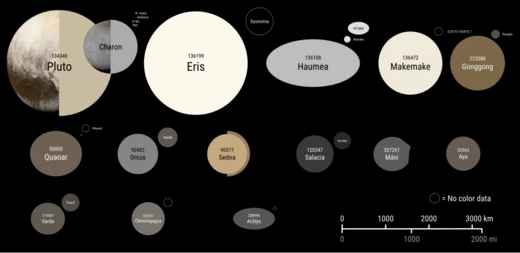
(35671) 1998 SN165 is a minor planet in the Kuiper belt, the region beyond Neptune. Discovered on September 23, 1998, by Arianna Gleason at Kitt Peak National Observatory in Arizona, it is a cold classical Kuiper belt object, meaning its orbit is nearly circular and not heavily influenced by Neptune's gravity. With a diameter estimated at roughly 400 kilometers (250 miles), it is considered a dwarf planet candidate. The object has a grey-blue color (classified as BB) and rotates once every 8.8 hours. As of 2025, it remains unnamed.
The object orbits the Sun at distances between 36.5 and 39.7 AU, completing one revolution every 234 years and 9 months. Its orbit has a low eccentricity of 0.04 and an inclination of 5° relative to the ecliptic. As of 2021, it was 37.2 AU from the Sun and will reach perihelion on July 15, 2065. It is a non-resonant cubewano, part of the less populous classical Kuiper belt population, and was originally misclassified as a plutino.
The minor planet was numbered 35671 on February 27, 2002. According to naming conventions, it will eventually receive a mythological name associated with creation.
Photometric observations in February 2001 by Pedro Lacerda and Jane Luu yielded a lightcurve with a rotation period of 8.84 hours (or possibly 8.70 hours) and a brightness variation of 0.16 magnitude. Measurements from the Herschel and Spitzer space telescopes indicate a diameter between 393 and 460 kilometers and a low albedo of 0.043 to 0.060. Other estimates, using different assumptions, give diameters of 473 kilometers (Michael Brown), 334 kilometers (Collaborative Asteroid Lightcurve Link), or 352 kilometers (generic conversion).
Quick Facts
- Minorplanet
- yes
- Background
- #C2E0FF
- Discoverer
- A. Gleason
- Discovery Site
- Kitt Peak Obs.
- Discovered
- 23 September 1998
- Mpc Name
- (35671) 1998 SN · 165
- Mp Category
- TNOcubewano / p-DPdistant
- Epoch
- 1 July 2021 (JD 2459396.5)
- Uncertainty
- 2
- Observation Arc
- 22.26 yr (8,129 d)
- Aphelion
- 39.662 AU
- Perihelion
- 36.453 AU
Facts from the source article.
Lore & Background
1998 SN165 was discovered on 23 September 1998 by American astronomer Arianna Gleason at the Kitt Peak National Observatory. It orbits the Sun at a distance of 36.5–39.7 AU once every 234 years and 9 months, with a low eccentricity of 0.04 and an inclination of 5°. It is a non-resonant cubewano, part of the cold classical population, distinct from the hot population with higher inclinations. Originally classified as a plutino, it was later reclassified as a classical object.
Physical characteristics include a grey-blue color (BB) and a rotation period of 8.8 hours, derived from photometric observations by Pedro Lacerda and Jane Luu in February 2001. The lightcurve analysis gave an ambiguous period of 8.84 hours with a brightness amplitude of 0.16 magnitude, and an alternative period of 8.70 hours is also possible. Diameter estimates vary: Herschel and Spitzer telescopes give 393–460 kilometers, while Michael Brown gives 473 kilometers; the Collaborative Asteroid Lightcurve Link assumes a diameter of 334 kilometers based on an absolute magnitude of 5.5.
The object was numbered by the Minor Planet Center on 27 February 2002, receiving the number 35671. As of 2025, it has not been named. According to naming conventions, it will receive a mythological or mythic name associated with creation.
Reader's Guide
As a cold classical Kuiper belt object, (35671) 1998 SN165 represents a relatively undisturbed population of trans-Neptunian objects that have experienced minimal gravitational stirring. Its low eccentricity and inclination place it among the cold classical cubewanos, which are thought to be primordial remnants from the early Solar System. The object's grey-blue color and low albedo (0.043–0.060) suggest a surface composition distinct from redder Kuiper belt objects. The ambiguity in its rotation period—8.84 or 8.70 hours—highlights the challenges of characterizing distant, faint objects. Its status as a dwarf planet candidate, based on a diameter around 400 kilometers, places it near the threshold for hydrostatic equilibrium. The object's approach to perihelion in 2065 offers a future opportunity for detailed study. The fact that it remains unnamed as of 2025 underscores the vast number of minor planets awaiting mythological designations.
Did You Know?
- It was discovered by American astronomer Arianna Gleason at Kitt Peak National Observatory on 23 September 1998.
- Its rotation period is ambiguous, with possible values of 8.84 hours or 8.70 hours.
- It will reach perihelion on 15 July 2065.
- As of 2025, it has not been named, but will receive a mythological name associated with creation.
More in Trans-Neptunian Objects, Part 3 1-24
Spotted an error? Know more?
Reader corrections go straight into our review queue. Suggest an edit · How this site is sourced