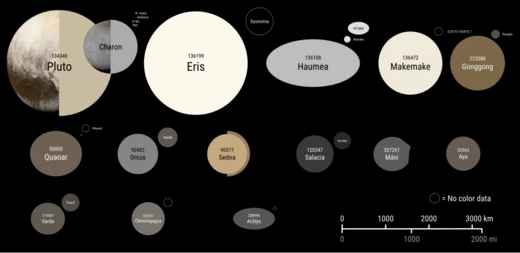
(119951) 2002 KX14
A flattened, reddish inner classical Kuiper belt object.

(119951) 2002 KX14 is a trans-Neptunian object located in the inner classical Kuiper belt. It is notable for being a highly flattened object with an equatorial diameter of 482 km and a maximum polar diameter of 314 km, and for being one of the largest known cold classical Kuiper belt objects. It is suspected to have a large moon, though this has not been confirmed.
Quick Facts
- Minorplanet
- yes
- Background
- #C2E0FF
- Discovered
- 17 May 2002
- Discoverer
- Chadwick A. Trujillo / Michael E. Brown
- Discovery Site
- Palomar Obs.
- Mpc Name
- (119951) 2002 KX · 14
- Mp Category
- TNOclassical (inner55/cold) / distant
- Epoch
- 25 February 2023 (JD 2460000.5)
- Uncertainty
- 2
- Observation Arc
- 38.96 yr (14,230 d)
- Earliest Precovery Date
- 31 May 1984
- Aphelion
- 40.515 AU
Facts from the source article.
Lore & Background
2002 KX14 was discovered on 17 May 2002 by astronomers Chad Trujillo and Michael Brown at Palomar Observatory as part of their Caltech Wide Area Sky Survey for bright, Pluto-sized Kuiper belt objects. The discovery was announced by the Minor Planet Center on 20 July 2002. Pre-discovery observations were later identified from Cerro Tololo Observatory (August 2001) and the Digitized Sky Survey (May 1984 and April 1993). The object received its permanent minor planet number 119951 on 16 November 2005. It does not have a proper name; naming suggestions relating to creation myths are open.
Observations of stellar occultations show that 2002 KX14 is a highly flattened oblate spheroid. Its surface is dark and reddish, likely covered with tholins, and its spectrum is featureless. A 2021 study suggested its surface composition is 20%±10% water, 60%±10% silicates, and 20%±10% organics. Its rotation period is unknown, as photometric measurements have found no significant brightness variations. The object is located in the Milky Way's galactic plane, which complicates rotation measurements but increases chances of stellar occultations. The first occultation was observed on 26 April 2012; five more were observed from 2020 to 2023.
2002 KX14 has a nearly circular orbit with low eccentricity (0.04) and low inclination (0.4°), classifying it as a dynamically cold classical Kuiper belt object, though some astronomers argue it may belong to the hot population. It last passed perihelion in July 1840 and will next do so in May 2085. The object is suspected to have a large moon, inferred from excess thermal radiation, with a possible diameter of about 251 km. Hubble Space Telescope images from 2006 and occultation observations have not directly detected this moon, suggesting it orbits very close to the primary.
Reader's Guide
2002 KX14 is significant as one of the largest known cold classical Kuiper belt objects, with its shape and size precisely measured through stellar occultations. Its highly flattened shape—an equatorial diameter of 482 km versus a polar diameter of 314 km—makes it a rare example of an oblate spheroid among trans-Neptunian objects. The object's dark, reddish surface and featureless spectrum are typical of tholins, common among classical Kuiper belt objects. Its suspected large moon, inferred from thermal emission data, would make it a binary system, though this remains unconfirmed. The object's low orbital inclination and eccentricity place it in the inner classical Kuiper belt, a region whose dynamical classification is debated. Its location in the Milky Way's galactic plane offers both challenges and opportunities for further study, particularly for occultation observations that can refine its shape and search for its putative moon. The object's legacy includes contributing to understanding the formation and evolution of the Kuiper belt, especially the distinction between cold and hot classical populations.
Did You Know?
- 2002 KX14 has an equatorial diameter of 482 km and a polar diameter of 314 km, making it highly flattened.
- It is suspected to have a large moon about 251 km in diameter, inferred from excess thermal radiation.
- The object was discovered as part of a survey that also found Eris, Sedna, and Quaoar.
More in Trans-Neptunian Objects, Part 3 1-24
Spotted an error? Know more?
Reader corrections go straight into our review queue. Suggest an edit · How this site is sourced