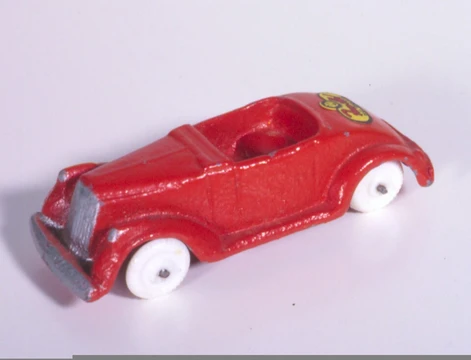
Educational toy
Toys designed to instruct and develop skills in children.

Educational toys, also called instructive toys, are objects of play designed for children that are intended to meet an educational purpose, such as helping a child develop a particular skill or teaching about a particular subject. They often simplify, miniaturize, or model activities and objects used by adults. The difference between an educational toy and a natural object like a rock or stick lies in the toy's designed intention and expected educational value. Throughout history, educational toys have reflected the cultural concerns of their time, and today more toys are designed with children's education and development in mind than ever before.
- first_explicitly_educational_toy
- Alphabet dice (proposed by John Locke, 1693)
Lore & Background
The identification of specific toys as having an explicitly educational purpose dates to the 1700s. In 1693, John Locke suggested that dice with letters could teach children the alphabet through play. British cartographer John Spilsbury is universally credited with inventing the jigsaw puzzle or 'dissected map' in 1766 as an educational tool for geography. In 1798, Maria Edgeworth and her father Richard Lovell Edgeworth described a 'rational toy-shop' that would sell materials for carpentry, handicrafts, gardening, chemistry, and natural history, and advocated for a dedicated playroom for loud and messy educational activities.
Reader's Guide
Educational toys have evolved significantly, reflecting changing cultural concerns and theories of childhood. In the 1800s, Germany became the center of toy making, and Friedrich Froebel introduced geometric solids called 'gifts' and foldable papers called 'occupations' to stimulate the senses and teach concepts like number, size, shape, weight, and cause and effect. His work inspired the Anchor Stone Blocks by the Lilienthal brothers in 1880. In the early 20th century, Maria Montessori introduced a wide array of manipulatives based on developmental theories, emphasizing tactile and perceptual learning, practical exercises, and materials for mathematics. Her methods are still used in homes and schools today. The history of educational toys shows that while manufactured toys were once costly and owned mainly by the wealthy, children throughout history have improvised toys from natural and household objects. The range of manufactured toys broadened during the Victorian era, but toys remained expensive. Today, educational toys are more widely available and designed with explicit learning goals.
Did You Know?
- Dolls can be seen as early educational toys because they allowed children to learn to care for living babies and children.
- In 1560, Pieter Bruegel the Elder's painting 'Children's Games' depicts around 200 children in at least 75 play activities, but only a few involved toys made specifically for children.
- French engineer Arthur Good, under the pen name 'Tom Tit', published La Science Amusante starting in 1889, featuring experiments with everyday household materials.
- Maria Montessori's work was strongly motivated by slum conditions and the social and economic disadvantages facing poor women and their children.
Frequently Asked Questions
What exactly is an educational toy?
An educational toy is a play object crafted with the deliberate goal of helping a child build a specific skill or learn a particular subject. They frequently work by simplifying, shrinking down, or modeling activities that adults perform in everyday life.
What was the first toy ever designed with an educational purpose?
The alphabet dice, proposed by John Locke in 1693, is recognized as the earliest explicitly educational toy on record. Before that, children played with everyday objects without any structured learning intent behind them.
How do you tell an educational toy apart from a regular toy or a natural object?
The key distinction is the designer's deliberate intention: an educational toy is built around a specific expected learning outcome, whereas a stick or a rock simply exists without that purpose. A standard toy may entertain, but an educational toy is engineered to develop a particular ability or teach a concept.
What kinds of skills do educational toys typically target?
They aim to nurture competencies ranging from fine motor control and problem-solving to literacy, numeracy, and understanding of real-world subjects. By modeling or miniaturizing adult tasks, they give children a hands-on, playful way to practice those skills.
Have educational toys changed much over the centuries?
Yes; the themes and subjects they address have shifted to mirror the cultural priorities of each era. While the core idea of embedding learning into play remains constant, the specific skills emphasized and the materials used have evolved alongside broader societal concerns about child development.
More in Toys 1-20
Spotted an error? Know more?
This is a living reference — every entry is fact-audited, and reader corrections feed straight into our audit queue. Suggest an edit · See this site's audit record