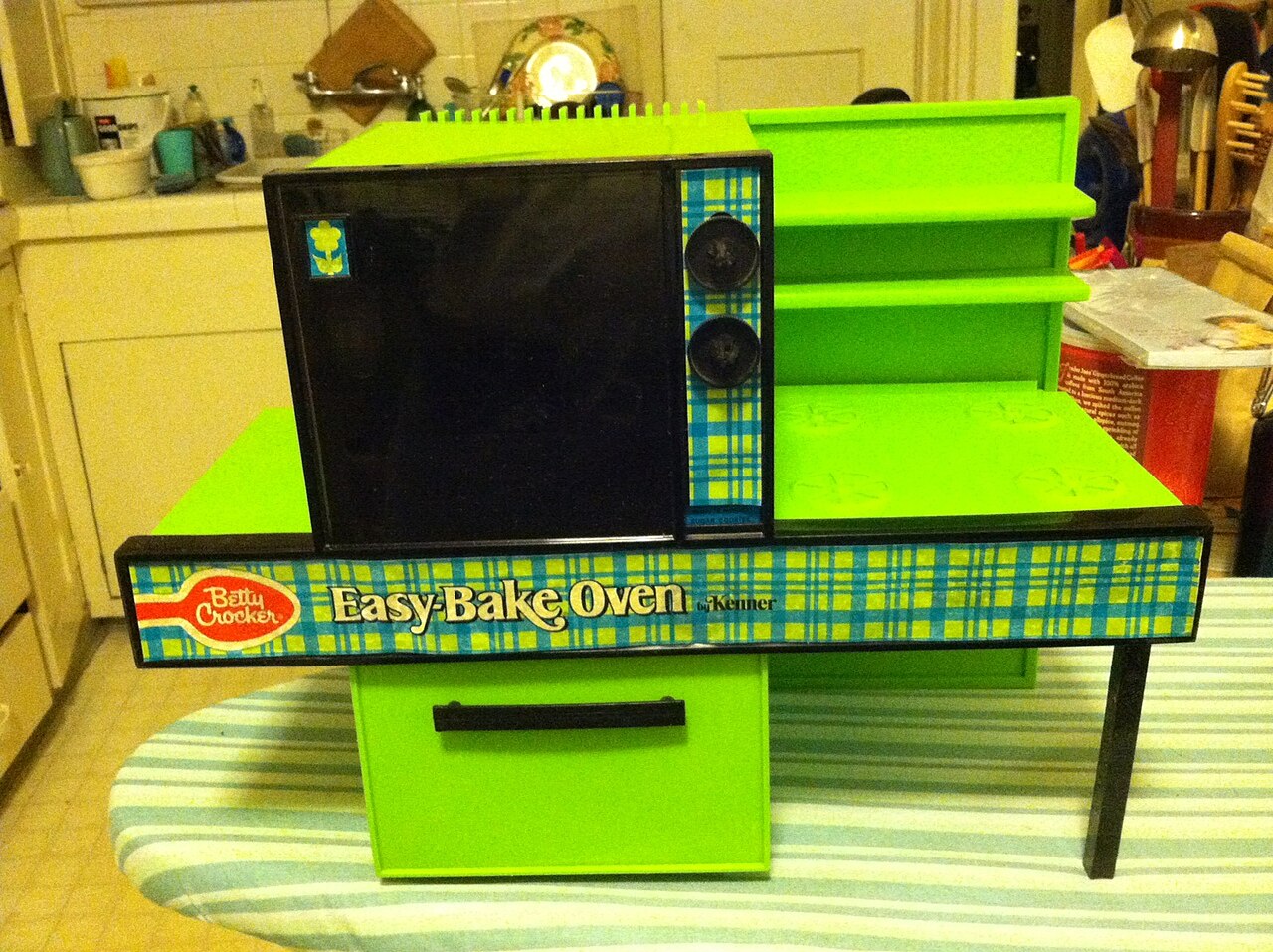
Easy-Bake Oven
A working toy oven that baked real cakes.

User:Rdmsf · CC BY-SA 3.0
The Easy-Bake Oven is a working toy oven introduced in 1963 by Kenner Products and later manufactured by Hasbro. It is notable for using incandescent light bulbs as a heat source in its original design, and for being inducted into the National Toy Hall of Fame in 2006.
- introduced
- 1963
- original_manufacturer
- Kenner Products
- later_manufacturer
- Hasbro
- first_year_sales
- 500,000 units
- total_sales_by_1997
- over 16 million units
- original_heat_source
- two 100-watt incandescent light bulbs
- inducted_into_National_Toy_Hall_of_Fame
- 2006
Lore & Background
The Easy-Bake Oven was introduced in 1963 by Kenner Products, a Cincinnati, Ohio-based toy company. The idea came from Norman Shapiro, Kenner's sales manager in New York, who was inspired by ovens used by street vendors to bake pretzels. The Kenner team, led by research and development vice-president James Kuhn with major contributions from Ronald Howes, developed the toy. The original model used two 100-watt incandescent light bulbs, one above and one below the food tray, to bake cakes. Later models used only one bulb, leveraging convection for even heating.
Kenner sold 500,000 Easy-Bake Ovens in the first year of production. By 1997, more than 16 million had been sold. The original oven came in pale yellow or turquoise. An updated 'Premier' model in avocado green or red was released in 1969, followed by a 'Mod' model in yellow or light green in 1971. A one-of-a-kind model was presented to the winner of the 5,000,000th Easy-Bake Oven Sweepstakes, though the exact year of this milestone is uncertain (often cited as 1973 or 1974). Kenner licensed the toy to international markets, including Japan, where Nakajima Corporation sold it as Margaret's Cooking Oven.
After Kenner became a division of Hasbro and was closed down, Hasbro continued production. The Easy-Bake Oven and Snack Center was introduced in 1993. In 2002, Hasbro released the Queasy Bake Cookerator, a variant targeted at young boys. In 2006, a front-loading version was released, but it was recalled in 2007 due to burn hazards. In 2011, the last version using a 100-watt incandescent light bulb was replaced by the Easy-Bake Ultimate Oven with a dedicated heating element, due to availability concerns about incandescent bulbs.
Reader's Guide
The Easy-Bake Oven's significance lies in its enduring popularity as a working toy that introduced children to baking. It sold 500,000 units in its first year and over 16 million by 1997, reflecting its broad appeal. The toy's design evolved from using incandescent light bulbs to a true heating element, adapting to changing technology and safety standards. Its induction into the National Toy Hall of Fame in 2006 recognized its cultural impact. The oven also sparked discussions about gender-neutral marketing; in 2012, after a petition from a girl named McKenna Pope, Hasbro announced a black and silver version and a blue prototype. The 2006 recall, affecting approximately 985,000 units due to entrapment and burn hazards, highlighted safety concerns. National Easy-Bake Oven Day is observed annually on November 4, established in 2017 by author and toy historian Todd Coopee. The toy's legacy includes its role in inspiring creativity and its adaptation across decades.
Did You Know?
- The original Easy-Bake Oven used two 100-watt incandescent light bulbs as a heat source.
- Kenner sold 500,000 Easy-Bake Ovens in the first year of production.
- The oven was inducted into the National Toy Hall of Fame in 2006.
- In 2012, after a petition by McKenna Pope, Hasbro announced a black and silver version of the oven.
Origins & Innovation
The Easy-Bake Oven's story begins not in a toy factory but on the streets of New York City. In 1963, Norman Shapiro, Kenner Products' sales manager based in the city, spotted vendors baking pretzels in small portable ovens and saw a commercial opportunity. He pitched the idea to Kenner executives: what if a child could have their own working oven? The company's research and development team, led by vice-president James Kuhn with significant input from Ronald Howes, spent time refining the concept. The result was a pale yellow or turquoise appliance that mimicked a real kitchen oven, heated by two 100-watt incandescent light bulbs positioned above and below the food tray for even, quick baking. Children would combine a packet of cake blend with water in a small round pan, slide it through a slot on one side, and push the finished cake out the other. Kenner sold 500,000 units in that first year alone, proving the concept had struck a deep nerve with families.
Evolution & Design Changes
Over five decades, the Easy-Bake Oven underwent a remarkable series of transformations. Kenner's original two-bulb design gave way to a single-bulb model that relied on improved interior convection. The 1969 Premier edition arrived in avocado green or red, while 1971's Mod version came in yellow or light green. After Hasbro absorbed and eventually closed the Kenner division, the brand continued under new stewardship. The 1993 Easy-Bake Oven and Snack Center marked Hasbro's first entry, followed a decade later by the Real Meal Oven, which could bake two larger pans simultaneously and handle both desserts and main courses. Its neutral color palette addressed long-standing parental complaints about the product being marketed exclusively to girls. In 2002, Hasbro released the Queasy Bake Cookerator aimed at young boys. The 2011 Easy-Bake Ultimate Oven replaced the incandescent bulb entirely with a dedicated heating element, a change driven by fears that lamp regulations would make bulb-based models unproducible. In 2012, following a Change.org petition by a New Jersey girl, Hasbro announced a black-and-silver version with gender-neutral packaging, unveiled at the 2013 New York Toy Fair.
Marketing & Cultural Impact
The Easy-Bake Oven's cultural footprint extended far beyond the kitchen table. Kenner's 1962 corporate mascot, the Gooney Bird, became inseparable from the brand, appearing on packaging alongside the slogan "It's Kenner, It's Fun!" In 1968, the company enlisted Muppet creator Jim Henson to produce a puppet version of the bird for television commercials featuring child actress Barbara Price. The character proved so beloved that Henson repurposed it as Little Bird, Big Bird's younger sibling, in the early seasons of Sesame Street. The oven's commercial success was staggering: 500,000 units in year one, and more than 16 million by 1997. Kenner also licensed the product internationally, with Japan's Nakajima Corporation selling it under the name Margaret's Cooking Oven. In 1972, a one-of-a-kind model was presented to the winner of the fifth-million Easy-Bake Oven Sweepstakes. The product's enduring significance was formally recognized in 2006 when it was inducted into the National Toy Hall of Fame.
The 2006 Recall
In May 2006, Hasbro introduced a redesigned Easy-Bake Oven featuring a front-loading door, a substantial departure from the traditional push-through mechanism that had defined the product for decades. The new model also incorporated a stove-top warmer and a heating element, though it retained smaller pans and could only bake one at a time. The innovation, however, proved dangerous. Hasbro received reports that 29 children had trapped their hands or fingers in the front-loading door, with five of those incidents resulting in burns. In February 2007, Hasbro and the Consumer Product Safety Commission issued a voluntary recall covering approximately 985,000 units. Parents were urged to stop using the oven with children under eight and to contact the company for a free retrofit kit. The CPSC-approved kit consisted of a plastic grate designed to sit over the existing door, creating an additional barrier against small fingers while still allowing the oven to function. Despite this corrective measure, the underlying problems persisted, underscoring how a well-intentioned design change could undermine the safety of an otherwise beloved product.
Gallery



Frequently Asked Questions
What is the Easy-Bake Oven?
It is a working toy oven that bakes real cakes, first released in 1963 by Kenner Products and later produced by Hasbro.
How does the Easy-Bake Oven actually generate heat?
The original design relied on two 100-watt incandescent light bulbs to warm the baking chamber, a clever alternative to a conventional electrical heating element.
Who made the Easy-Bake Oven and when did it come out?
Kenner Products launched the toy in 1963, and Hasbro assumed manufacturing responsibilities in later years.
How popular was the Easy-Bake Oven in its early years?
It sold roughly 500,000 units in its first year on the market, and cumulative sales surpassed 16 million units by 1997.
Why is the Easy-Bake Oven considered a landmark toy?
Its cultural impact was formally recognized when it was inducted into the National Toy Hall of Fame in 2006, cementing its status as one of the most influential kitchen toys ever made.
More in Toys 1-20
Spotted an error? Know more?
This is a living reference — every entry is fact-audited, and reader corrections feed straight into our audit queue. Suggest an edit · See this site's audit record