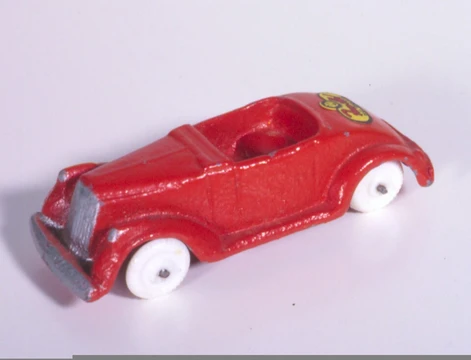
Construction set
Standardized piece assortments for constructing various models.

Jiří Sedláček · CC BY-SA 3.0
A construction set is a collection of standardized parts designed to build many different models, typically sold as a toy. Well-known brands include Lincoln Logs and LEGO.
Playing with construction toys helps build social skills and trust, as it often requires cooperation to complete a project, such as a LEGO model. This effect has been observed in high school students. For children, completing models with building blocks improves spatial ability, and spatial ability itself predicts how well they can finish such models. Autistic children benefit from both individual and group block play, as it motivates them to initiate social contact with peers, sustain that contact, and overcome tendencies toward withdrawal and rigid behavior.
Some vintage LEGO blocks—specifically red and yellow ones made between 1963 and 1981—can release carcinogenic cadmium when exposed to stomach acid, at levels about ten times higher than today’s safety limits.
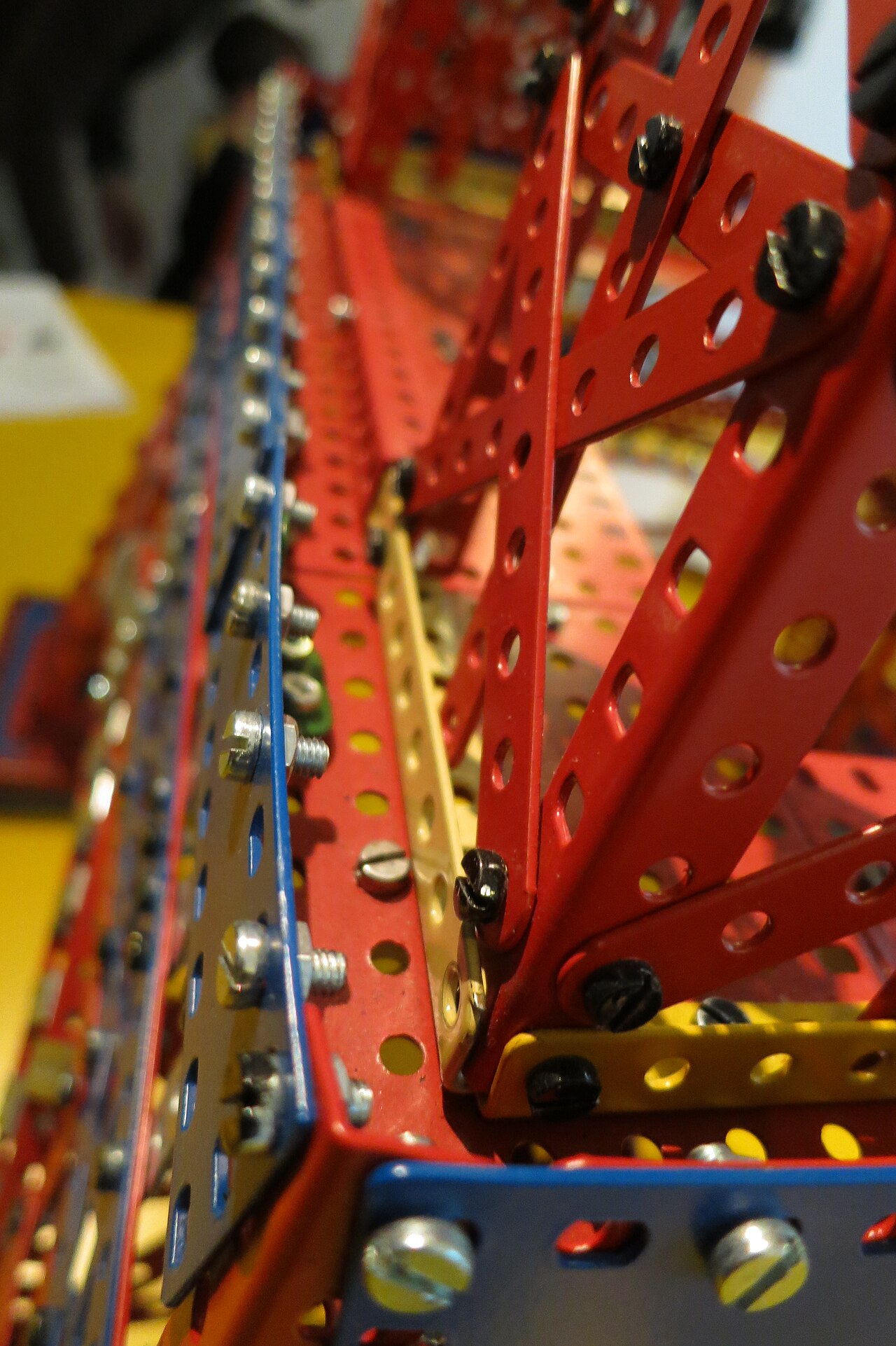
Construction sets can be grouped by connection method and geometry. Types include struts of variable length connected at any point or at nodes; fixed-length struts connected by nodes for space frames, often allowing full rotation; and various node designs used by different brands (e.g., K'Nex, Tinkertoys, Playskool Pipeworks, Cleversticks, interlocking disks, and Zometool). Other categories cover panels of varying sizes and shapes connected by pins or screws (e.g., Erector Set, Meccano, Lego Technic); panels with flexible hinges (e.g., Tog'l, Polydron); strut-and-panel systems like Girder and Panel; magnetic sets like Geomag; and building components with various connections—no connection (toy blocks, KEVA planks), studs (Lego, Mega Bloks, Fischertechnik), notches (Lincoln Logs, Stickle bricks), sleeves (Capsela), and spherical magnets. Many marble run toys are also construction sets.
The architect Frank Lloyd Wright credited his childhood Fröbel blocks as a major influence, and his son John Lloyd Wright invented Lincoln Logs. Many architects say construction set play shaped their later design work. A set of 3D-printable adapters for popular toy systems, the Free Universal Construction Kit, is in the Museum of Modern Art’s collection and was featured in its 2025 exhibition *Pirouette: Turning Points in Design*, alongside icons like the Bean Bag ch
- field
- Toys
- known_for
- Standardized piece assortments for building models
- connection_methods
- Struts, panels, studs, notches, sleeves, spherical magnets
- notable_brands
- Lincoln Logs, LEGO, K'Nex, Tinkertoys, Erector Set, Meccano
Lore & Background
Construction sets are categorized by connection method and geometry. Struts of variable length connect at any point along another strut or at nodes. Struts of fixed multiple lengths connected by nodes allow full rotational freedom and are used for space frames. Different brands use distinct node designs—for example, K'Nex and Tinkertoys have their own patented connectors, while Zometool uses a unique ball-and-socket system based on geometric principles. Panels of varying sizes and shapes connect by pins or screws perpendicular to the panels, suitable for linkages such as Erector Set, Mini Unit Beams, Meccano, Merkur, Steel Tec, Lego Technic, Trix, FAC-System, Constructo Straws, and Überstix. Other panel sets include flexible panels or
Reader's Guide
Construction sets have psychological benefits. Construction toy play is beneficial for building social skills and building trust in others because it acts as a collaborative task where individuals cooperate to finish building an object. This effect was found in high school students. For children specifically, those who complete models using toy building blocks have much better spatial ability than children who do not complete such models. Spatial ability also predicts completion of models. Construction toy play is also beneficial for autistic children when both individual and group play with building blocks is incorporated. Autistic children who played with building blocks were motivated to initiate social contact with children their age, able to maintain and endure contact, and able to surpass barriers of being withdrawn and highly structured. In the arts and culture, architect Frank Lloyd Wright credited his childhood building blocks designed by Friedrich Fröbel as a major influence, and his son John Lloyd Wright invented the Lincoln Logs building set. Many architects credit construction set play as influencing their later design. A set of 3D-printable adapters for popular toy construction systems called the Free Universal Construction Kit is in the collection of the Museum of Modern Art and was included in the museum's 2025 exhibition Pirouette: Turning Points in Design.
Did You Know?
- Red and yellow Lego building blocks manufactured between 1963 and 1981 can release carcinogenic cadmium when exposed to stomach acid in amounts exceeding today's limits about 10-fold.
- The Free Universal Construction Kit, a set of 3D-printable adapters for popular toy construction systems, is in the collection of the Museum of Modern Art.
- Construction toy play is beneficial for building social skills and trust in others because it acts as a collaborative task.
- Children who complete models using toy building blocks have much better spatial ability than children who do not.
Psychological and Developmental Impact
Construction toy play has been shown to foster social skills and build trust in others, largely because it functions as a collaborative task in which individuals must cooperate to complete a shared goal—such as assembling an object from Lego pieces. This effect was specifically observed in high school students. For younger children, the benefits extend into cognitive development: those who complete models using toy building blocks demonstrate significantly stronger spatial abilities than peers who do not engage in such play, and spatial ability in turn predicts a child's likelihood of successfully finishing a model. Perhaps most remarkably, construction toy play has proven beneficial for autistic children when both individual and group block play are incorporated into their routines. Autistic children who engaged with building blocks showed increased motivation to initiate social contact with children their own age, were able to maintain and endure that contact, and demonstrated the capacity to surpass the barriers of withdrawal and highly structured behavior. Collectively, these findings position construction sets not merely as entertainment but as tools carrying meaningful developmental and therapeutic value.
Engineering Diversity and Connection Systems
Construction sets span a remarkable range of mechanical and geometric design. Some rely on struts of variable length that attach at any point along another strut and at nodes, while others use fixed-length struts in multiple sizes joined at nodes—ideal for building space frames and often incorporating components that permit full rotational freedom. Specific node geometries define entire product lines: D8h nodes underpin K'Nex, Tinkertoys, Playskool Pipeworks, Cleversticks, and interlocking disks in general; D6h nodes serve interlocking disk systems; and Ih nodes are the signature of Zometool. Another major category involves panels of varying sizes and shapes connected by pins or screws perpendicular to the panels, a method well suited to building linkages and seen in Erector Set, Meccano, Lego Technic, Trix, and many others. Some sets combine struts and panels, as in Geomag (whose components are magnetic) or Ramagon (whose panels include studs compatible with Lego clones). At the simplest end, sets like KEVA planks, Kapla, and Anchor Stone Blocks require no connection mechanism at all, relying instead on gravity and friction. This extraordinary diversity means construction sets address everything from freeform imaginative play to precise structural engineering.
Architectural Heritage and Cultural Presence
The lineage between construction sets and professional architecture runs deeper than most realize. Frank Lloyd Wright credited the building blocks designed by Friedrich Fröbel, which he played with as a child, as a major influence on his work. His son, John Lloyd Wright, went on to invent Lincoln Logs, one of the most recognizable construction toy brands in the world. Beyond the Wright family, many architects credit their childhood experience with construction set play as a formative influence on their later design thinking, particularly in grasping concepts like modularity and load-bearing construction. In the contemporary design world, construction sets have crossed into fine art and museum culture. A set of 3D-printable adapters called the Free Universal Construction Kit, designed to interconnect popular toy building systems, is held in the permanent collection of the Museum of Modern Art. It was featured in MoMA's 2025 exhibition, Pirouette: Turning Points in Design, which showcased widely recognized design icons highlighting pivotal moments in design history—displaying the toy construction system alongside objects such as the Bean Bag chair, the Sony Walkman portable cassette player, and the NASA Worm insignia. This inclusion places construction sets firmly within the broader narrative of landmark design achievement.
Safety Concerns and Market Breadth
While construction sets are widely celebrated for their developmental benefits, their history carries cautionary notes about material safety. Red and yellow Lego building blocks manufactured between 1963 and 1981 present a documented health risk: when exposed to stomach acid, these vintage pieces can release carcinogenic cadmium at levels approximately ten times higher than today's regulatory limits. This finding underscores how safety standards for toy materials have evolved substantially since the early 1960s, and it serves as a reminder that older construction sets still in circulation may carry chemical risks that modern equivalents have eliminated. The broader construction set market, meanwhile, has grown to encompass an enormous variety of brands and connection methods—from Lincoln Logs and LEGO to niche systems like Engino, Rokenbok, and the Guangdong Loongon subbrands Cogo, Lepin, and Xingboa. Many marble run toys also qualify as construction sets, further blurring the boundary between play and engineering. The category's sheer breadth, spanning no-connection blocks to magnet-based systems to panel-and-girder kits, reflects nearly a century of iterative design in how humans build, connect, and play.
Gallery

Frequently Asked Questions
What is a construction set?
A construction set is a toy sold as a collection of standardized, interchangeable parts that let the builder assemble a wide variety of models rather than one fixed design.
Which brands are most associated with construction sets?
The most frequently cited names in the hobby are Lincoln Logs, LEGO, K'Nex, Tinkertoys, Erector Set, and Meccano, each with its own signature piece style.
How do the pieces in a construction set connect?
Depending on the brand, parts lock together through struts, panels, studs, notches, sleeves, or spherical magnets, giving the set a repeatable, modular building system.
What developmental benefits does construction-set play offer?
Research notes that cooperative building projects boost social skills and trust, while completing block models strengthens spatial ability in children. Autistic children in particular have shown gains from both solo and group block play.
What separates a construction set from a single-model building kit?
A construction set is defined by its standardized assortment of reusable pieces intended for open-ended, multi-model building, whereas a single-model kit ships with parts tailored to one specific finished product.
More in Toys 1-20
Spotted an error? Know more?
This is a living reference — every entry is fact-audited, and reader corrections feed straight into our audit queue. Suggest an edit · See this site's audit record