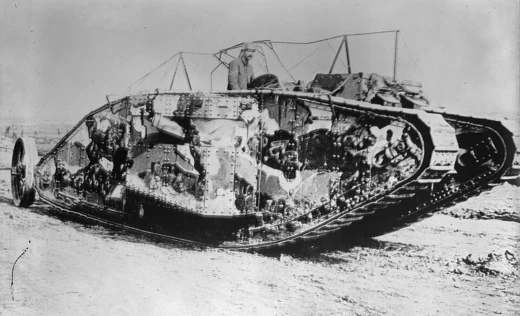
Churchill tank
A heavily armoured British infantry tank of the Second World War, known for its ability to climb steep slopes and serve as a basis for many specialist vehicles.

The Tank, Infantry, Mk IV (A22) Churchill was a British infantry tank of the Second World War, distinguished by its heavy armour, long chassis, and tracks that ran the full length of the vehicle, mounted on multiple bogies. This design gave it exceptional ability to climb steep slopes, and it served as the foundation for numerous specialist vehicles. It ranked among the heaviest Allied tanks of the conflict. Its design origins lay in the expectation that a future European war might mirror the trench conditions of the First World War, prioritising the ability to cross difficult ground. The tank was rushed into production to bolster British defences against a potential German invasion. Early models suffered from flaws that required correction before the tank was widely accepted. After several marks were built, the better-armoured Mark VII entered service, and these improved versions performed well in the later stages of the war. The Churchill saw action with British and Commonwealth forces in North Africa, Italy, and North-West Europe. Additionally, over three hundred Churchills were sent as military aid to the Soviet Union, where a similar number saw active service on the Eastern Front. The tank was named after John Churchill, 1st Duke of Marlborough; Winston Churchill remarked that it was named after him only after it was found to be no good. The initial specification, the A20, was intended to supplement the Matilda II and Valentine infantry tanks, designed to be immune to the German 37 mm anti-tank gun and to cross wide trenches. Woolwich Arsenal produced outline drawings, and Harland & Wolff built four prototypes by June 1940. After the evacuation from Dunkirk, the design was revised for the A22 specification, given to Vauxhall in June 1940. With a German invasion imminent, the War Office required production within a year; the first Churchill tanks rolled off the line in June 1941. Vauxhall developed a flat-12 petrol engine based on a Bedford lorry engine to power the tank.
- type
- Infantry tank
- country
- United Kingdom
- in_service
- 1941–1945
- weight
- Heavy (one of the heaviest Allied tanks)
- armament
- QF 2 pounder gun (early marks); later QF 6 pounder or British 75 mm gun
- notable_variants
- Mark III, Mark IV, Mark VII (A22F)
Quick Facts
- Origin
- United Kingdom
- Is Vehicle
- yes
- Service
- 1941–1952 (British Empire)
- Used By
- See Operators
- Wars
- Second World War, Korean War
- Designer
- Harland & Wolff (A20) / Vauxhall Motors (A22)
- Manufacturer
- Vauxhall Motors and others
- Production Date
- 1941–1945
- Number
- ~5,640
- Variants
- See Variants
- Weight
- 39.1 t (Mark I) / 40.7 t (Mark VII)
- Length
- 24 ft
Facts from the source article.
Lore & Background
The Churchill tank was named after John Churchill, 1st Duke of Marlborough. Winston Churchill told Field Marshal Jan Smuts 'That is the tank they named after me when they found out it was no damn good!' The origins of the Churchill's design lay in the expectation that war in Europe might be fought in conditions similar to those of the First World War, and thus emphasised the ability to cross difficult ground. The Churchill was hurried into production in order to build up British defences against a possible German invasion. The first vehicles had flaws that had to be overcome before the Churchill was accepted for wide use. After several marks (versions) had been built, a better-armoured specification, the Mark VII, entered service with the British Army. The improved versions performed well in the later stages of the war.
Reader's Guide
The Churchill tank was a British infantry tank of the Second World War, distinguished by its exceptionally heavy armour, a long chassis with tracks encircling the entire hull, and multiple bogie wheels. Its design originated from the expectation of trench warfare similar to the First World War, prioritising the ability to traverse difficult terrain. The tank was rushed into production to bolster British defences against a potential German invasion, and early models suffered from flaws that required correction before widespread acceptance. Later versions, particularly the better-armoured Mark VII, performed effectively in the later stages of the conflict. The Churchill was deployed by British and Commonwealth forces in North Africa, Italy, and North-West Europe. Additionally, several hundred were sent to the Soviet Union as military aid, where they saw active service on the Eastern Front. The tank’s name was taken from John Churchill, 1st Duke of Marlborough, and Winston Churchill wryly noted that the tank was named after him only after it was found to be unsatisfactory. The initial A20 specification, intended to supplement the Matilda II and Valentine, featured side sponsons for two-pounder guns and an unditching beam, but the fall of France rendered this trench-warfare concept obsolete. The revised A22 design was completed under Dr. H. E. Merritt and rushed into production within a year, using a Bedford “Twin-Six” engine based on a lorry engine. A manufacturer’s leaflet included in the handbook acknowledged known faults and provided workarounds. The tank’s robust construction also made it the basis for numerous specialist vehicles.
Did You Know?
- The Churchill tank was named after John Churchill, 1st Duke of Marlborough, not after Winston Churchill.
- Winston Churchill remarked that the tank was named after him when they found it was 'no damn good.'
- The Churchill was one of the heaviest Allied tanks of the Second World War.
- 344 Churchills were sent as military aid to the Soviet Union.
Common Misconceptions (Editorial)
Some people assume the Churchill tank was named after Prime Minister Winston Churchill, but it was actually named after John Churchill, 1st Duke of Marlborough. Another common misconception is that the Churchill was a successful design from the start; in reality, the first vehicles had significant flaws that had to be overcome before they gained wide acceptance.
Why It Matters (Editorial)
The Churchill tank endures as a symbol of British wartime ingenuity and adaptability, serving not only as a resilient frontline infantry tank but also as the platform for numerous specialized vehicles like bridge-layers and flame-throwers. Its ability to climb steep slopes and cross difficult terrain, born from lessons of the First World War, made it a uniquely capable vehicle in the later stages of the conflict, proving that sometimes the most effective designs come from learning from past hardships.
Frequently Asked Questions
What is the Churchill tank?
The Churchill tank, formally designated Tank, Infantry, Mk IV (A22), was a heavy British infantry tank that saw service from 1941 to 1945 during the Second World War. It ranked among the heaviest Allied tanks of the conflict.
What made the Churchill tank stand out from other tanks of its era?
Its defining traits were exceptionally thick armour, a long chassis with tracks running the full length of the hull, and a remarkable ability to climb very steep slopes. These qualities made it a natural platform for crossing obstacles and operating in rough terrain.
What gun did the Churchill tank carry?
Early marks were armed with a QF 2-pounder anti-tank gun, while later production vehicles received a QF 6-pounder or a British 75 mm gun for greater stopping power.
Why is the Churchill tank considered important in tank history?
Beyond its frontline combat role, the Churchill's sturdy chassis was adapted into a wide family of specialist vehicles, from flame-throwers to assault bridges. Its emphasis on maximum protection and cross-country capability left a lasting mark on British tank design philosophy.
More in Tanks 1-21
Spotted an error? Know more?
This is a living reference — every entry is fact-audited, and reader corrections feed straight into our audit queue. Suggest an edit · See this site's audit record