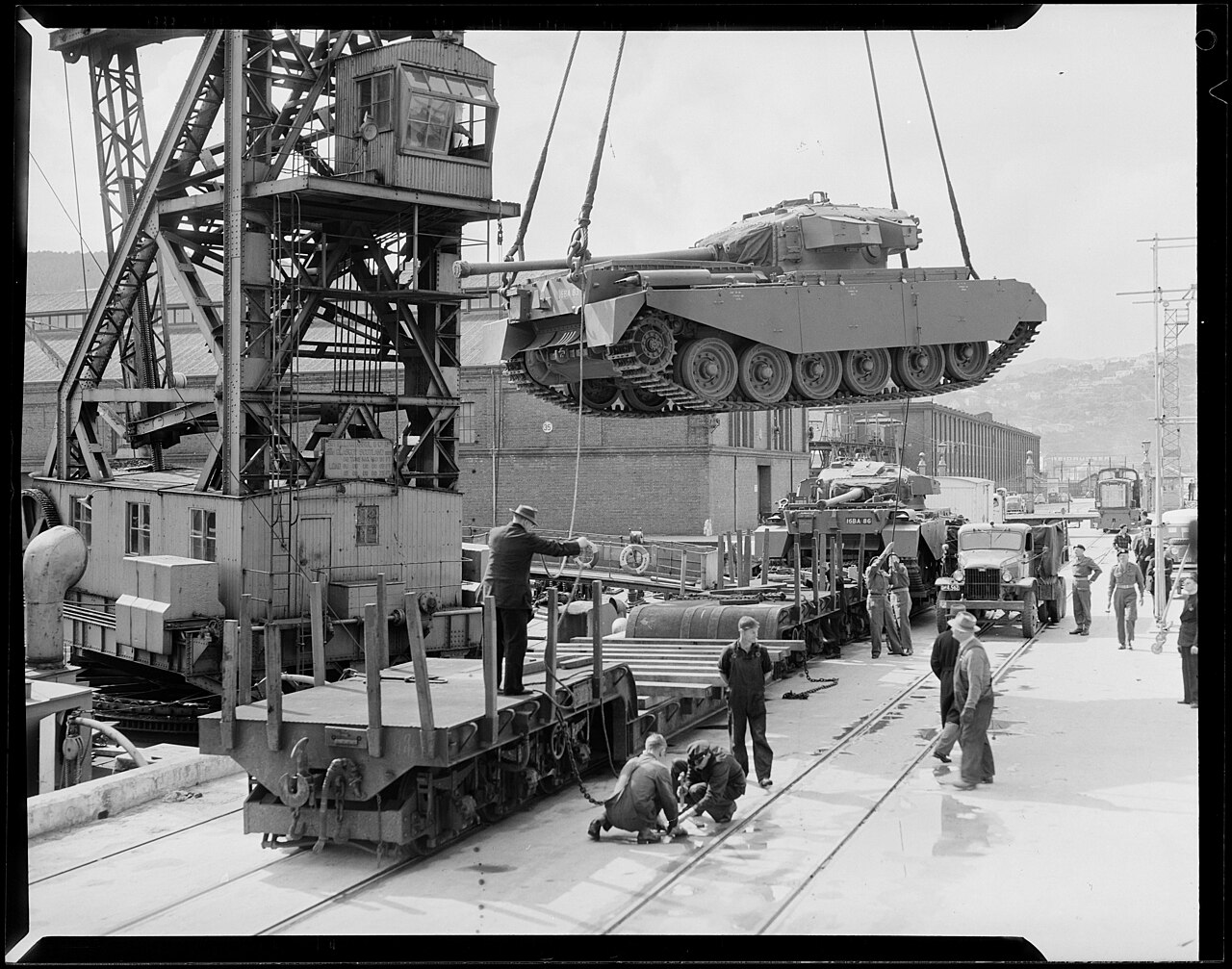
Centurion
Post-war British main battle tank, widely exported and long-serving.

Archives New Zealand · CC BY 2.0
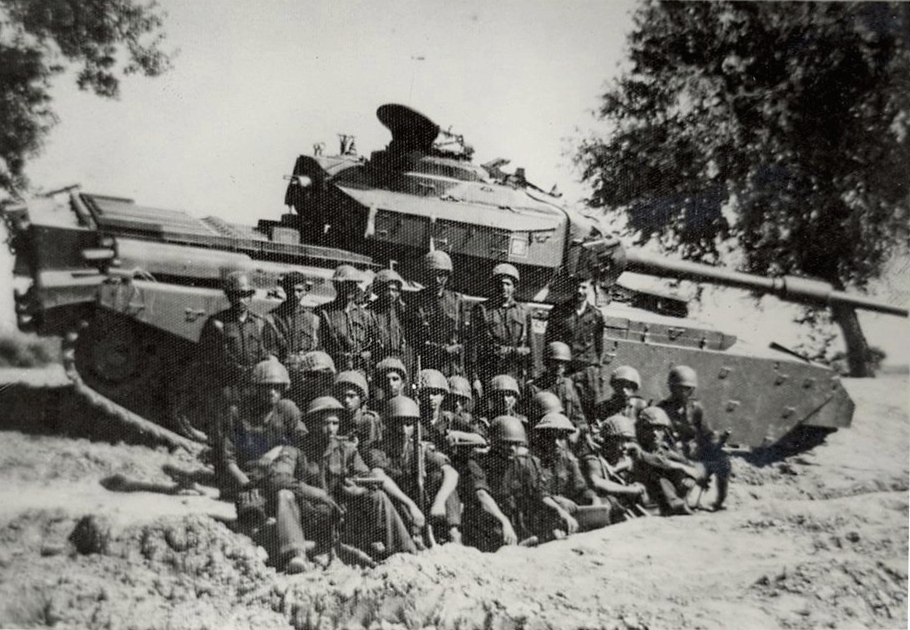
The British Army’s main battle tank after World War II was the FV4007 (A41) Centurion, introduced in 1945. It ranks among the most successful post-war tank designs, with production continuing into the 1960s and combat service lasting into the 1980s. Its chassis was adapted for various roles, and some variants remain operational. The Centurion was valued for its strong armour, good mobility, and powerful main gun.
Development began in 1943, and manufacture started in January 1945. Six prototypes reached Belgium less than a month after the European war ended in May 1945. The tank first saw combat with the British Army in the Korean War in 1950, supporting UN forces. Later, it fought for India in the 1965 Indo-Pakistani War against US-supplied M47 and M48 Pattons, and with the Royal Australian Armoured Corps in Vietnam. Israel used Centurions in the 1967 Six-Day War, the 1973 Yom Kippur War, the 1978 South Lebanon conflict, and the 1982 Lebanon War; modified versions served as armoured personnel carriers in Gaza, the West Bank, and along the Lebanese border. Jordan deployed Centurions in 1970 to repel a Syrian incursion during its civil war and later on the Golan Heights in 1973. South Africa used its Centurions in Angola during the Border War.
The Centurion equipped dozens of armies worldwide, with some remaining in service into the 1990s. During the 2006 Lebanon War, the Israel Defense Forces used modified Centurions as armoured personnel carriers and combat engineering vehicles. South Africa still operates over 170 Centurions, modernised in the 1980s and 2000s as the Olifant (elephant). Between 1946 and 1962, 4,423 Centurions were built across 13 basic marks and numerous variants. In British service, it was replaced by the Chieftain.
In 1943, the Directorate of Tank Design, led by Sir Claude Gibb, was tasked with creating a new heavy cruiser tank under the General Staff designation A41. Given past mediocre A-series designs and the threat of the German 88 mm gun, the War Office demanded improved durability, reliability, protection against an 88 mm hit, and better mine resistance. Initially, the A41 was limited to 40 long tons to fit existing transport trailers and Bailey bridges, with a width restriction of 10 ft 8 in. High top speed was not a priority, but agility had to match the Comet, and a high reverse speed was specified—learned from Allied tanks trapped in Italian sunken roads. The production gearbox later included a two-speed reverse, with the higher speed similar to second gear.
The Department enlarged the hull by replacing the Comet’s five-wheel Christie suspension with a six-wheel Horstmann system, spacing the second and third wheels further apart. The Horstmann suspension, with three externally mounted two-wheel bogies on each side, offered a rougher ride but took up less space and was easier to maintain; individual units could be swapped after mine damage. The hull was redesigned with welded, sloped armour and a partially cast turret mounting the 17-pounder (76.2 mm) gun and a 20 mm Polsten cannon. A Rolls-Royce Meteor engine provided excellent performance.
By October 1943, weight limits were removed, and the design grew to 45 long tons to accommodate heavier armour and a wider turret for a more powerful gun. The new version matched the armour of the heaviest infantry tanks while offering superior cross-country mobility. The War Office chose to build new trailers rather than restrict the design. A mockup by AEC Ltd was reviewed in May 1944, followed by orders for twenty pilot models with various armament combinations: ten with a 17-pounder and a 20 mm Polsten (half with a Besa machine gun in the turret rear, half with an escape door), five with a 17-pounder, a forward Besa, and an escape door, and five with a QF 77 mm gun and a driver-operated hull machine gun.
The original 40-ton prototypes, the Centurion Mark I, had 76 mm of frontal glacis armour—thinner than the Churchill’s 101–152 mm—but the plate was highly sloped, giving high effective thickness, similar to the German Panther and Soviet T-34. The turret was well armoured at 152 mm, and the tank remained highly mobile.
- field
- Armoured fighting vehicle
- nationality
- United Kingdom
- introduced
- 1945
- produced
- 1945–1960s
- known_for
- Widely used main battle tank, long service life, numerous variants
Lore & Background
Development of the Centurion began in 1943 with manufacture beginning in January 1945. Six prototypes arrived in Belgium less than a month after the war in Europe ended in May 1945. It entered combat with the British Army in the Korean War in 1950 in support of the UN forces. Centurions modified as armoured personnel carriers were used in Gaza, the West Bank and on the Lebanese border. South Africa deployed its Centurions in Angola during the South African Border War. The Centurion became one of the most widely used tank designs, equipping dozens of armies around the world, with some in service until the 1990s.
Reader's Guide
The Centurion's significance lies in its longevity and adaptability. Introduced at the end of World War II, it set a new standard for main battle tanks with its combination of good armour, mobility, and powerful armament. The tank saw extensive combat in multiple conflicts across Asia, the Middle East, and Africa, serving with numerous nations. Its chassis was adapted for specialist roles such as armoured personnel carriers, combat engineering vehicles, and armoured recovery vehicles, some of which remained in service into the 21st century. The Centurion's legacy is reflected in its widespread use and the fact that it was replaced in British service by the Chieftain, while South Africa continues to operate modernised versions.
Did You Know?
- Six Centurion prototypes arrived in Belgium less than a month after the war in Europe ended in May 1945.
Design Philosophy & Development
The Centurion's origins trace to 1943, when the Directorate of Tank Design under Sir Claude Gibb received a mandate to create a new heavy cruiser tank designated A41. The impetus was clear: the German 88mm gun had proven devastating, and the War Office demanded a vehicle capable of surviving a direct hit from it while also offering improved mine protection. The design team moved away from the Comet's Christie suspension toward a six-wheel Horstmann system with externally mounted bogies, sacrificing some ride quality for easier field maintenance and the ability to swap damaged wheel units quickly. The hull featured welded, sloped armour, and the partially cast turret mounted the formidable 17-pounder gun alongside a 20mm Polsten cannon. A Rolls-Royce Meteor engine, shared with the Comet and Cromwell, delivered strong cross-country performance. Crucially, the War Office lifted the original 40-ton weight cap, allowing the design to grow to 45 long tons with heavier armour and a wider turret. Rather than constrain the design to fit existing transport infrastructure, the decision was made to build new trailers. The result was a tank whose sloped glacis plate, though nominally thinner than the Churchill's, offered effective protection rivaling the heaviest infantry tanks of the era.
A Global Combat Record
Few post-war armoured vehicles can claim a combat résumé as broad as the Centurion's. It first saw action in 1950, supporting UN forces in the Korean War alongside the British Army. South Africa sent its Centurions into the South African Border War in Angola. This extraordinary span of conflicts and operators underscores the design's universal appeal.
Production Scale & Variant Proliferation
These tanks were organised into thirteen basic marks, each representing incremental improvements in armour, armament, or mechanical components, alongside a vast array of specialised variants. The earliest production models, the Mark I, featured a 76mm sloped glacis plate and a 152mm turret, but were quickly superseded by the Mark II, which carried an 118mm glacis and increased side and rear armour from 38mm to 51mm. Only a handful of Mark I vehicles had been completed before production lines shifted. The chassis proved remarkably adaptable, serving as the basis for armoured personnel carriers, combat engineering vehicles, and other support roles that remained in service long after the main battle tank variant was retired. In the British Army, the Centurion was eventually succeeded by the Chieftain, yet the platform's legacy persisted through its numerous derivative roles well into subsequent decades.
Enduring Legacy & Modern Service
The Centurion's longevity is perhaps its most remarkable attribute. Introduced in 1945, it remained in production into the 1960s and continued to see active combat into the 1980s, a service life spanning nearly four decades. It equipped dozens of armies worldwide, with some operators retaining the tank into the 1990s. The tank's combination of robust armour, capable mobility, and a powerful main gun made it a favourite among operators who valued reliability and protection. That a design conceived in the closing months of the Second World War could still be shaping military operations in the 21st century speaks to the exceptional quality of its original engineering.
Common Misconceptions (Editorial)
Some believe the Centurion first saw combat in World War II, but it was not used in action until the Korean War in 1950. Another misconception is that the Centurion was retired shortly after the war; in fact, production continued into the 1960s and some variants remained in service into the 1990s.
Why It Matters (Editorial)
The Centurion’s longevity—spanning from the closing days of World War II to late-20th-century conflicts—demonstrates how a well-designed platform can adapt to changing battlefields. Its widespread adoption by dozens of nations and continued use in specialized roles underscores its enduring influence on post-war armored vehicle development.
Gallery
Frequently Asked Questions
What is the Centurion tank?
The Centurion (designated FV4007 or A41) is a British main battle tank that entered service in 1945 and became the standard armoured fighting vehicle for the post-war British Army. It is widely regarded as one of the most successful and widely exported tank designs of the Cold War era.
What role did the Centurion fill in the British Army?
It served as the primary main battle tank, combining a powerful main gun, balanced armour protection, and reliable mobility in a single platform. The same chassis was also adapted into numerous other variants for support and specialised combat roles.
How long did the Centurion stay in production and active service?
Over 4,400 units were built between 1946 and the early 1960s, yet the design kept seeing active combat into the 1980s. Several derived variants remain in service well beyond their original introduction, making it one of the longest-serving tank families in history.
Why do tank fans consider the Centurion so important?
It set a benchmark for post-war Western tank design and was adopted by many allied nations, giving it a global footprint that few contemporaries matched. Its adaptability into dozens of variants and its decades-long combat record cemented its reputation as a design icon.
What made the Centurion stand out against other tanks of its era?
Its well-balanced combination of firepower, protection, and a dependable diesel powerplant kept it relevant far longer than many rival designs. The fact that a 1940s concept was still firing in real engagements in the 1980s speaks to how thoroughly its fundamentals were executed.
More in Tanks 1-21
Spotted an error? Know more?
This is a living reference — every entry is fact-audited, and reader corrections feed straight into our audit queue. Suggest an edit · See this site's audit record