Leopard 2

Manniman2 · CC BY-SA 4.0
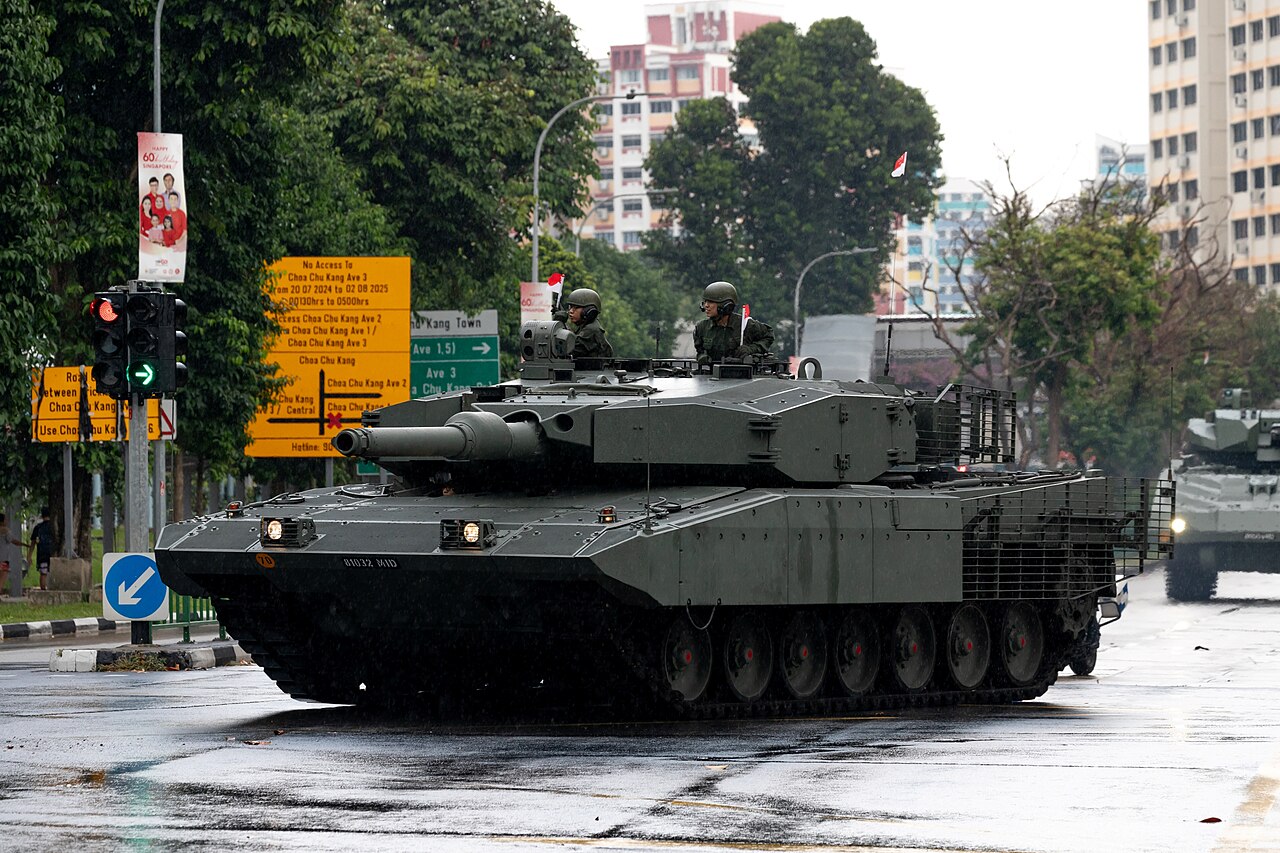
The Leopard 2 is a third-generation German main battle tank. Krauss-Maffei developed it during the 1970s, and it entered service in 1979, succeeding the Leopard 1 as the West German army’s primary tank. Today, Germany and 13 other European nations, plus Canada, Chile, Indonesia, and Singapore, operate various versions of the Leopard 2. Some of these countries have also licensed the design for local production and further development.
The tank comes in two main development groups. The first group includes models up to the Leopard 2A4, which have vertical turret armor. The second group, starting with the Leopard 2A5, features angled, arrow-shaped appliqué armor on the turret, along with other upgrades. All Leopard 2 tanks use a Rheinmetall 120 mm smoothbore cannon as their main weapon, paired with a digital fire control system, a laser rangefinder, and advanced night vision and sighting equipment. An MTU Friedrichshafen V12 twin-turbo diesel engine powers the vehicle.
The German Army deployed the Leopard 2 in peacekeeping operations in Kosovo during the 1990s. In the 2000s, Dutch, Danish, and Canadian forces used their Leopard 2s in Afghanistan as part of the International Security Assistance Force. Turkish Leopard 2 tanks saw action in Syria in the 2010s. Since 2023, Ukrainian Leopard 2 tanks have been used in the Russo-Ukrainian War.
**History**
**Development** While the Leopard 1 was still entering service, the West German military wanted a better tank for the next decade. This led to the joint MBT-70 project with the United States, which began in 1963. By 1967, it was unclear when the MBT-70 would actually enter service, so the West German government ordered Porsche to research future upgrades for the Leopard 1 in 1967. This study, called *vergoldeter Leopard* (Gilded Leopard), focused on adding advanced technology to the Leopard design. Planned upgrades included an autoloader, a coaxial autocannon, an independent commander’s periscope, an internally operated anti-air machine gun, and a TV surveillance camera on an extendable mast. The turret and hull were reshaped using cast steel armor, and the suspension, transmission, and engine exhaust vents were improved.
**Prototype development** After the Gilded Leopard study ended in 1967, the West German government decided to pursue an *Experimentalentwicklung* (experimental development) feasibility study. This aimed to develop new components for upgrading the Leopard 1 and for a future main battle tank. Initially, 25 million Deutsche Marks were invested, but the industry said this was too little to build two planned testbeds, so the budget was raised to 30–32 million DM. Krauss-Maffei received the contract, but had to work with Porsche on the chassis and Wegmann on the turret.
Two prototypes with different components were built to improve the Leopard 1’s firepower to match the MBT-70’s requirements. The main goals were a high first-hit probability at 2,000 meters and the ability to accurately fire on the move using a computerized fire control system. These vehicles were nicknamed *Keiler* (tusker). Two prototypes (ET 01 and ET 02) were built in 1969 and 1970, both powered by the MB 872 engine.
The MBT-70 was a revolutionary design, but after major cost overruns and technical problems, Germany left the project in 1969. Attempts to save it by changing the concept—especially moving the driver from the turret—failed, and by late 1969 Germany ended the joint development. The assistant secretary of the military procurement division suggested reusing as many MBT-70 technologies as possible in a new program, nicknamed *Eber* (boar) after his name, Eberhardt. The Eber used a modified MBT-70 turret and hull, with the driver seated in the hull. Only a wooden mock-up was built.
A year later, the decision was made to continue development based on the earlier Keiler project rather than finishing the Eber. In 1971, the design was named Leopard 2 (the original Leopard became the Leopard 1), and Paul-Werner Krapke became the project officer. Two versions were initially planned: the gun-armed Leopard 2K and the Leopard 2FK, which would use the MBT-70’s XM150 gun/launcher.
In 1971, 17 prototypes were ordered, but only 16 hulls were built (hull PT12 was canceled). Ten hulls were ordered first, then seven more. The 17 turrets were labeled T1 to T17, and the hulls PT1 to PT11 and PT13 to PT17. Each prototype tested different components and concepts. Ten turrets had 105 mm smoothbore guns, while the other seven had 120 mm smoothbore guns. Hulls PT11 and PT17 had a hydropneumatic suspension based on the MBT-70 design, with only six road wheels. Various auxiliary power units were also fitted across the prototypes.
- Type
- Main battle tank
- Nationality
- West German / German
- Manufacturer
- Krauss-Maffei
- Engine
- MTU Friedrichshafen V12 twin-turbo diesel
- Operators
- Germany and 13 other European countries, plus Canada, Chile, Indonesia, Singapore
Lore & Background
The Leopard 2 was developed by Krauss-Maffei in the 1970s, replacing the Leopard 1 as the main battle tank of the West German army. Its development followed earlier projects including the MBT-70 cooperation with the United States, the Keiler and Eber prototypes, and the Gilded Leopard study (which was actually an export variant study for the Leopard 1, not a precursor to the Leopard 2). There are two main development tranches. The first, up to the Leopard 2A4 standard, features vertically faced turret armor. The second, from Leopard 2A5 onwards, has angled, arrow-shaped turret appliqué armor. The tank is powered by an MTU Friedrichshafen V12 twin-turbo diesel engine. In 2010, the Leopard 2 saw its first combat deployment with German forces in Afghanistan. Dutch, Danish and Canadian forces also deployed their Leopard 2 tanks in the War in Afghanistan. In the 2010s, Turkish Leopard 2 tanks saw action in Syria.
Reader's Guide
Its design evolved through two main tranches, with the later versions introducing distinctive arrow-shaped turret armor. The Leopard 2 has been widely exported, operated by Germany, 13 other European countries, and non-European nations including Canada, Chile, Indonesia, and Singapore. Some operators have licensed the design for local production. Its combat history includes deployments in Kosovo, Afghanistan, Syria, and the Russo-Ukrainian War, demonstrating its continued relevance in diverse conflict environments. The tank's development history, including the earlier MBT-70 cooperation and subsequent national projects, reflects the complex process of armored vehicle design and international collaboration.
Did You Know?
- There are two main development tranches: up to Leopard 2A4 with vertical turret armor, and from Leopard 2A5 with angled arrow-shaped turret appliqué armor.
- The Leopard 2 has been used in combat in Afghanistan (first deployed by Germany in 2010), Syria, and the Russo-Ukrainian War.
A Tangled Path to a New Tank
The Leopard 2 did not emerge from a clean slate. In 1971 the design was officially named Leopard 2, the original tank was retroactively re-designated Leopard 1, and Paul-Werner Krapke assumed the role of project officer.
Two Generations of Armour, One Cannon
The Leopard 2 family divides neatly into two broad development tranches, each defined by its turret-protection philosophy. Tanks built up to the 2A4 standard feature vertically faced turret armour, a straightforward approach suited to the Cold War threat environment. From the 2A5 onward, the design shifted to an angled, arrow-shaped appliqué armour arrangement on the turret, paired with a suite of other refinements that collectively improved survivability. That gun is supported by a digital fire control system, a laser rangefinder, and advanced night-vision and sighting equipment, giving the crew the ability to acquire and engage targets with high first-hit probability at ranges around 2,000 metres, even while the vehicle is on the move. Under the hull, a V12 twin-turbo diesel engine manufactured by MTU Friedrichshafen provides the power to move the roughly 47.5-tonne vehicle across varied terrain.
A Tank for the World
Today the Leopard 2 remains the backbone of Germany's own armoured forces and is also operated by thirteen other European nations. Its reach extends well beyond the continent: Canada, Chile, Indonesia, and Singapore all field variants of the design. Several of these operating countries have gone a step further by licensing the Leopard 2 for local production and domestic development, embedding the platform into their own industrial and defence ecosystems. This breadth of adoption speaks to a design that has proven adaptable across different doctrinal environments, climate conditions, and upgrade pathways, from the vertically armoured early tranches to the later arrow-shaped turret configurations. The tank's longevity in service—spanning from the late 1970s through the 2020s and beyond—reflects not just a single generation of technology but a continuous programme of refinement that has kept it relevant across decades.
From Peacekeeping to the Front Line
The Leopard 2's operational record spans a wide spectrum of military engagement. In the 1990s, German Army units deployed the tank on peacekeeping missions in Kosovo, a role that tested the vehicle in a multinational, low-intensity environment. The following decade saw Dutch, Danish, and Canadian forces send their Leopard 2s into the War in Afghanistan as part of the International Security Assistance Force, exposing the tanks to the rugged terrain and asymmetric threats of that conflict. In the 2010s, Turkish Leopard 2 tanks saw direct action in Syria, marking a new theatre of operations for the platform. Across these deployments, the Leopard 2 has demonstrated its versatility in roles ranging from stabilisation operations to full-scale conventional warfare.
Common Misconceptions (Editorial)
Some believe the Gilded Leopard study was a precursor to the Leopard 2, but the facts show it was actually an export variant study for the Leopard 1, not related to Leopard 2 development. Another common mistake is thinking all Leopard 2 variants have the same turret shape; in reality, models up to the 2A4 have vertical turret armor, while the 2A5 and later have angled, arrow-shaped appliqué armor.
Why It Matters (Editorial)
The Leopard 2 endures as one of the most widely operated Western main battle tanks because its continuous upgrades have kept it competitive across decades of evolving battlefield threats. Its combat use in Afghanistan, Syria, and Ukraine demonstrates both its adaptability and the continued geopolitical relevance of heavy armored warfare in modern conflicts.
Gallery
Frequently Asked Questions
What engine powers the Leopard 2?
Under the hood, the Leopard 2 runs on an MTU Friedrichshafen V12 twin-turbo diesel engine, providing the mobility needed for a tank of its weight class.
Which countries field the Leopard 2 today?
Beyond Germany itself, the Leopard 2 is in service with 13 European nations as well as several non-European operators including Canada, Chile, Indonesia, and Singapore.
Why is the Leopard 2 considered important in tank history?
As the direct successor to the Leopard 1, the Leopard 2 shaped Germany's post-Cold War armored doctrine and became one of the most widely exported Western main battle tanks of its generation.
More in Tanks 1-21
Spotted an error? Know more?
This is a living reference — every entry is fact-audited, and reader corrections feed straight into our audit queue. Suggest an edit · See this site's audit record