Whipple's triad
Three criteria linking hypoglycaemia symptoms to low glucose and relief.
Last updated

Samanthafara · CC BY-SA 4.0
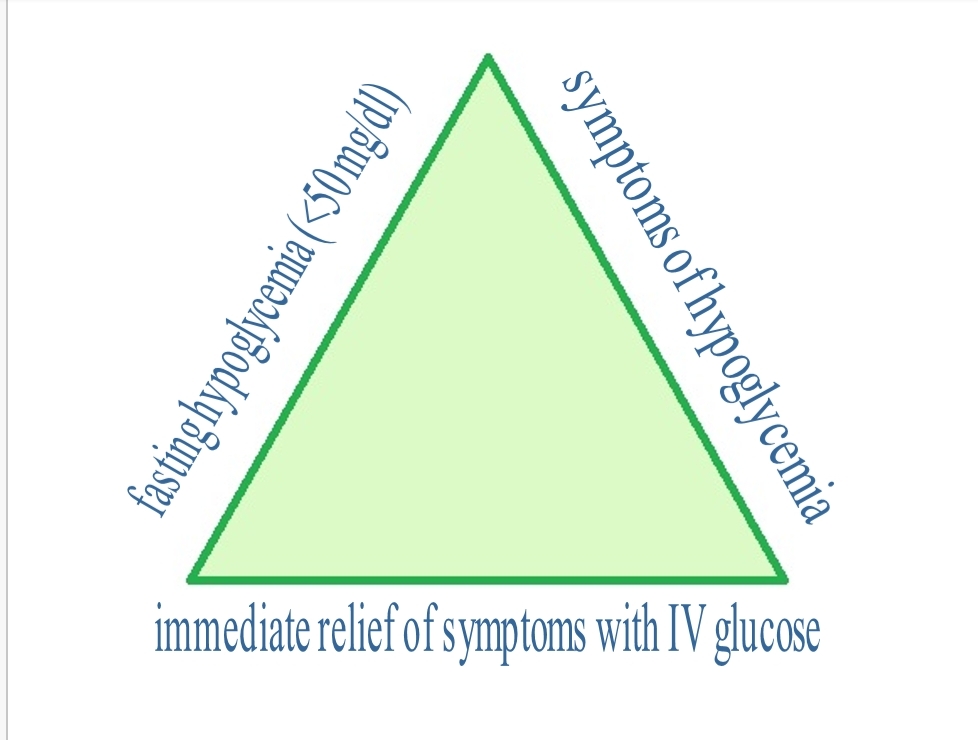
Whipple's triad, also referred to as Whipple's criteria, consists of three clinical signs that point to hypoglycemia as the cause of a patient's symptoms, with insulinoma as a possible underlying condition. The criteria were developed by surgeon Allen Whipple to guide decisions about exploratory pancreatic surgery for insulinoma. The three required elements are: symptoms consistent with hypoglycemia, a low blood plasma glucose level, and the resolution of those symptoms once the plasma glucose is raised.
Lore & Background
Whipple's triad dates back to the 1930s, when a few patients with hypoglycaemic symptoms due to hypoglycaemia were found to be cured by surgery to remove an insulinoma, but a large proportion of people with symptoms suggestive of hypoglycaemia apparently had no need of surgery. Diagnostic testing was rudimentary; beyond a crude assay for reducing substances as an indirect measure of blood glucose, no way had yet been found to measure hormones and metabolites such as insulin, with no imaging procedures for internal organs such as the pancreas.
Allen Whipple was a well-known surgeon who had pioneered pancreatic surgery. He proposed that no pancreatic surgery to look for insulinoma be performed unless these criteria were met. For this reason, Whipple's triad is also known as Whipple's criteria.
The use and significance of the criteria have evolved over the last century as understanding of the many forms of hypoglycaemia has increased and diagnostic tests and imaging procedures have improved. Whipple's criteria are no longer used to justify surgical exploration for an insulinoma, but to separate 'true hypoglycaemia' from a variety of other conditions in which symptoms suggestive of hypoglycaemia occur, but low glucose levels cannot be demonstrated.
The Three Pillars of the Triad
Whipple's triad rests on three interlocking observations that together point toward a genuine drop in blood sugar as the source of a patient's distress. The first pillar demands that the individual experiences symptoms consistent with hypoglycaemia—trembling, a racing heart, anxiety, dizziness, or even a complete loss of consciousness—particularly in the context of prolonged fasting or strenuous physical exertion.
The second pillar requires that, at the very moment those symptoms are present, a laboratory measurement confirms a low plasma glucose concentration, typically defined as falling below 55 milligrams per deciliter, or roughly 3.1 millimoles per litre. The third and perhaps most critical pillar is the reversal test: once the glucose level is raised, the symptoms must resolve. Together, these three conditions form what is also called Whipple's criteria, a compact diagnostic framework originally designed to signal that a patient's complaints are the product of true hypoglycaemia and may ultimately trace back to an insulin-secreting tumour of the pancreas.
A Surgeon's Answer to a Diagnostic Vacuum
In the 1930s, medicine faced a peculiar puzzle. A small number of patients presenting with shakiness, fainting, or profuse sweating were found to be cured when surgeons removed a pancreatic tumour, yet a far larger group displaying similar hypoglycaemic symptoms apparently required no operation at all. The diagnostic tools of that era were painfully limited. Physicians could only run a crude assay for reducing substances as an indirect proxy for blood glucose; there was no method yet available to directly measure hormones or metabolites such as insulin, and no imaging technique existed to peer inside the pancreas or other internal organs.
Into this uncertainty stepped Allen Whipple, a prominent surgeon who had already pioneered techniques in pancreatic surgery. Recognizing that indiscriminate exploration would subject many patients to unnecessary risk, he proposed a strict gate: no pancreatic surgery to search for an insulinoma should be undertaken unless all three of his criteria were satisfied. This pragmatic safeguard gave the medical community its first reliable filter and is why the triad is so often referred to simply as Whipple's criteria.
A Century of Shifting Purpose
The role of Whipple's triad has transformed dramatically over the past hundred years. When Whipple first articulated his criteria, their primary purpose was to justify an exploratory operation on the pancreas. Today, that surgical justification has largely fallen away. As clinicians have come to understand the many different forms of hypoglycaemia, and as diagnostic testing and imaging have advanced considerably, the triad now serves a different and perhaps more nuanced function.
Rather than green-lighting an operation, it is invoked to distinguish true hypoglycaemia—a condition in which a demonstrably low glucose level can be captured in the laboratory—from a constellation of other disorders, such as idiopathic postprandial syndrome, in which patients report symptoms that mimic low blood sugar yet no actual hypoglycaemia can be documented. This shift in emphasis has also changed who reaches for the criteria: endocrinologists now call upon them far more frequently than surgeons do. When imaging is ultimately required, the investigation of choice has moved to endoscopic and intraoperative ultrasonography, rendering the old open exploratory approach largely obsolete.
Not a Single-Answer Test
A common misconception is that satisfying Whipple's triad automatically confirms an insulinoma. In reality, the three criteria are necessary but not sufficient for that specific diagnosis. The same constellation of symptoms, a documented low glucose reading, and subsequent relief upon glucose correction can arise from a range of other conditions. Hyperinsulinism, for instance, can produce an identical clinical picture even when no discrete pancreatic tumour is present.
Because of this overlap, the triad must be read as part of a broader differential diagnosis rather than as a standalone verdict. Clinicians are therefore expected to weigh additional evidence—hormonal assays, imaging findings, and the patient's full clinical history—before settling on a single aetiology. The triad's enduring value lies not in naming one disease but in establishing that the patient's symptoms are genuinely glucose-driven, thereby narrowing the field of possibilities and steering subsequent investigation in the right direction.
Reader's Guide
Whipple's triad remains a foundational concept in the evaluation of hypoglycaemia, though its role has shifted over time. Originally proposed by surgeon Allen Whipple in the 1930s to justify exploratory pancreatic surgery for suspected insulinoma, the criteria are now invoked far more often by endocrinologists than by surgeons. The triad consists of symptoms known or likely to be caused by hypoglycaemia (such as tremor, tachycardia, anxiety, dizziness, and loss of consciousness), a low blood plasma glucose concentration measured at the time of symptoms (less than 55 mg/dL or 3.1 mmol/L), and relief of symptoms when glucose level is increased.
Today, the criteria are used primarily to distinguish true hypoglycaemia from conditions like idiopathic postprandial syndrome, where symptoms occur without demonstrable low glucose. The radiological investigation of choice for insulinoma is now endoscopic and/or intraoperative ultrasonography. Whipple's triad is not exclusive to insulinoma; other conditions causing hyperinsulinism can produce the same signs.
More in Symptoms and signs: Endocrinology, nutrition, and metabolism
Sources
Compiled from Wikipedia and the sources listed below. Text from Wikipedia is available under CC BY-SA 4.0; this entry is adapted from it.
- Wikipedia: Whipple's triad (CC BY-SA 4.0).
- Word definitions: the Codexery glossary, each quoted from its Wikipedia article.
Spotted an error? Know more?
Reader corrections go straight into our review queue. Suggest an edit · How this site is sourced